Lead scoring ranks leads by fit and engagement so sales works the ones most likely to buy. It matters because 73% of B2B leads aren’t sales-ready (MarketingSherpa) scoring is how you stop flooding sales with leads that waste their time.
Sales reps have limited hours, and most of the leads they get aren’t ready to buy. Chasing them all is how good pipeline gets buried under junk.
It fixes that by putting a number on each lead’s likelihood to convert. This guide explains how it works, what to score, and how to build a model that actually helps.
What is lead scoring?
Lead scoring is the practice of assigning points to each lead based on how well they fit your ideal customer and how actively they engage so sales can prioritize the leads most likely to convert. It turns a messy list into a ranked one.
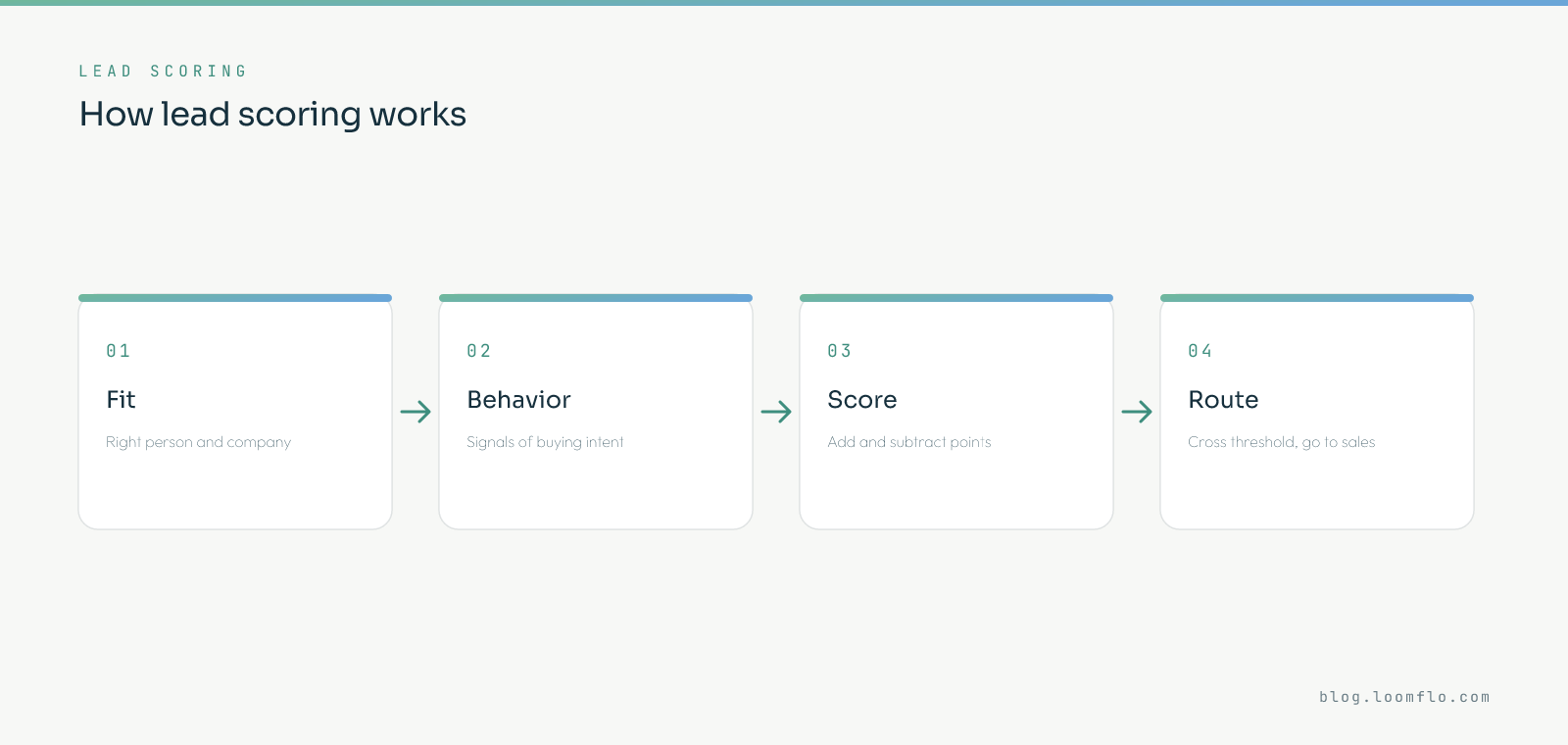
When a lead’s total crosses a set threshold, it becomes a marketing qualified lead and moves to sales. Below it, the lead keeps getting nurtured.
The payoff is focus. Instead of treating every lead equally, your team spends time where it pays off.
Why lead scoring matters
The case for scoring is the gap between lead volume and lead quality. Most leads simply aren’t ready.
MarketingSherpa’s benchmark found 73% of B2B leads are not sales-ready, and separately that 61% of marketers send all leads straight to sales while only 27% are actually qualified. That mismatch wastes rep time and buries the good leads.
Scoring closes the gap. Forrester found companies that excel at nurturing and qualification generate 50% more sales-ready leads at 33% lower cost per lead.
How it works
Scoring runs on two axes, and a strong lead needs both. Fit tells you if they’re the right buyer; behavior tells you if they’re ready now.
Fit (explicit) signals
These describe who the lead is job title, seniority, company size, industry and tech stack. They answer whether the lead is a fit for what you sell.
Behavior (implicit) signals
These describe what the lead does pricing-page visits, demo requests, email clicks and content downloads. They answer whether the lead is interested and ready.
The two must work together. High engagement with low fit is an enthusiast who won’t buy; high fit with low engagement is the right company that isn’t ready yet.
Negative scoring keeps junk out
Just as important as adding points is subtracting them. Negative scoring prevents bad-fit leads from inflating their way to sales.
Common negative triggers include unsubscribing, using a free email domain, a student or job-seeker title, or going cold for 60–90 days. Without it, scores drift upward and sales gets flooded again.
An example scoring model
A model is just a list of signals with point values. Here’s an illustrative one your real numbers should come from your own closed-won data.
- Requested a demo: +25
- Visited the pricing page: +15
- Decision-maker job title (VP/Director/C-level): +20
- Company size in target range: +15
- Opened or clicked a nurture email: +3
- Unsubscribed: −10
- Free or personal email domain: −5
- Student or job-seeker title: −15
A common approach sets around 50+ points as a marketing qualified lead, and 80+ as “hot.” Calibrate the threshold to where your past winners actually scored.
Rule-based vs predictive lead scoring
There are two ways to build a model, and the right one depends on your data. Both aim at the same goal.
Rule-based scoring uses point values a human assigns, which is transparent and easy to start with. Predictive scoring uses machine learning trained on your historical conversions to weigh signals automatically.
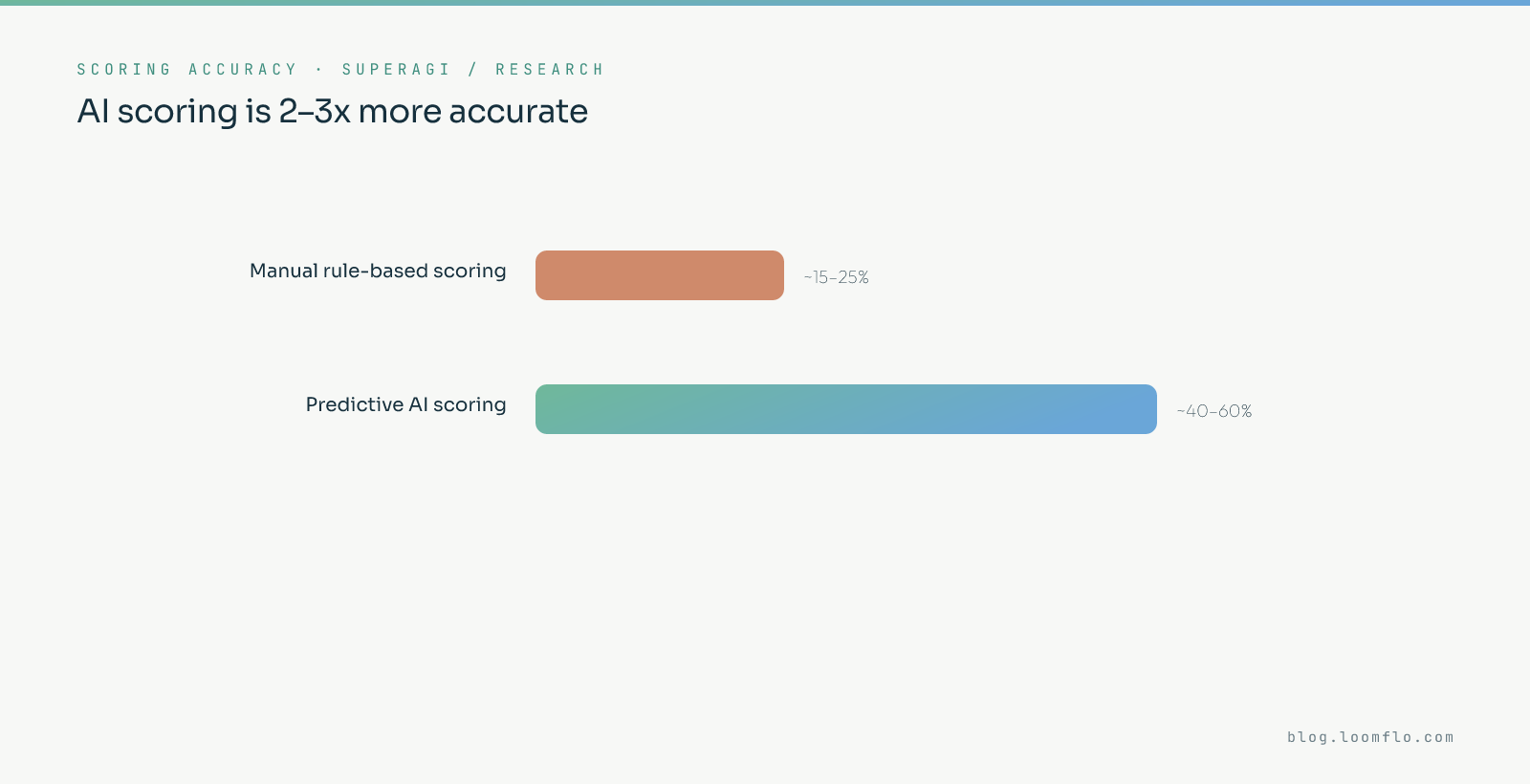
The accuracy gap is real. Predictive models reach roughly 40–60% accuracy versus 15–25% for manual scoring about a 2–3x improvement (SuperAGI and recent research).
How AI improves lead scoring
AI scoring improves on manual rules by learning what actually predicts a sale. It’s less guesswork, more evidence.
Instead of a human guessing point values, the model learns from your closed-won and closed-lost data, sometimes surfacing non-obvious signals. It weighs hundreds of factors at once and updates continuously as new outcomes arrive.
It also ingests behavioral, intent and enriched third-party data, so fit scoring isn’t based on half-empty records. The result is less junk handed to sales.
The honest caveat: AI scoring needs enough historical deal data to train on, so early-stage teams should often start rule-based. Dirty CRM data produces biased scores, and models still need monitoring and a sales feedback loop.
Common scoring mistakes
A few errors quietly break most scoring models. Each is avoidable.
- Scoring in a vacuum: Building the model without sales input means it won’t match reality.
- Over-weighting demographics: Fit without behavior sends “right company, wrong time” leads to sales.
- Set and forget: Models drift stale without regular retraining and review.
- Threshold too low: A loose bar floods sales with unready leads and defeats the point.
Avoid these and scoring sharpens your funnel. Ignore them and it just adds process without improving quality.
Where scoring fits
Lead scoring is the engine that decides which leads become sales-ready. It’s the mechanism behind a clean handoff from marketing to sales.
It connects directly to how you define and route qualified leads. See how it powers the MQL vs SQL handoff and feeds your broader AI lead generation system.
Define your signals, add negative scoring, and refine against real outcomes that’s how scoring turns a pile of leads into a prioritized queue.
Frequently asked questions
What is lead scoring?
It’s ranking leads by point value based on fit and engagement, so sales focuses on the most likely buyers. When a lead crosses a threshold, it’s qualified and routed to sales.
How does it work?
You assign positive and negative points to attributes and actions, then sum them into a total. Fit signals show if they’re the right buyer, and behavior signals show if they’re ready.
What is a good lead score threshold?
There’s no universal number calibrate it to your own data. Analyze the scores of past closed-won leads and set the bar where conversion probability jumps.
What’s the difference between rule-based and predictive scoring?
Rule-based uses human-defined point rules; predictive uses machine learning trained on historical conversions. Predictive is roughly 2–3x more accurate but requires enough data.
How do you build a scoring model?
Define your ideal customer, mine closed-won data for common traits, list positive and negative signals, assign weights, and set a threshold. Then align sales and marketing, and refine over time.
Is it worth it for small businesses?
Yes, even at modest lead volume start simple and rule-based. Predictive AI scoring only pays off once you have enough historical deal data to train on.
Send sales only the leads worth working
Loomflo builds AI growth infrastructure clean data pipelines, enrichment and predictive lead scoring that rank your leads by real likelihood to convert.