AI cold email lets you write genuinely personalised messages to thousands of prospects, work that used to be impossible by hand. Done right it more than doubles reply rates; done wrong it lands you in spam, so deliverability and restraint matter as much as the copy.
Cold email has a brutal baseline. Across 12 million outreach emails, Backlinko found the average response rate is just 8.5%, meaning more than nine in ten go unanswered.
And it is getting harder. Belkins analysed 16.5 million cold emails and found the average reply rate fell to 5.8% in 2024, down from 6.8% the year before.
AI cold email is the response to that decline, but only if you use it to be more relevant, not more noisy. This guide covers what it is, why personalisation works, and how to scale it without wrecking your domain.
What is AI cold email?
AI cold email is the use of AI to research prospects and write personalised outreach messages at scale, tailoring each email to the recipient’s context instead of sending the same template to everyone. It automates the part of outreach that used to cap how many quality emails one person could send.
The distinction that matters is relevance, not volume. AI cold email done well means a thousand different, genuinely relevant emails not the same generic blast a thousand times.
Why personalisation is the whole game
The data on personalisation is unusually clear. Backlinko found that personalising the email body lifts response rates by 32.7%, and personalised subject lines lift them by 30.5%.
The gap widens with depth. Woodpecker, analysing more than 20 million emails, found advanced personalisation hits a 17% reply rate versus 7% for non-personalised emails, roughly a 143% increase.
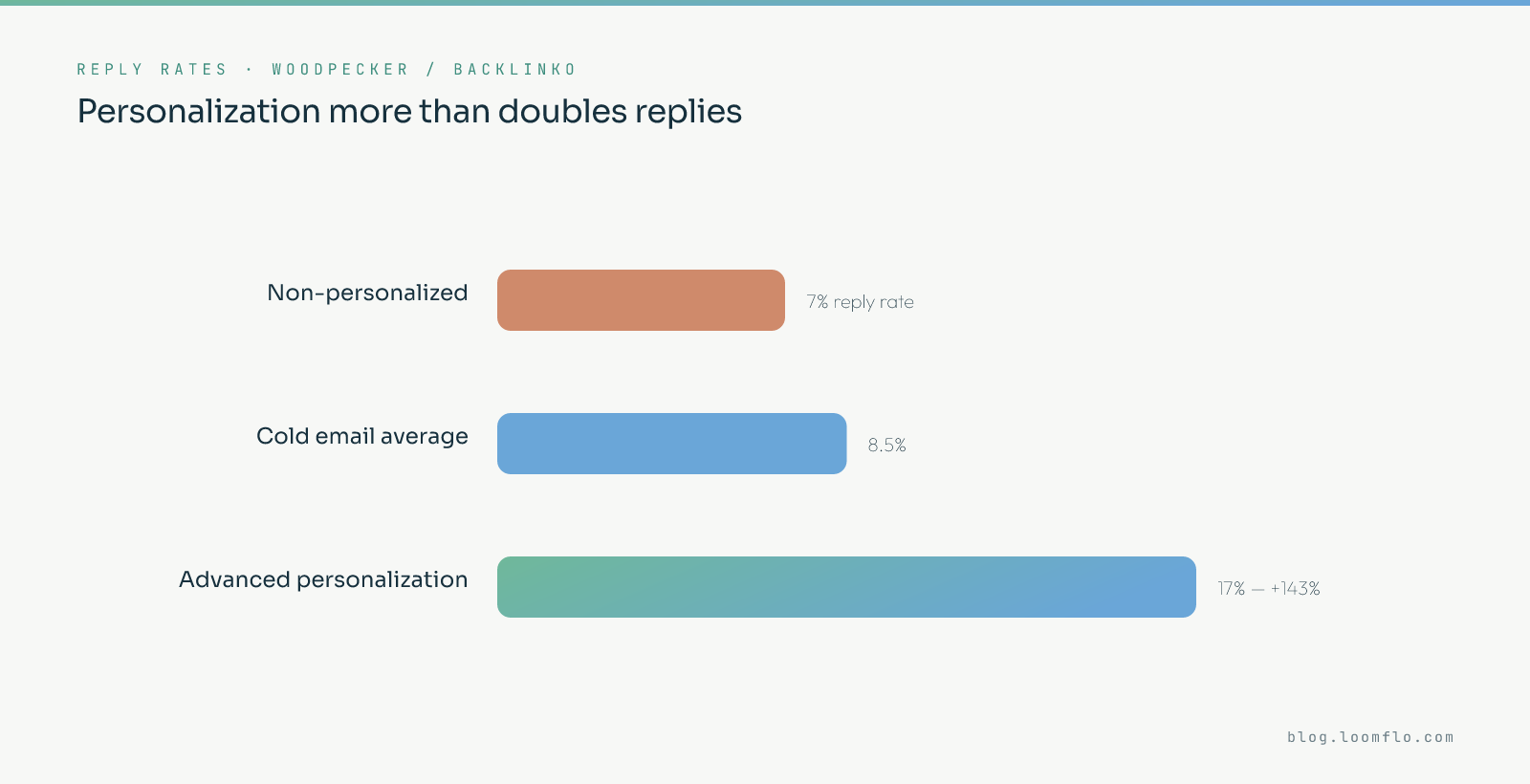
This is exactly the work AI is built for. Researching each prospect’s role, company and recent activity, then writing a relevant message, is a volume problem, and volume is where humans break down.
It also pays at the business level. McKinsey research finds personalisation typically drives a 10–15% revenue lift, and AI is what makes that achievable across thousands of contacts.
The catch: deliverability decides everything
None of those reply rates matter if your email never reaches the inbox. Mailreach found global inbox placement dropped to 83.5% in 2024, meaning roughly one in six emails never lands in the inbox at all.
Scaling AI volume on a weak foundation just sends more mail to the spam folder. So the deliverability setup has to come before the scale, not after.
The rules tightened in 2024. Google and Yahoo now require bulk senders of more than 5,000 emails a day to authenticate with SPF, DKIM and DMARC, offer one-click unsubscribe, and keep spam complaints under 0.3%, or risk being blocked.
Most senders still aren’t compliant. Mailreach found only about 9.7% of domains have implemented DMARC, which makes proper authentication an easy edge for those who do it.
How to do AI cold email without the spam
Scaling outreach safely is mostly about discipline. Here is what the data says to do.
1. Authenticate and protect your domain
Set up SPF, DKIM and DMARC on every sending domain, and keep spam complaints below 0.3% (ideally under 0.1%). Keep bounce rate under 4% by verifying lists, the cold-email average is 7.5%, and high bounces wreck domain reputation.
2. Send to small, tightly targeted lists
Counter-intuitively, smaller is better. Belkins found campaigns under 100 recipients average a 5.5% reply rate, and emailing one contact per company gets 7.8% versus 3.8% when you blast 10-plus contacts at the same company.
So “at scale” should mean many small, targeted batches, not one giant blast. AI helps you run hundreds of precise campaigns, not bigger ones.
3. Personalise with real signals, not just a first name
Mail-merging {{first_name}} is not personalisation. Use AI to reference something specific and true, a role, a recent post, a company change, because that is what separates the 17% reply rate from the 7%.
4. Follow up but know when to stop
Follow-ups are where most replies come from. QuickMail’s analysis of 65 million emails found 55% of replies come from a follow-up, not the first email, and Backlinko found a single follow-up improves replies by 65.8%.
But more is not better past a point. Belkins found the best cadence is an initial email plus one follow-up, and that by the fourth follow-up, spam complaints more than triple, so cap sequences at two or three touches.
5. Write subject lines like a human
Keep subject lines short and specific, Backlinko found 36–50 characters performs best, and HubSpot found personalised subject lines lift open rates by around 50%. Avoid spam triggers like ALL CAPS, exclamation points, and words such as “free,” “guarantee” and “make money.”
AI cold email vs the old playbook
The old outbound playbook was a trade-off: personalise and stay small, or scale and go generic. AI cold email breaks that trade-off by making per-prospect relevance possible across large lists.
That is why the category is growing fast. The AI-in-sales market was around $24.6 billion in 2024 and is projected to reach $145.1 billion by 2033, according to Grand View Research.
It works best as part of a complete pipeline, not a standalone hack. For how autonomous agents handle the rest of the funnel, see our guide on AI lead generation, and on the economics versus hiring reps in AI vs Human SDRs.
Why cold email keeps getting harder
The channel is more crowded and more filtered than it used to be. Reply rates fell from 6.8% to 5.8% in a single year, and inbox placement slipped to 83.5% as providers tightened their defences.
That squeeze is exactly why generic blasting no longer works. As inboxes get more defensive, only relevant, well-authenticated mail gets through — which is the case for AI personalisation, not against it.
How to warm up a sending domain
Never send cold volume from your primary domain. Buy separate sending domains so any reputation damage never touches your main company email.
Then ramp slowly. Start with a small daily volume and increase it gradually over a few weeks so mailbox providers learn to trust the domain.
Use a warm-up service to build that reputation automatically. These tools exchange seed emails so your domain looks active and human before real outreach begins.
Keep volume per inbox modest. Spreading sends across several authenticated inboxes at low daily limits protects deliverability far better than blasting from one.
A realistic AI cold email setup
Picture the safe version of “at scale.” Instead of one blast to 5,000 people, you run fifty tightly targeted campaigns of around 80 prospects each.
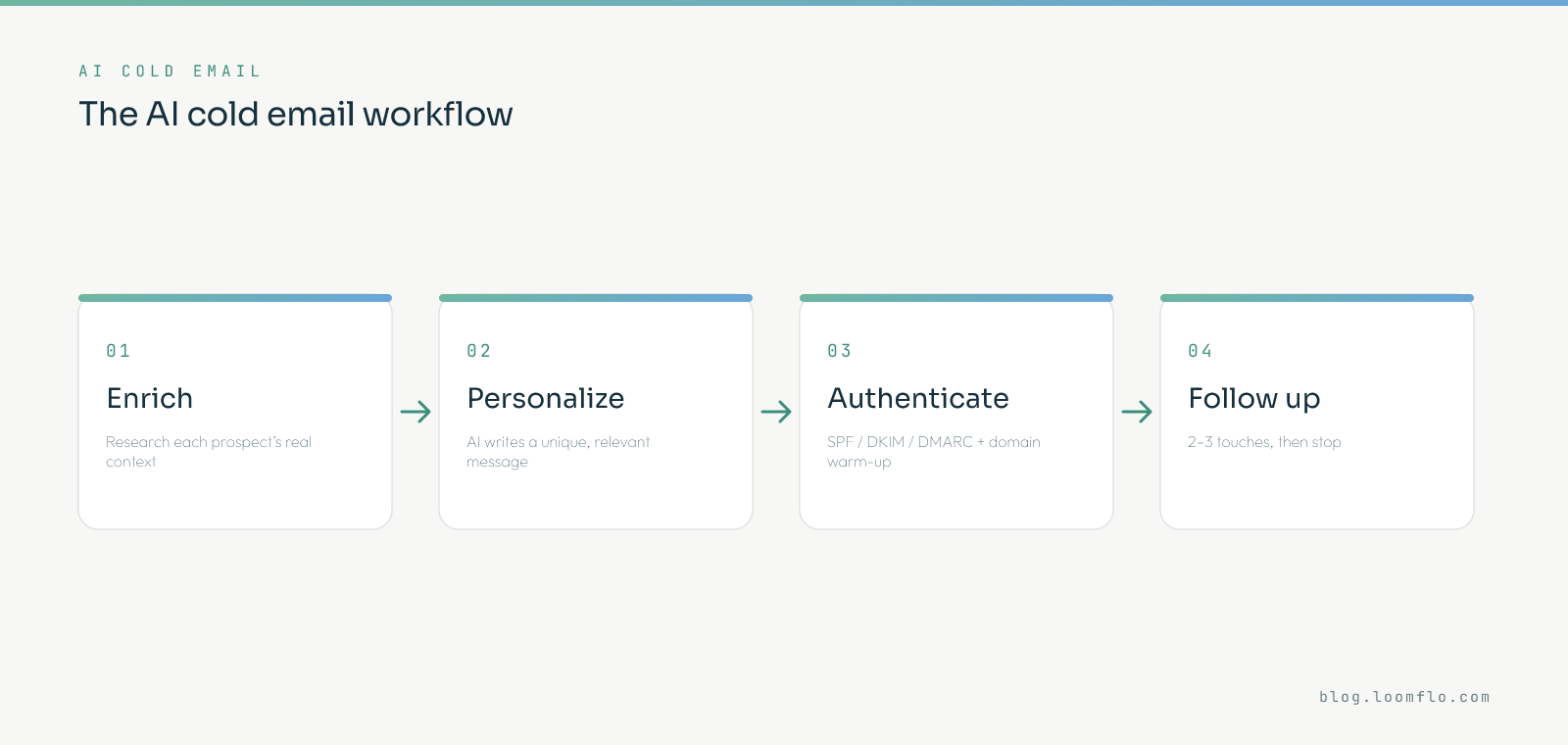
Every email is enriched and written for its recipient, referencing something specific and true. The system sends from warmed, authenticated domains at low per-inbox volume.
Each prospect gets the first email plus one or two follow-ups, then the sequence stops. Replies route to a human who takes the conversation from there.
That is the whole model. AI does the research, writing and sequencing, discipline keeps it out of the spam folder, and humans close.
The metrics that tell you it’s working
Watch deliverability and relevance, not just volume sent. Vanity counts look huge with automation, so judge the system on the numbers that map to revenue and reputation.
- Reply rate — the core signal. Beating the 5.8% average means your targeting and personalisation are landing.
- Positive reply rate — interested replies, not just any reply. This is what actually fills the pipeline.
- Bounce rate — keep it under 4%. Higher means dirty lists that damage your domain.
- Spam-complaint rate — keep it under 0.3%. Cross it and providers start blocking you.
- Open rate — a deliverability proxy. A sudden drop usually means you are landing in spam.
If those stay healthy, you can scale with confidence. If they slip, slow down and fix the foundation before adding volume.
Mistakes that get your domain blocked
Most blocklisting is self-inflicted and predictable. The fastest way to burn a domain is to ignore the fundamentals while chasing volume.
- Skipping authentication. Without SPF, DKIM and DMARC, bulk mail is filtered or rejected outright under the 2024 rules.
- Blasting from day one. High volume from a cold domain is the clearest spam signal there is.
- Fake personalisation. A mail-merged first name on an otherwise generic pitch fools no one and lifts nothing.
- Over-following-up. A fourth and fifth touch more than triples spam complaints, undoing the gains from the first two.
- Spammy copy. ALL CAPS, exclamation points and hype words like “free” or “guarantee” trip filters before a human ever reads them.
None of these are hard to avoid. They are simply the difference between AI cold email that builds pipeline and outreach that gets you blocked.
AI cold email vs buying a lead list
A purchased list is a static snapshot that decays the day you buy it. Many contacts have already changed roles or gone stale, which is part of why blasting bought lists bounces and burns domains.
It works differently. The system builds and enriches a live, targeted list, verifies deliverability, and writes to each prospect’s current context.
The difference shows up in the numbers. Clean, verified, personalised outreach keeps bounces low and replies high, while a bought-and-blasted list reliably does the opposite.
One is an expense that decays. The other is a system that improves with every campaign it runs.
Frequently asked questions
Does AI cold email actually work?
Yes, when it is genuinely personalised. Advanced personalisation more than doubles reply rates (17% versus 7%, per Woodpecker), and personalising the body lifts replies by about 33%.
Generic AI-written blasts do not work, relevance is the whole point.
Is automated cold email spam?
Only if it is untargeted and non-compliant. Properly done, it means authenticated domains, small targeted lists, real personalisation and capped follow-ups, which keeps you out of the spam folder and protects your reputation.
How many follow-ups should I send?
Two to three touches is the sweet spot. Most replies come from follow-ups, but Belkins found spam complaints more than triple by the fourth follow-up, so stop before you become a nuisance.
What stops cold email from landing in spam?
Authenticate with SPF, DKIM and DMARC, keep spam complaints under 0.3% and bounces under 4%, send small targeted batches, and avoid spam-trigger words. Deliverability fundamentals matter more than clever copy.
How many emails a day can I safely send?
Keep each inbox to a low daily volume and spread sends across several authenticated inboxes rather than one. Crossing 5,000 a day per sender also triggers Google and Yahoo’s strict bulk-sender rules, so many small inboxes beat one large one.
Do I need a separate domain for cold email?
Yes, always use dedicated sending domains, never your primary company domain. That way any deliverability damage stays contained and never affects your main business email.
Does it replace sales reps?
No, it replaces the manual research, writing and follow-up at the top of the funnel. Humans still handle the conversations and the close once a prospect replies.
What is the best cold email subject line?
Keep it short, specific and human, 36 to 50 characters performs best, and a personalised subject line lifts open rates by around 50%. Avoid hype words and exclamation points, which trip spam filters before anyone reads the message.
Can cold and warm outreach work together?
Yes, and they should. AI handles the cold, high-volume top of the funnel, while your warmest relationships still deserve a personal, human-written touch.
Put your outbound on autopilot
Loomflo’s AI Lead Generation finds, personalises, sends and follows up, autonomously and safely, so qualified meetings land on your calendar without the spam risk.