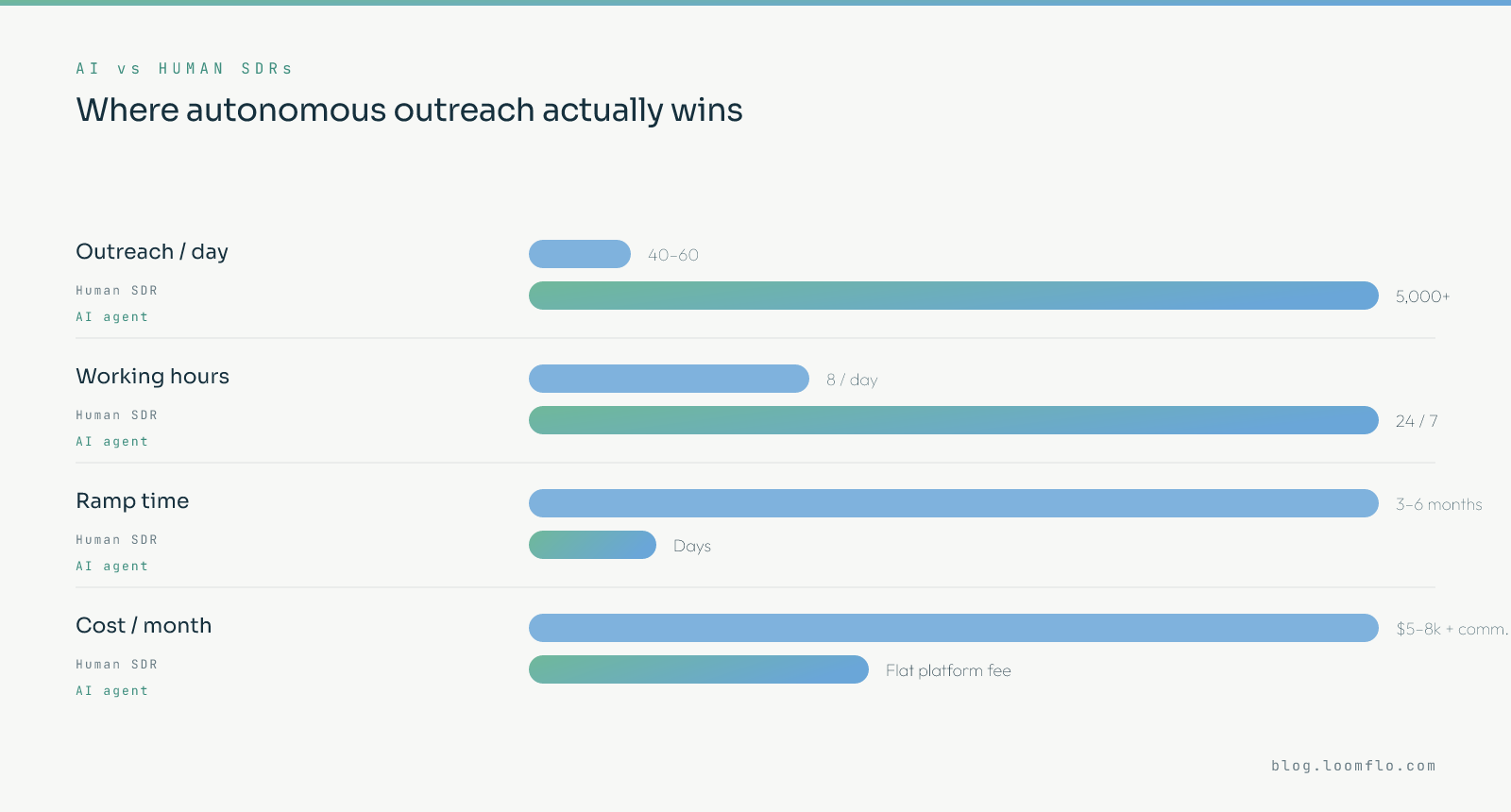
AI vs human SDR comes down to economics. A fully loaded human SDR costs roughly $110k–$160k a year (SalesHive), takes 3.2 months to ramp and lasts just 1.5 years on average (Bridge Group), and can realistically make 50–80 calls a day.
An AI SDR runs 24/7 at far higher volume for a flat fee with near-zero ramp. AI wins on cost, volume and consistency; humans win on nuance and relationships.
The smart play is hybrid AI opens, humans close.
Every founder scaling outbound hits the same fork: hire another sales development rep, or deploy an AI SDR. The AI vs human SDR decision usually starts as a salary comparison.
But the real comparison is about throughput, ramp time, tenure, consistency, and where human judgment actually adds value. Get that right and the question stops being “which one” and becomes “which one for which job.” This is also no longer a niche decision Gartner predicts that by 2028, AI agents will outnumber human sellers by 10×.
What is an AI SDR?
An AI SDR (sales development representative) is an autonomous agent that performs the prospecting work of a human SDR finding leads, qualifying them, sending personalised outreach, and following up without manual effort, running continuously at machine scale. It handles the top-of-funnel motion so human reps can concentrate on conversations and closing.
The category is growing fast: the AI SDR market was valued at roughly $4.1 billion in 2025 and is projected to reach $15 billion by 2030 (MarketsandMarkets), a ~29.5% compound annual growth rate. That money is moving because the underlying cost comparison is lopsided.
AI vs human SDR: the honest cost
Comparing fairly means looking past base salary. According to RepVue’s verified data (8,700+ submissions), the median SDR earns a $60k base and $85k OTE.
The Bridge Group’s SDR benchmark puts on-target earnings around $75k. But OTE is only the visible cost.
Once you add commission, benefits, tooling, and management overhead, a fully loaded in-house SDR runs roughly $110k–$160k per year about 2–3× base salary (SalesHive).
Now layer in the time dynamics:
- Ramp time: the average SDR takes 3.2 months to reach full productivity (Bridge Group) months you pay for before you get output.
- Tenure: average SDR tenure is just 1.5 years. After ramp, you get ~15 productive months before churn resets the clock.
- Quota attainment: only about 68% of SDRs hit quota nearly a third miss, adding performance variability to the cost.
The hidden cost of a human SDR isn’t the salary it’s the 3+ months of ramp, the 18-month tenure, and the hard ceiling on how many conversations one person can start.
The activity ceiling: volume and consistency
Human output is capped by hours in the day. Industry benchmarks put the average outbound SDR at 50–80 cold calls per day (manual dialing tops out around 40–55), and even then the funnel is leaky: B2B cold-call connect rates average 8–12%, and cold-email reply rates have slipped to around 5.8% (Instantly, on a Belkins dataset of 16.5M emails).
None of that is a criticism of reps it’s arithmetic. A person can only dial, type, and follow up so many times in eight hours.
An AI agent isn’t bound by those hours. It runs 24/7, executes every step of a multi-touch sequence without fatigue, and scales volume without a new hire.
It doesn’t replace the connect-rate reality but it works far more of the funnel, far more consistently, so more of those low-percentage attempts actually happen.
Cost per meeting: the number that matters
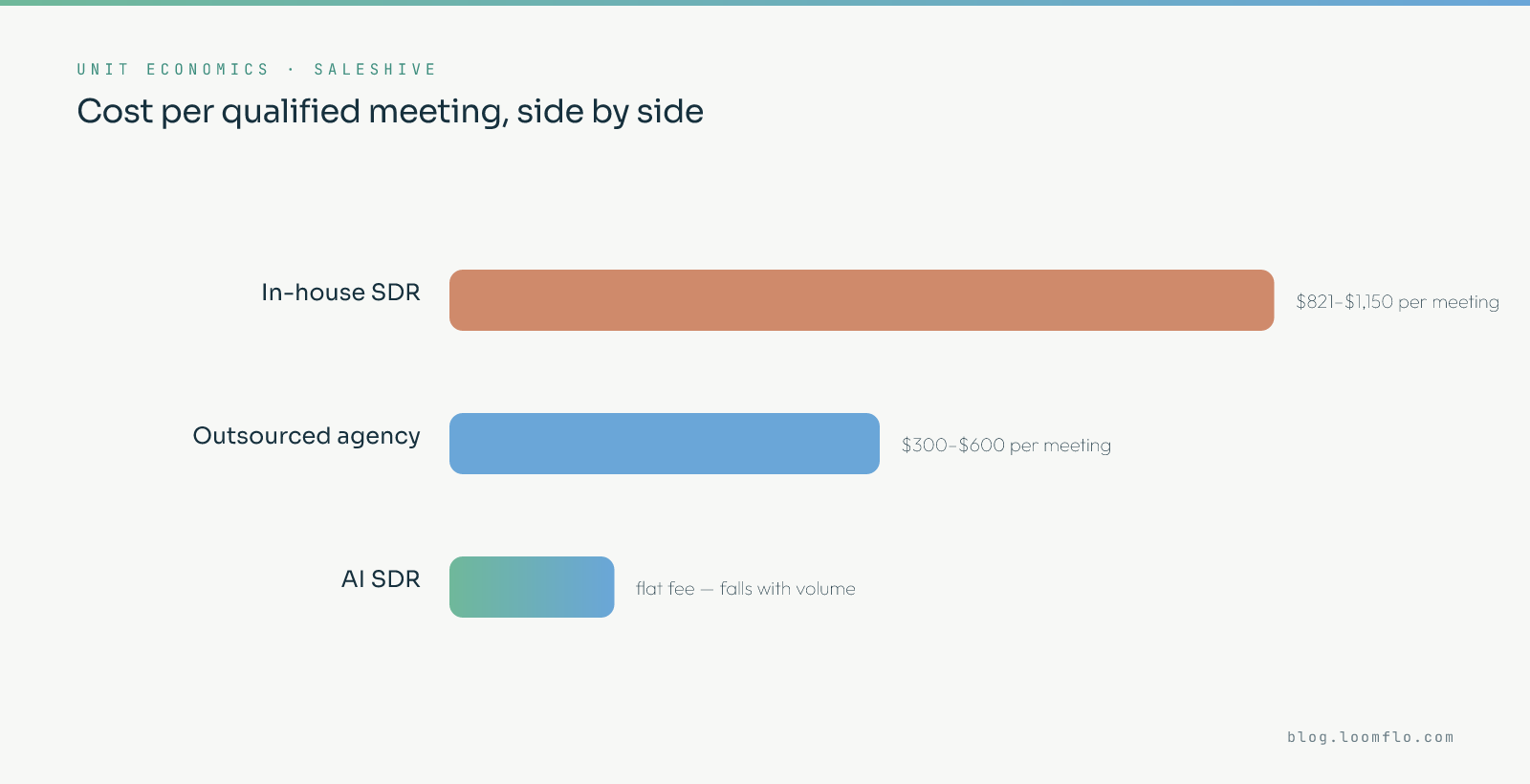
Activity and salary only matter relative to output. The cleanest way to compare is cost per qualified meeting:
- A fully loaded in-house SDR booking 10–14 meetings a month works out to roughly $821–$1,150 per qualified meeting (SalesHive).
- Outsourced appointment-setting agencies typically charge $300–$600 per qualified meeting (more at enterprise level).
- An AI SDR is a flat platform fee with no commission and no management load so as volume rises, cost per meeting falls rather than scaling linearly with headcount.
That’s the structural difference. Human capacity is bought in expensive, slow-to-ramp, high-turnover units.
AI capacity is bought once and scales.
Where humans still win
The AI vs human SDR question is not really a story about replacing salespeople and the data cautions against over-hyping AI. Gartner notes that even as agents proliferate, fewer than 40% of sellers will report that AI agents improved their productivity by 2028 if deployed poorly.
There are jobs where a human is simply better, and pretending otherwise costs you deals:
- Complex discovery — reading nuance, handling objections, and navigating multi-stakeholder buying.
- Relationship building — trust, rapport, and the judgment calls that close large or strategic deals.
- High-value conversations — where a real person on the other end is part of the value proposition.
AI is exceptional at breadth starting thousands of relevant conversations. Humans are exceptional at depth turning the right ones into revenue.
A worked example: cost per meeting, side by side
Abstract numbers get clearer with a simple scenario. Suppose you need 30 qualified meetings a month.
- Human SDR route: at 10–14 meetings per rep per month, you need 2–3 SDRs. Fully loaded at ~$110k–$160k each per year, that’s roughly $220k–$480k annually plus 3.2 months of ramp before they’re at full output, and the near-certainty that at least one churns inside 18 months and resets the clock. Cost per meeting lands around $820–$1,150.
- Outsourced agency route: at $300–$600 per qualified meeting, 30 meetings runs $9k–$18k a month predictable, but you don’t own the system and quality varies.
- AI SDR + human closer route: a flat platform fee covers the find/qualify/engage/book motion at machine volume, and your existing closers handle the meetings. Cost per meeting drops as you add volume, because you’re not buying another $130k human to do more outreach.
The point isn’t that one line item is always smallest it’s that the human route’s cost scales with headcount while the AI route’s cost scales with software. Those are different curves, and over a year they diverge sharply.
What AI SDRs still get wrong
An honest comparison names the failure modes. Deployed badly, AI SDRs can: send outreach that’s technically personalised but tone-deaf; over-contact prospects and burn domains; mis-qualify edge cases a human would catch; and create a polished first impression that collapses the moment a prospect asks a nuanced question the agent can’t handle.
Gartner’s caution that fewer than 40% of sellers will report productivity gains from agents by 2028 is really a warning about thoughtless deployment. The tools reward operators who set tight targeting, sensible volume limits, and a clean handoff to humans.
They punish “turn it up to maximum and walk away.”
The hybrid model that actually wins
In practice, the smartest answer to AI vs human SDR is to stop choosing. They let AI handle the top of the funnel finding, qualifying, engaging, and booking and let human reps take over the moment a conversation is qualified and warm.
The AI removes the volume ceiling, the ramp cost, and the follow-up busywork; the humans do what only humans can. Cost per qualified meeting drops, rep morale rises (no more cold-list grinding), and pipeline becomes predictable instead of dependent on how many SDRs you can afford to ramp and retain.
This is also the model the productivity data supports: AI agents earn their keep when they’re pointed at the repetitive, high-volume work and humans stay on judgment not when they’re expected to replace the entire role.
How to roll out a hybrid SDR model
If the hybrid model wins, the question becomes how to get there without disrupting a team that’s already selling. A sensible sequence:
- Start with the work reps hate. Point the AI at list-building, research, and first-touch sequencing first the tasks that eat the ~70% of time reps don’t spend selling. Wins here are pure upside and meet zero resistance.
- Define the handoff precisely. Decide exactly when a conversation moves from agent to human typically the moment a prospect replies with intent or books. Ambiguity here is where leads get dropped.
- Set guardrails before volume. Tight ICP targeting, daily send limits, and domain warm-up protect deliverability. Reply rates near 5.8% mean there’s no room for sloppy blasting.
- Measure cost per qualified meeting, not activity. Vanity metrics (emails sent, dials made) will look enormous with AI. The number that matters is qualified meetings booked and what each one cost.
- Let reps redeploy upward. As agents absorb prospecting, move human reps toward discovery, demos, and closing — the depth work where they outperform any model.
Done in that order, you don’t fire your sales team and bet on a bot. You take the ceiling off how many conversations they can start, remove the ramp-and-churn tax, and let people do the part of selling that’s actually human.
Why this shift is happening now
The AI vs human SDR conversation isn’t being driven by hype alone three forces are pushing it at once. First, economics: with loaded SDR costs at $110k–$160k and rising, every founder is under pressure to make outbound cheaper per meeting.
Second, capability: language models crossed the threshold where personalised, context-aware outreach at scale became genuinely usable, not just plausible-looking. Third, adoption gravity: with the AI SDR market growing toward $15 billion by 2030 and Gartner projecting agents to outnumber sellers 10× by 2028, the tooling, integrations, and best practices are maturing fast which lowers the risk of adopting now versus a year ago.
The takeaway for an operator isn’t “replace your team this quarter.” It’s that the cost of not automating the repetitive top-of-funnel work is rising every year, while the cost and risk of automating it are falling. The teams that figure out the hybrid split early AI for breadth, humans for depth get a structural cost advantage their slower competitors will feel in their cost per meeting.
Frequently asked questions
Is an AI SDR cheaper than a human SDR?
Per qualified meeting, almost always. A fully loaded human SDR runs ~$110k–$160k/year and books meetings at roughly $821–$1,150 each (SalesHive).
An AI SDR is a flat fee with no ramp, no commission, and no management — and its cost per meeting falls as volume rises.
Can AI SDRs replace human sales reps entirely?
For top-of-funnel prospecting, largely yes. For discovery, relationship-building, and closing, no Gartner’s data shows AI agents only deliver productivity gains when deployed thoughtfully.
The strongest setups are hybrid: AI opens the conversation, humans close the deal.
Do AI SDRs hurt your brand or domain reputation?
Only if they’re used as a volume-for-volume’s-sake spam tool. With cold-email reply rates already down near 5.8%, untargeted blasting hurts everyone.
Properly configured AI SDRs qualify before they engage and personalise outreach, which protects deliverability and brand perception.
How long until an AI SDR is productive?
Days, not months. Once the ideal customer profile and messaging are set, it starts working immediately versus the 3.2-month average ramp of a new human hire, who then averages only 1.5 years of tenure.
What size company should consider an AI SDR?
Any business doing or wanting to do consistent outbound. Early-stage teams use AI SDRs to build pipeline before they can afford multiple human reps; scaling teams use them to lift the volume ceiling without tripling headcount and ramp cost.
The common thread is needing more qualified conversations than current human capacity can start.
Do I still need a CRM and sales process?
Yes. An AI SDR fills the top of the funnel, but it works best on top of a clear ICP, defined messaging, and a CRM where qualified meetings land and humans take over.
The agent amplifies a good process; it can’t substitute for not having one.
Scale outbound without scaling headcount
Loomflo’s AI Lead Generation gives you autonomous SDRs that find, qualify and engage prospects 24/7 so your human team only handles meetings worth closing, without the ramp cost or the turnover. Book a discovery call →
Related reading: AI Lead Generation: How Autonomous Agents Book Meetings 24/7.