Customer onboarding is how you get a new customer to real value fast, and it decides whether they stay. On average only 37.5% of SaaS users ever reach activation (Userpilot), and 86% of people say they’d stay more loyal to a company that invests in onboarding (Wyzowl) the first week sets the whole relationship.
Most churn is decided long before the cancellation. It’s decided in the first days, when a new customer either reaches value or quietly gives up.
Customer onboarding is how you win that moment. This guide explains why it drives retention, what a good flow looks like, and how to measure it.
What is customer onboarding?
Customer onboarding is the structured process of guiding a new customer from signup to becoming a confident, active user who has realized the product’s value. It spans setup, education, and the first key actions.
It’s more than a welcome email. Good onboarding removes friction and walks the customer to their first real win.
The stakes are high, and customers know it 63% say onboarding is an important factor when deciding to buy (Wyzowl). It’s part of the purchase decision, not an afterthought.
Why onboarding makes or breaks retention
Onboarding is the highest-leverage point in the customer lifecycle. A weak start is nearly impossible to recover from.
The evidence is blunt. Wyzowl found 8 in 10 users have deleted an app because they didn’t know how to use it, and over 90% of customers feel the companies they buy from could do better at onboarding.
The upside is just as large. Since a 5% increase in retention can lift profits by 25% or more (Bain & Company), and onboarding is a primary retention lever, the first week pays off for years.
Time-to-value and the aha moment
The single most important idea in onboarding is time-to-value. It’s the clock that decides whether a customer stays.
Time-to-value (TTV) is how long it takes a new customer to experience real value for the first time. The shorter it is, the more likely they retain for self-serve SaaS the median is around a day and a half (Userpilot).
Closely related is the aha moment the point where a user realizes the product is worth keeping. Activation is its measurable proxy: a defined key action that signals the user “got it.”
Most users never activate
Here’s the problem onboarding exists to solve. Most people who sign up never reach value at all.
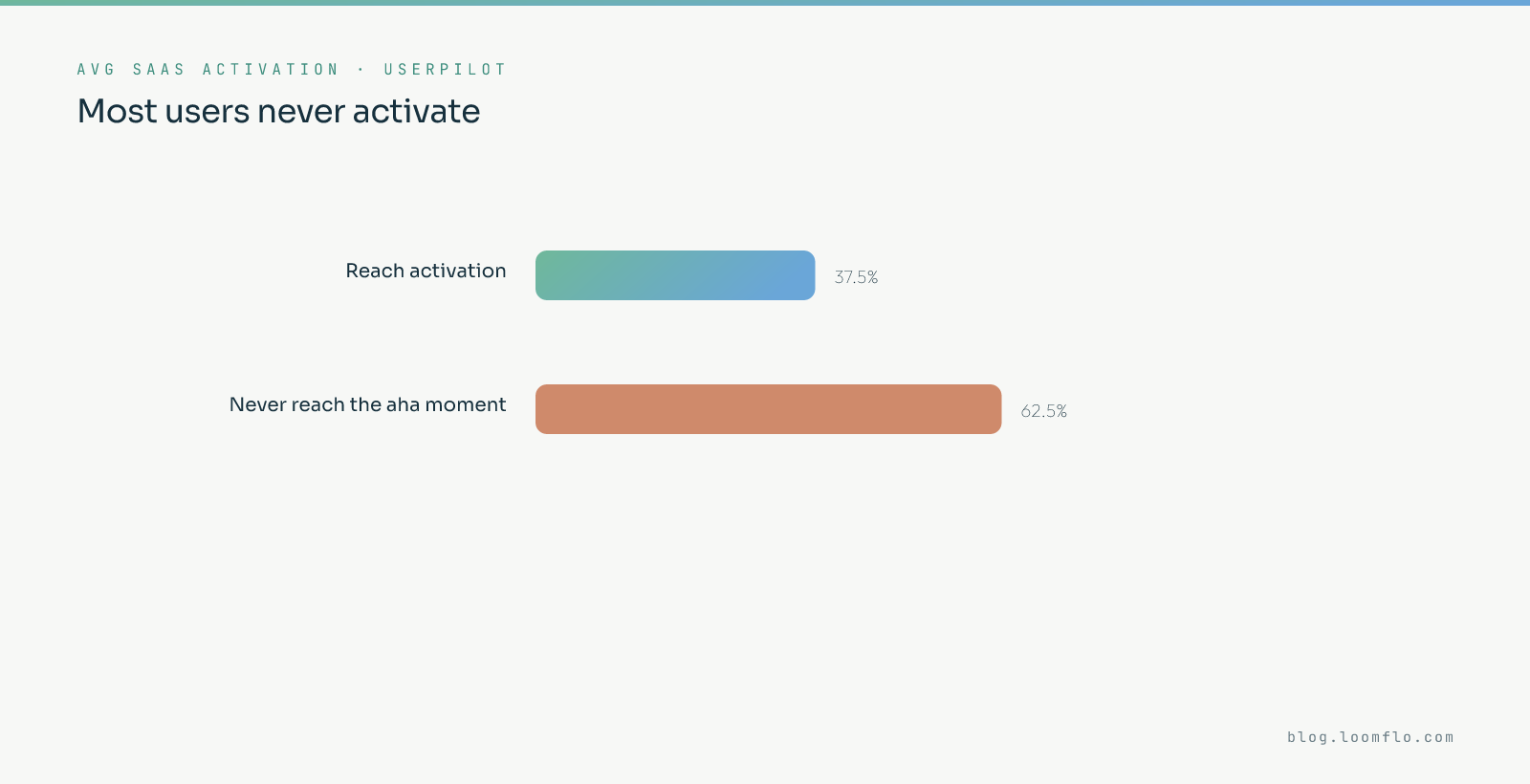
Userpilot’s benchmark across 547 companies found the average activation rate is 37.5%, meaning nearly two-thirds of signups never hit the aha moment. That’s an enormous pool of nearly-customers walking away.
Every one of those users cost you acquisition spend. Onboarding is how you convert more of them into activated, retained customers.
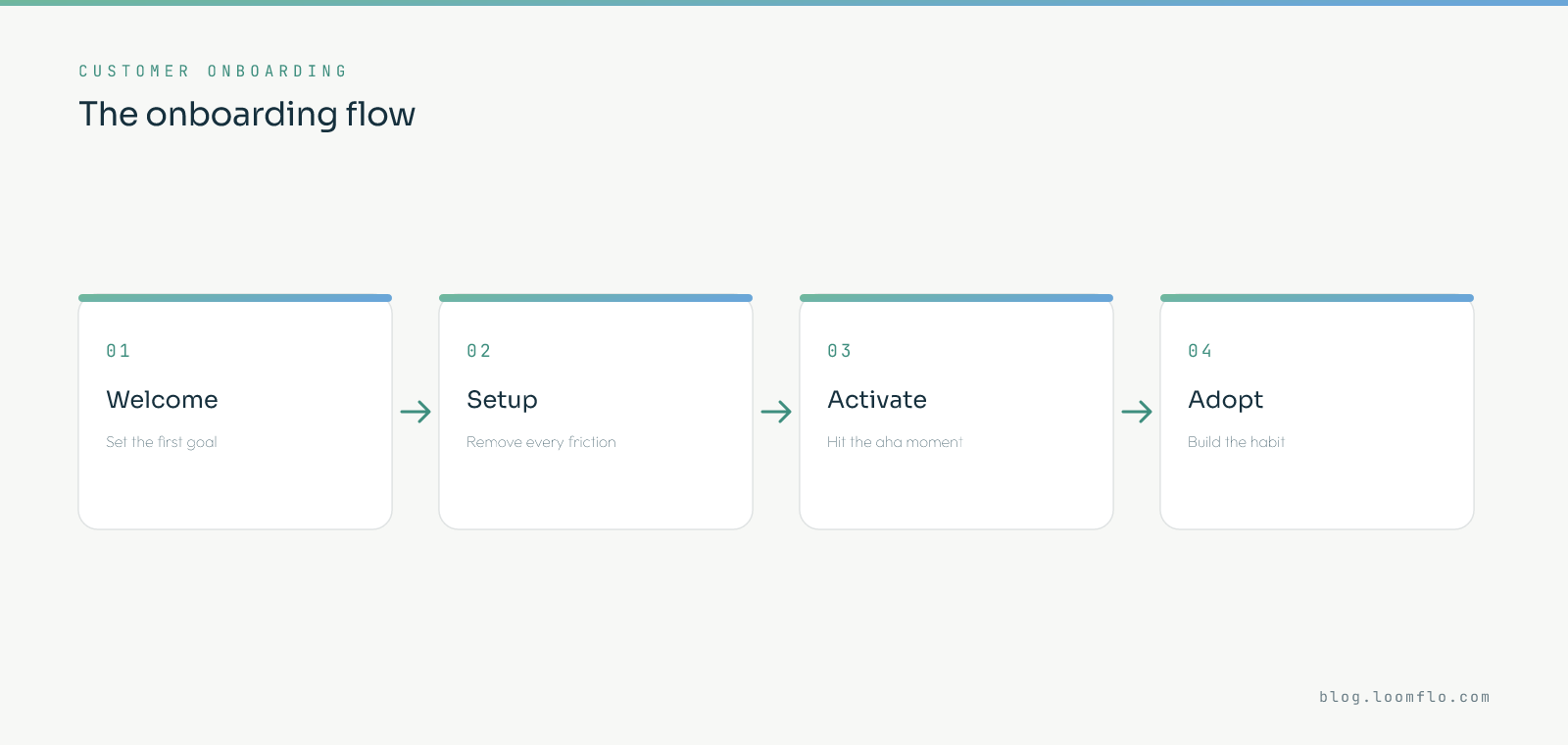
The stages of an onboarding flow
A good onboarding flow moves a user through clear stages, each with one job. Keep it practical, not exhaustive.
1. Welcome
Set expectations and point to the first meaningful goal. The user should know exactly what to do next.
2. Setup
Remove every possible friction from configuration. The faster they’re set up, the closer they are to value.
3. Activate
Guide them to the key action that delivers the first real win. This is the aha moment you’re engineering toward.
4. Adopt
Turn that first win into a repeated habit across more features. Adoption is where retention becomes durable.
Onboarding best practices
The best onboarding experiences share a handful of principles. They all serve one goal: faster time-to-value.
- Reduce steps: Every extra field or screen before value is a place users drop off.
- Personalize by use case: Route users by role or goal so the path fits their reason for signing up.
- Deliver a quick win: Get them to one tangible outcome fast, before asking for more.
- Use checklists and progress: A visible path with momentum keeps people moving.
- Guide in context: Surface help at the moment it’s needed, not as a front-loaded feature tour.
These principles compound. Each removed friction point nudges more users past activation.
Common onboarding mistakes
Most weak onboarding fails in predictable ways. Watch for these.
- Too long or complex: Long flows lose people before they reach value.
- No clear first win: If users don’t experience value early, they don’t come back.
- One-size-fits-all: A single generic path ignores why different users signed up.
- Front-loading feature tours: Dumping every feature upfront overwhelms instead of activating.
- Abandoning users after week one: Onboarding should carry into early adoption, not stop at setup.
Fix these and activation climbs. Ignore them and even great products lose users at the door.
How AI improves onboarding
Onboarding is hard to personalize at scale by hand, which is exactly where AI helps. It makes tailored, timely onboarding feasible for every user.
AI can branch the onboarding path by persona or behavior, so a first-time user and a power user get different flows. It surfaces contextual, in-app guidance at the right moment instead of a one-size tour.
It also watches behavior for stalls a user who hasn’t hit the activation event in the expected window — and triggers a nudge or alerts a human before they churn. AI assistants can answer setup questions in context, so no one gets stuck waiting on docs.
The honest framing: AI removes friction and scales personalization teams can’t do manually, but it doesn’t replace a well-designed flow. The real leverage is the huge activation headroom most users never reach value, and better onboarding is how you capture them.
Measuring onboarding success
You can’t improve onboarding you don’t measure. A few metrics tell you where users win or drop off.
Track activation rate, time-to-value, and onboarding or checklist completion, plus early retention in the first weeks. The Userpilot benchmark of 37.5% activation is a useful yardstick to measure yourself against.
Match the model to your customer, too. High-touch, CSM-led onboarding suits enterprise deals, while low-touch, self-serve flows fit product-led and SMB customers.
Where onboarding fits
Onboarding is the foundation of retention, and retention is the foundation of growth. It’s where acquisition either pays off or leaks away.
It works hand in hand with the systems around it. See how it feeds customer retention and how AI personalization tailors the experience to each user.
Get customers to value in the first week and everything downstream improves they stay longer, expand faster, and refer more.
Frequently asked questions
What is customer onboarding?
It’s the process of guiding a new customer from signup to actively using and getting value from your product. It covers setup, education, and the first key actions.
Why is customer onboarding important?
Because it decides retention 8 in 10 users have deleted an app they couldn’t figure out (Wyzowl), and most churn is set in the first days. Good onboarding turns signups into activated, loyal customers.
How long should customer onboarding take?
As short as possible to first value the median time-to-value for self-serve SaaS is about a day and a half (Userpilot). The goal is speed to the aha moment, not a long tour.
What makes a good onboarding experience?
Low friction, a personalized path by use case, and a fast first win, with contextual guidance instead of feature dumps. Every step should move the user closer to value.
How do you measure onboarding success?
Track activation rate, time-to-value, onboarding completion, and early retention. Activation rate the share of users who reach the key action is the closest proxy for the aha moment.
What’s the difference between onboarding and adoption?
Onboarding gets a user to first value and activation; adoption is the ongoing, deepening use of the product over time. Onboarding starts the relationship, adoption sustains it.
Get every customer to value faster
Loomflo builds AI growth infrastructure personalized onboarding paths, in-app guidance and stall detection that lift activation, so more signups become customers who stay.