Lead nurturing is how you stay useful to buyers who aren’t ready yet which is most of them. A widely cited MarketingSherpa benchmark found 73% of B2B leads are not sales-ready, and Forrester found companies that nurture well generate 50% more sales-ready leads at 33% lower cost.
Most companies treat a lead as either ready now or worthless. That binary throws away the majority of the pipeline they paid to create.
The truth is that timing, not interest, is usually the blocker. This guide covers how to keep those buyers warm until they’re ready to move.
What is lead nurturing?
Lead nurturing is the practice of building a relationship with prospects who aren’t ready to buy yet delivering relevant, useful information over time until they are. It’s the bridge between interest and purchase.
It’s distinct from lead generation, which creates the lead in the first place. Generation fills the top; nurturing moves people down.
It’s also different from cold outreach. You’re contacting people who already raised a hand, so the job is to stay helpful rather than to interrupt.
Why most leads aren’t ready
The single biggest misconception in B2B is that a downloaded guide means buying intent. Usually it means curiosity.
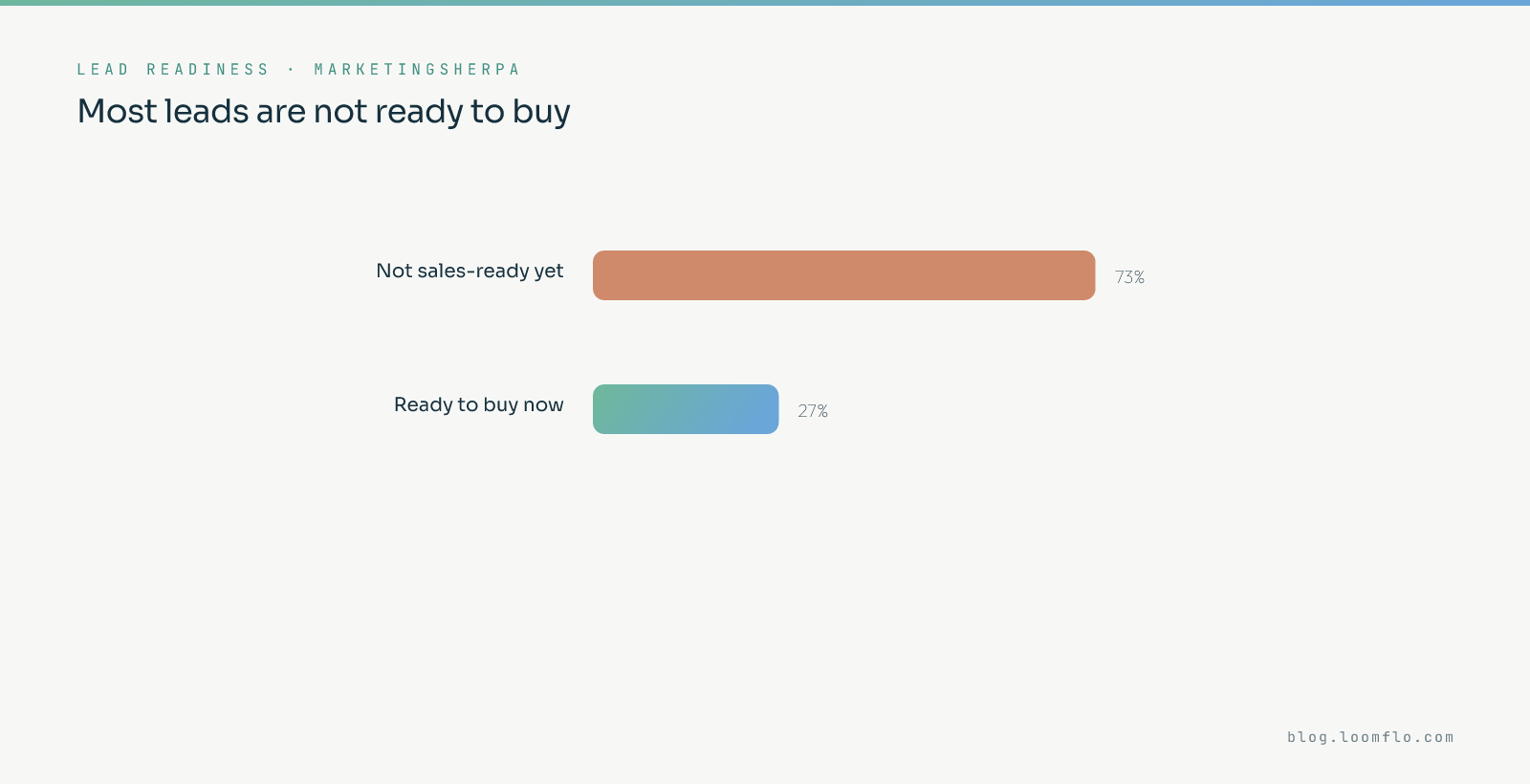
MarketingSherpa’s long-standing benchmark put 73% of B2B leads as not sales-ready at the moment of capture. Passing those straight to sales wastes rep time and burns the lead.
The waste is enormous when nobody follows up. Gleanster research widely cited across the industry found 79% of marketing leads never convert, with poor follow-up the leading cause.
The business case
Lead nurturing isn’t a soft activity the economics are strong. Two numbers make the case.
Forrester found companies that excel at this generate 50% more sales-ready leads at 33% lower cost per lead. You get more qualified pipeline while spending less to produce it.
Deal size improves too. Annuitas Group research, widely cited since, found nurtured leads make purchases roughly 47% larger than non-nurtured ones.
The buyer decides before you talk
Modern buyers self-educate, which is precisely why staying present matters. If you’re absent during research, you’re absent from the decision.
Gartner found B2B buyers spend just 17% of their time meeting with potential suppliers across the entire journey. And 6sense found 84% already have a preferred vendor before they ever contact sales.
Nurturing is how you become that preferred vendor while they’re still deciding quietly.
How to build a nurture sequence
A good sequence teaches rather than pitches. Build it in four steps.
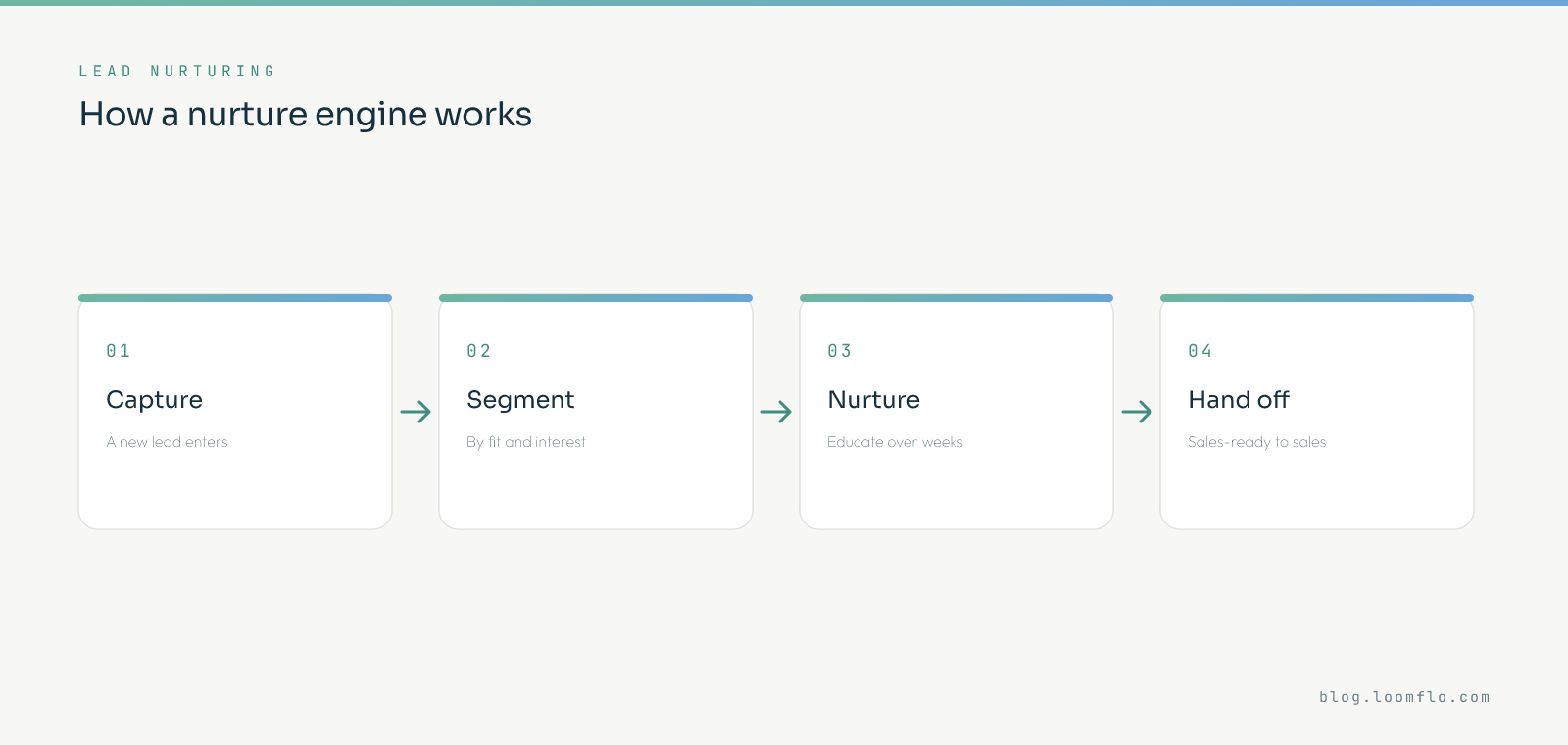
1. Capture and set expectations
Deliver whatever they signed up for immediately, and tell them what’s coming next. The welcome message is your highest-engagement moment use it.
2. Segment
Split by fit (role, company size, industry) and by interest (what they downloaded or viewed). One generic sequence for everyone underperforms badly.
3. Educate over time
Send genuinely useful content spaced over weeks guides, case studies, comparisons, answers to real objections. Aim to be the most helpful vendor in their inbox, not the most frequent.
4. Hand off at the right moment
Watch for buying signals like pricing-page visits or demo requests, then route to sales. This is where scoring earns its keep.
Types of nurture sequences
Different moments call for different sequences. Most teams need several.
- Welcome: Introduce your perspective and set the relationship’s tone.
- Educational: Teach the problem space over several weeks for early-stage leads.
- Post-demo: Keep momentum with proof, answers and next steps after a call.
- Re-engagement: Wake up contacts who’ve gone quiet for months.
- Win-back: Return to closed-lost deals when circumstances change.
Each one addresses a different reason a deal stalled. Running only a welcome series leaves most of the value untouched.
Common mistakes
Lead nurturing programs usually fail in the same few ways. All are correctable.
- Pitching every message: Constant selling trains people to ignore you.
- One sequence for everyone: No segmentation means no relevance.
- Fixed drips that ignore behavior: Sending step 4 after someone requested a demo is a wasted moment.
- Stopping too early: B2B cycles run months; a three-email series expires long before the buyer is ready.
- Measuring opens only: The real metric is pipeline created, not engagement.
How AI improves nurturing
Traditional drips are rigid everyone gets the same emails on the same schedule regardless of behavior. AI makes the sequence respond to the person.
Behavior triggers replace fixed timing, so a pricing-page visit can jump someone straight to a sales handoff. Content adapts by segment, industry and stage without hand-building dozens of variants.
Predictive scoring flags when a lead is genuinely sales-ready rather than guessing at an arbitrary email count. Send-time optimization and automated variant testing squeeze more from the same list.
The honest limit: AI executes and personalizes, but humans still decide the strategy what you teach, what you stand for, and what a qualified buyer actually looks like. Automation applied to a bad sequence just delivers irrelevance faster.
Where lead nurturing fits
Nurturing is the layer that makes everything upstream pay off. It converts the 73% that acquisition already paid for.
It works alongside the systems on either side of it. See how lead scoring decides when to hand off, and how lead magnet ideas fill the top of the funnel it depends on.
Stay useful long enough and you become the vendor they were always going to choose.
Frequently asked questions
What is lead nurturing?
It’s building a relationship with prospects who aren’t ready to buy yet by delivering useful, relevant content over time. The goal is to stay top of mind until they’re ready.
Why is it important?
Because 73% of B2B leads aren’t sales-ready at capture and 79% of marketing leads never convert without follow-up. Companies that nurture well see 50% more sales-ready leads at 33% lower cost (Forrester).
How long should a nurture sequence be?
Long enough to match your sales cycle, which in B2B often means months rather than weeks. Behavior-triggered sequences beat fixed-length ones.
How many emails should it include?
There’s no magic number relevance matters more than count. Most effective programs run several sequences in parallel by segment and stage rather than one long chain.
What’s the difference between lead nurturing and lead generation?
Generation creates new leads; nurturing develops the ones you already have until they’re ready to buy. One fills the funnel, the other moves people through it.
How do you measure it?
Track pipeline created, lead-to-opportunity conversion, and how quickly leads become sales-ready not just opens and clicks. Engagement metrics are diagnostics, not outcomes.
Stop losing the leads you already paid for
Loomflo builds AI growth infrastructure behavior-triggered sequences, segmentation and scoring that keep every lead warm until they’re ready to buy.