Programmatic SEO uses a dataset and a template to generate hundreds or thousands of pages, each targeting a specific long-tail search. Done well it drives enormous traffic; done badly it triggers Google penalties, because 96.55% of all web pages get zero search traffic.
Some of the biggest organic traffic engines on the web were not written page by page. They were generated at scale from a single dataset and a single template.
That technique is programmatic SEO, and it is one of the highest-leverage, and highest-risk, plays in search. This guide covers how it works, who does it well, and how to scale without getting penalised.
What is programmatic SEO?
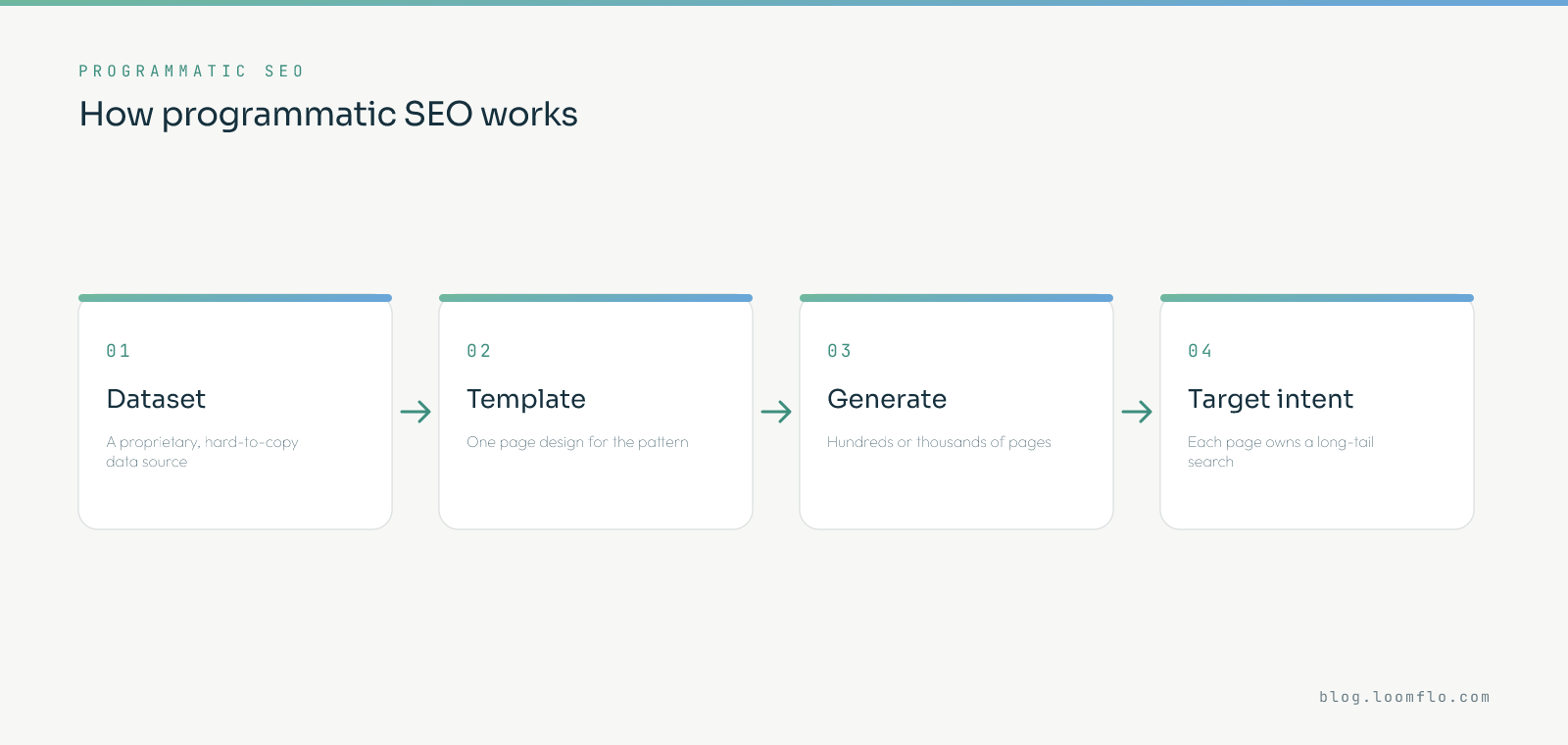
Programmatic SEO is the practice of automatically generating large numbers of landing pages from a structured dataset and a repeatable template, with each page targeting a specific long-tail keyword. Instead of writing one page at a time, you build a system that produces them in bulk.
Think of currency-converter pages, “best X in Y city” pages, or software-integration pages. Each follows the same template, but the data, and the search it captures, is unique.
Programmatic SEO examples that work
The best examples share one trait: a dataset competitors can’t easily copy. The pages are scaled, but each one is genuinely useful.
Canva is the flagship case. It has more than 190,000 pages indexed and pulls over 100 million monthly organic visits, with template and tool pages like “logo maker” alone drawing roughly 179,000 visits a month (per Ahrefs estimates).
Wise does the same in fintech. Its programmatic currency-converter pages help drive around 60.5 million monthly organic visits, capturing high-intent transactional searches at scale.
And it is not only for big companies. Nomad List, built by a solo founder, runs a single dataset of 24,000+ cities, each generating a structured page on cost of living, internet speed and safety.
The reality: most pages get nothing
Here is the statistic that should govern every programmatic project. Ahrefs studied around 14 billion pages and found 96.55% get zero traffic from Google.
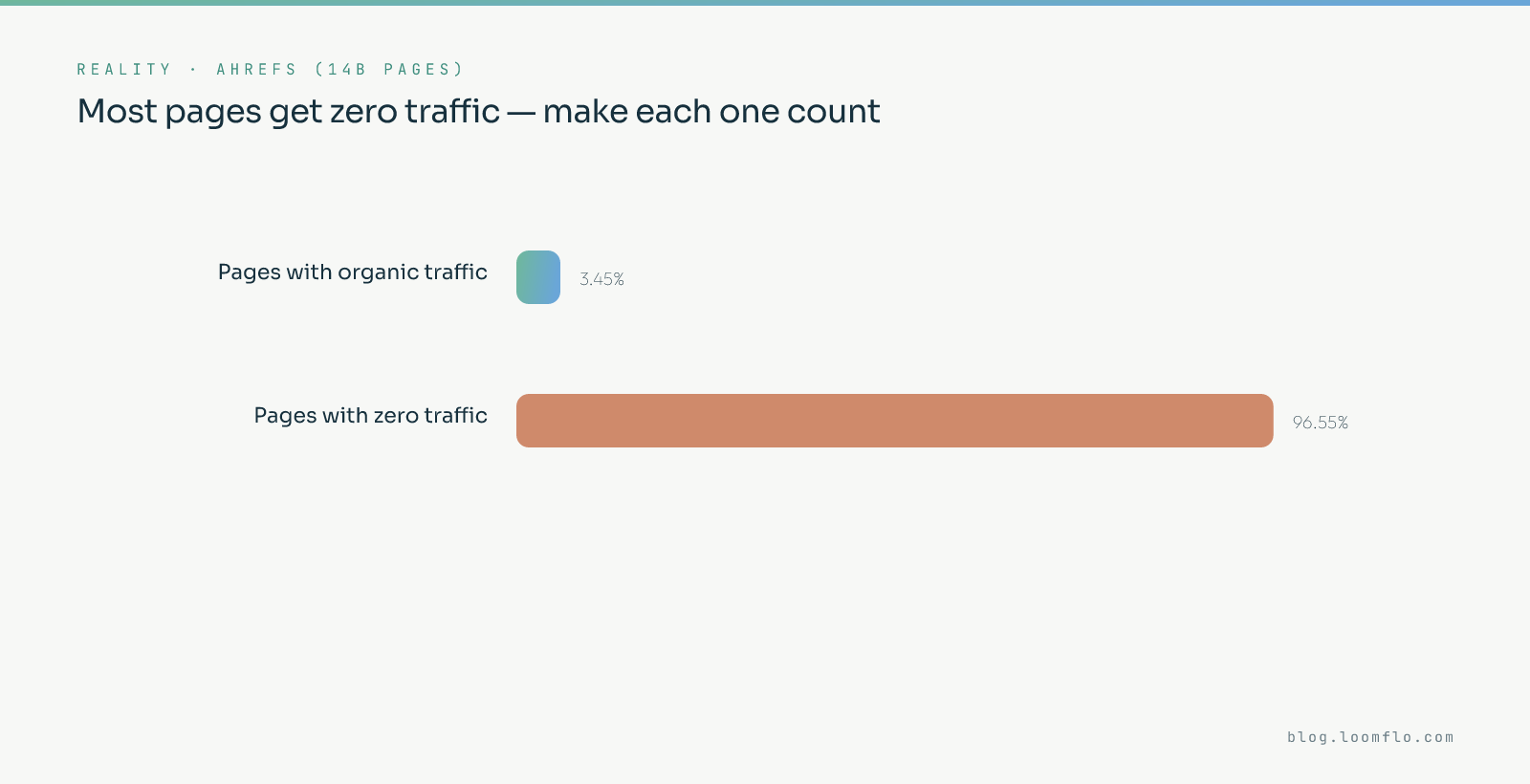
That is the trap of scale. Generating pages is easy, but generating pages that rank is not, and indexing thousands of thin, near-empty pages can drag down your whole site.
Zapier’s own data shows the edge of this. Its integration pages perform well for popular apps, but traffic collapses to zero as the app combinations get too specific and niche.
Google’s stance and the penalty risk
Programmatic SEO is allowed, but Google draws a hard line at intent. Its spam policy defines “scaled content abuse” as generating many pages primarily to manipulate rankings rather than help users, and it applies whether the pages are written by humans, AI or automation.
The penalties are real and recent. After a September 2024 exposé, Forbes Advisor was hit with a Google manual action, and analysts estimated roughly 1.7 million queries dropped or were lost.
It was not alone. Google’s late-2024 enforcement of its site-reputation-abuse policy hit major publishers including Forbes, The Wall Street Journal, Time and CNN, proof that scale and authority are no shield.
How to do programmatic SEO without getting penalised
The safe version of programmatic SEO is disciplined, not reckless. These principles keep you on the right side of Google.
1. Build on a real, hard-to-copy dataset
The durable examples all stand on a proprietary data source, Canva’s template library, Wise’s live rates, Nomad List’s city dataset. The dataset is the moat that makes each page genuinely useful.
2. Make every page add genuine value
Google explicitly flags pages that “make little or no sense to a reader but contain search keywords.” If a page would not help a human, it should not be published.
3. Don’t over-extend into the dead long tail
Past a point, pages can’t realistically earn traffic, as Zapier’s three-app combinations show. Prune or noindex the pages that will only ever bloat your index.
4. Maintain pages like living assets
Programmatic pages decay too. Ahrefs benchmarks content decay at a 20–40% drop in clicks over 8–12 weeks, so a scaled library needs scheduled refreshing, not set-and-forget.
5. Judge by value, not method
Automation is not the violation, low-value intent is. Google’s policies apply equally to AI and human pages, so a useful automated page is perfectly safe.
Programmatic SEO vs writing by hand
The economic case for programmatic SEO is simple. Manual SEO content runs roughly $1,000 to $10,000 per project (per Backlinko’s survey of 300+ SEO professionals), which makes covering thousands of long-tail terms by hand impossible.
Programmatic SEO solves the coverage problem, but only if quality control scales with it. This is exactly where automation plus human guardrails, the model behind our closed-loop SEO engine, earns its keep.
It also pairs with the newer answer-engine layer. Pages built to be genuinely useful are the same ones that get pulled into AI answers, as covered in our AEO vs SEO guide.
When programmatic SEO makes sense
Programmatic SEO is powerful, but it is not for every site. It fits when you have a repeatable search pattern and the data to fill it.
It works best for large sets of similar queries, locations, products, comparisons, integrations, conversions. Each follows the same structure with different data.
It works worst for topics that need depth and nuance. A complex how-to guide cannot be templated, and trying to mass-produce it just creates thin pages.
So the test is simple. If you can describe the page as a formula, “[tool] integration with [tool]” or “cost of living in [city]”, it’s a fit.
How to build a programmatic SEO project
A real project runs in a clear sequence. Skipping the early steps is what produces thin-content failures.
1. Find the keyword pattern
Identify a repeatable search with real demand across many variations. The pattern, not a single keyword, is the opportunity.
2. Source the dataset
Gather the structured data that fills each page, and ideally own a source competitors can’t copy. The dataset is the durable advantage.
3. Design one strong template
Build a single page layout that genuinely answers the query, with useful data, not just a keyword swapped into boilerplate.
4. Generate and internally link
Produce the pages and connect them with internal links so authority flows across the set. Good linking also helps search engines discover them.
5. Monitor, prune and refresh
Track which pages earn traffic, prune the ones that can’t rank, and refresh the winners as intent shifts.
How to find a dataset for your pages
The dataset is where most projects live or die. The strongest sources are ones you already own or can build.
Your own product data is the best starting point, integrations, templates, listings, prices. It is unique to you and naturally useful.
Public and licensed datasets work only when enriched. Raw public data is easy to copy, so add your own analysis, structure or commentary to make each page worth visiting.
User-generated and community data compounds over time. Reviews, listings and contributions create pages that get richer as your audience grows.
Where AI fits in programmatic SEO
AI changes the economics of the “value” problem. The old knock on the technique was that templated pages felt thin, AI can now write a unique, useful summary for each one.
Used well, AI enriches each page with original, on-brand context rather than boilerplate. That is the difference between a page that ranks and a page that bloats your index.
But the guardrails still apply. AI-written pages are judged exactly like human ones, so editorial standards matter more at scale, not less.
Metrics that tell you it’s working
Judge a programmatic project on quality of traffic, not page count. A big index is not a goal, earning traffic is.
- Indexation rate — what share of your pages Google actually indexes. A low rate signals thin or duplicate content.
- Pages earning traffic — the percentage of your set that pulls real visits, measured against that 96.55% baseline.
- Traffic per template — which patterns work, so you double down on winners and cut losers.
- Conversions — whether the long-tail traffic actually does anything, since rankings without outcomes are vanity.
- Decay — pages slipping over time, flagged early so you can refresh before they fall out.
Watch those and the project stays a controlled system. Ignore them and it becomes index bloat that quietly drags you down.
Is programmatic SEO still worth it?
Given the risks, it is fair to ask whether programmatic SEO is worth the effort in 2026. For the right site, the answer is a clear yes.
The upside is uncapped. A single dataset can power tens of thousands of pages and millions of visits, as Canva and Wise show, with no per-page writing cost.
The defensibility is real. A proprietary dataset is hard for competitors to copy, so the traffic it earns is durable rather than easily contested.
And the long tail is enormous. The specific, low-competition searches programmatic pages capture are impossible to cover by hand, which is exactly why the technique exists.
The catch is that the bar has risen. With Google penalising thin content and most pages earning nothing, sloppy execution is now a liability, not a shortcut.
So the verdict is conditional. Build on a real dataset, add genuine value to every page, and maintain the set — do that, and it stays one of the highest-leverage plays in search.
Frequently asked questions
Is programmatic SEO against Google’s rules?
No, programmatic SEO is allowed. What Google penalises is “scaled content abuse”, generating pages mainly to manipulate rankings rather than help users regardless of whether they are made by humans or automation.
Does it still work in 2026?
Yes, and major sites like Canva and Wise prove it at scale. But with 96.55% of pages getting zero traffic, it only works when each page is genuinely useful and built on a real dataset.
How many pages can I create?
There is no fixed limit, from hundreds to tens of thousands, depending on your dataset. The constraint is value, not volume: only create pages that can realistically rank and help a reader.
What’s the biggest risk?
Publishing thin, near-empty pages at scale, which can trigger a penalty and drag down your whole site. The fix is a strong dataset, genuine per-page value, and pruning pages that can’t rank.
How much traffic can it generate?
Potentially enormous, Canva pulls over 100 million monthly visits and Wise around 60 million from programmatic pages. But results depend on the dataset and per-page value, not the page count alone.
Do I need to be a developer?
It helps, but no-code and AI tools have lowered the barrier significantly. The harder part is sourcing a quality dataset and ensuring each page genuinely helps a reader.
How is programmatic SEO different from regular SEO?
Regular SEO optimises pages one at a time, while programmatic SEO generates many pages from a dataset and template at once. The strategy is the same; the scale and method differ.
Can AI write these pages?
Yes, and it increasingly does, AI can turn structured data into a unique, useful summary per page. Just hold AI pages to the same value bar, since Google judges them identically.
How long does it take to show results?
Expect months, not weeks. Pages need to be indexed and earn trust, and like all SEO, programmatic results compound gradually rather than spiking on launch.
Where should I start with a programmatic project?
Begin with one clear keyword pattern and a dataset you already own or can build. Prove it works on a few hundred pages before scaling to thousands.
Scale content the safe way
Loomflo’s HEO system scales content with human editorial guardrails, so you grow coverage without the thin-content risk. First articles live in 30 days, or you don’t pay.