AEO vs SEO is no longer an either/or choice. SEO gets you ranked in a list of blue links.
AEO (AI answer engine optimization) gets your content quoted inside the single answer that ChatGPT, Gemini, Perplexity and Google’s AI Overviews hand the user. Pew Research found that when an AI summary appears, users click a traditional result just 8% of the time, about half the rate of a normal search.
The two channels are different games with different rules, and in 2026 you need to win both. Loomflo calls the combined system HEO (Hybrid Engine Optimization).
For twenty years, “getting found online” meant one thing: ranking on Google. You optimised pages, earned backlinks, climbed to position one, and collected the click.
That game still exists, but it is no longer the only game. A fast-growing share of your buyers now type their question into ChatGPT, Gemini, Perplexity, or Google’s AI Overviews and never see ten blue links at all.
They get one synthesised answer, assembled from a handful of sources the AI decided to trust.
The scale of this shift is no longer theoretical. Google’s AI Overviews crossed 2 billion monthly users by mid-2025, according to figures Alphabet shared on its earnings calls (reported by TechCrunch).
ChatGPT reached an estimated 800 million weekly active users in October 2025. And Gartner has predicted that traditional search engine volume will fall 25% by 2026 as people shift queries to AI assistants.
If your business is not one of the sources these engines trust, you are invisible on the fastest-growing surface in search, no matter how well you rank on the classic results page.
That is the problem AI answer engine optimization solves, and it is why the AEO vs SEO conversation has become essential, the old “SEO is all you need” mindset needs an upgrade.
What is AEO (AI answer engine optimization)?
AI answer engine optimization (AEO) is the practice of structuring your content so that AI answer engines, ChatGPT, Gemini, Perplexity, Claude, and Google AI Overviews, quote it and cite it as a source when they generate an answer. Instead of competing for a ranked position on a results page, you are competing to be one of the few sources an AI model synthesises its answer from.
You will also hear this called GEO (Generative Engine Optimization). The labels differ; the goal is identical: be the source the machine trusts enough to repeat.
And this is not marketing hype, it is a studied discipline. In the peer-reviewed paper “GEO: Generative Engine Optimization” (Aggarwal et al., presented at KDD 2024), researchers from Princeton, Georgia Tech, IIT Delhi and the Allen Institute for AI tested optimisation tactics across a 10,000-query benchmark and showed that the right methods can boost a source’s visibility in AI-generated answers by up to 40%.
What is SEO (search engine optimization)?
Search engine optimization (SEO) is the practice of improving your pages so they rank higher in a traditional search engine results page, the ranked list of links you get from Google or Bing. It rewards keyword relevance, content quality, page experience, and the authority signalled by backlinks.
The prize is a click: the user sees your link, chooses it, and lands on your site.
SEO is not going away, and the numbers say so. Organic search still drives the majority of trackable website traffic, BrightEdge’s widely-cited channel research put it at 53% of all site traffic (versus roughly 15% for paid search).
Ranking well remains one of the highest-ROI channels in marketing. But it now describes only half of how people discover answers.
AEO vs SEO: the key differences
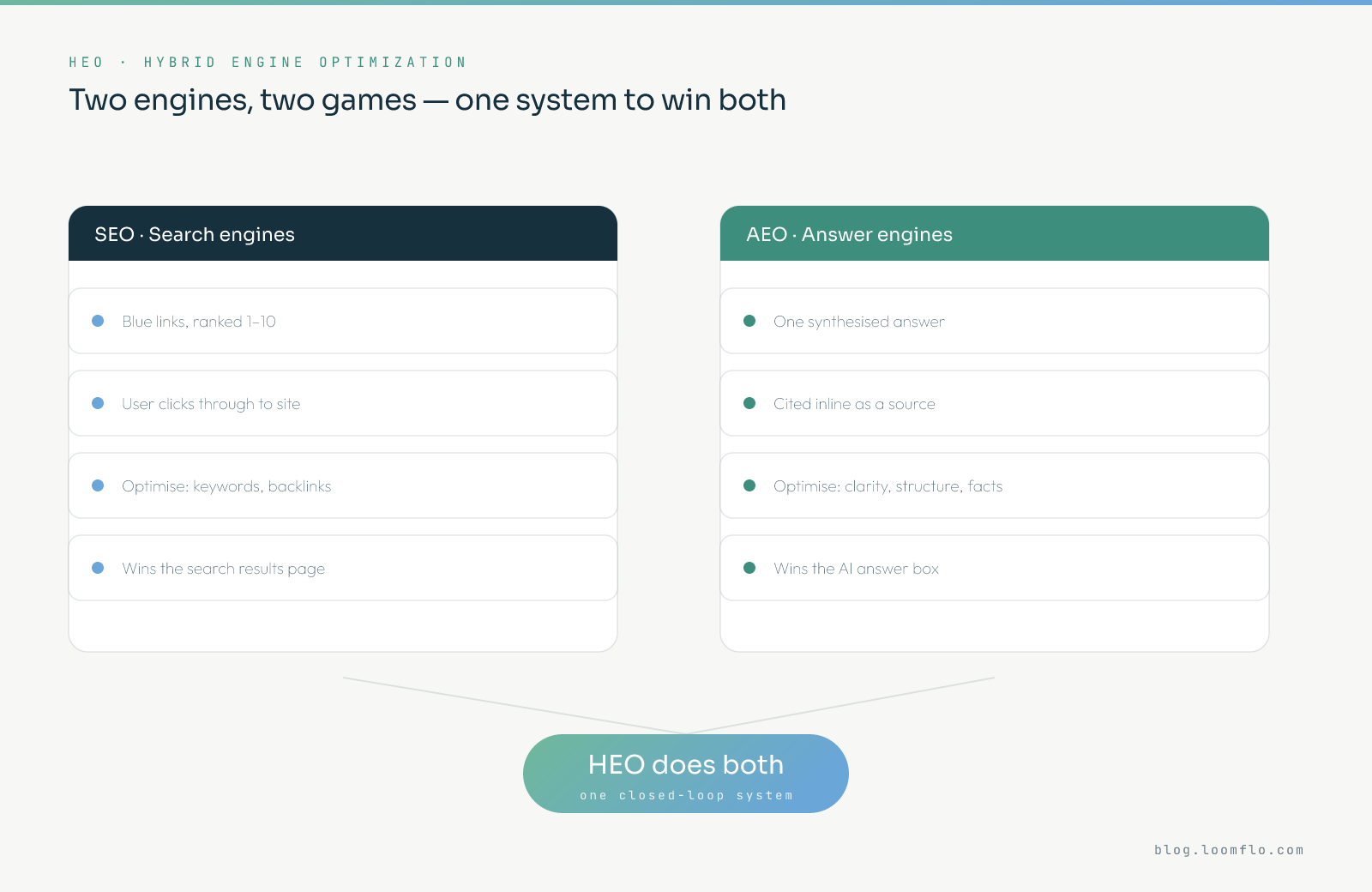
AEO vs SEO is not a turf war, the two disciplines overlap, but they optimise for fundamentally different moments. Here is how they compare:
- The output. SEO competes for a ranked list of links. AEO competes to be quoted inside a single, synthesised answer.
- The win condition. SEO wins the click. AEO wins the citation, your brand named as the source, often before any click happens.
- What gets rewarded. SEO rewards keywords, backlinks, and page authority. AEO rewards clarity, factual precision, clean structure, and content a language model can extract a confident answer from.
- The unit of content. SEO thinks in pages. AEO thinks in passages, the specific paragraph, list or statistic an engine can lift cleanly.
- How you measure it. SEO tracks rankings, impressions, and organic clicks. AEO tracks citations, brand mentions inside AI answers, and referral traffic from AI tools.
SEO is about being findable. AEO is about being quotable.
You need both, because the same buyer now uses both.
The data: why clicks are leaking out of search
The most important shift AEO responds to is the rise of the zero-click answer, the user gets what they need without visiting any website. A 2025 Pew Research Center study of nearly 69,000 searches by US adults quantified it precisely:
- When a Google AI Overview appeared, users clicked a traditional search result in just 8% of searches, nearly half the 15% click rate on searches without one.
- Users clicked a link inside the AI summary in only 1% of visits.
- People ended their browsing session entirely after 26% of visits to a page with an AI summary, versus 16% without.
- Around 18% of all searches already returned an AI summary as of March 2025, and 88% of those summaries cited three or more sources.
Read those last two numbers together and the strategy writes itself. Nearly one in five searches now produces an AI answer, and almost all of those answers name multiple sources.
Visibility is no longer just about ranking, it is about being one of the sources that gets cited. That is precisely the job AEO does.
Semrush’s analysis of more than 10 million keywords found AI Overviews showing up for as much as a quarter of tracked queries at their 2025 peak before settling around 16%, so the surface is large and still volatile.
Why ranking #1 doesn’t guarantee an AI citation
Here is the finding that ends the “good SEO is enough” argument. When Ahrefs studied the overlap between pages cited by AI assistants and pages ranking in Google’s top 10, it found that only about 12% of AI-cited URLs also ranked in the top 10 for the original prompt.
Roughly 80% of AI citations didn’t rank anywhere near the top of Google for that query.
In other words, the two systems pick winners differently. Ahrefs’ separate study of 75,000 brands found that branded web mentions were the single strongest predictor of AI Overview citations, far ahead of classic SEO metrics like domain rating, which correlated only weakly.
AI engines reward being talked about, structurally clear, and factually quotable. Classic search rewards authority and links.
The overlap is real but partial, which is exactly why you need a strategy for each, run as one system.
Why you can’t choose one: the case for HEO
In the AEO vs SEO debate, it is tempting to treat AEO as a replacement for SEO. It is not.
The two channels feed the same funnel and reinforce each other. AI engines still lean on authoritative, well-structured pages — so strong SEO improves your odds of being cited.
And content engineered to be quotable (clear definitions, direct answers, statistics, clean structure) tends to perform better in classic search too.
Running them as two disconnected projects wastes that compounding. That is why Loomflo built HEO (Hybrid Engine Optimization): one closed-loop system that researches keywords and competitors, writes articles engineered to rank and be cited, builds the internal links and brand signals both engines reward, and continuously audits and refreshes content so you keep winning on both surfaces.
One system, two engines, zero duplicated effort.
How to optimise for AI answer engines (AEO checklist)
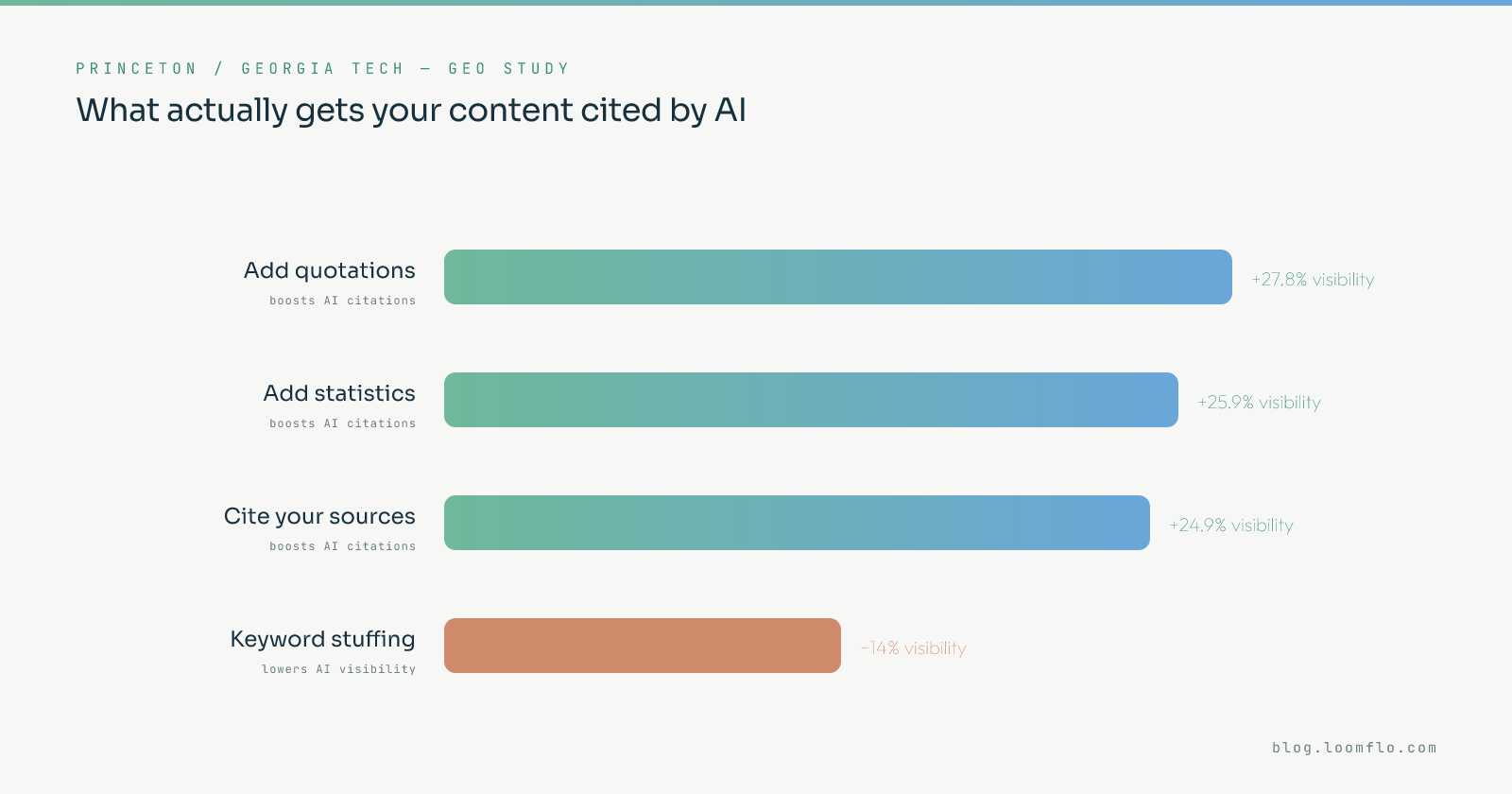
The Princeton GEO study didn’t just prove AEO works, it measured which tactics work best. The top performers were not keyword tricks.
They were adding quotations (+27.8% visibility), adding statistics (+25.9%), and citing your own sources (+24.9%). Notably, keyword stuffing actively hurt visibility.
Here’s how to apply that:
1. Answer the question in the first two sentences
Lead each section with a direct, self-contained answer before you elaborate. Answer engines lift the cleanest, most complete passage they can find, give them one.
2. Add statistics and quotations
The research is explicit: concrete numbers and credible quotations are what get content pulled into AI answers. Vague marketing copy is the first thing a model discards.
3. Cite your sources
Counter-intuitively, linking out to authoritative sources raises your citation odds, it signals trustworthiness to the model. (This article does it on purpose; see the Sources list below.)
4. Use clear, literal structure
Descriptive headings phrased as questions, short paragraphs, bullet lists, and tables. Structure is how a model knows which passage answers which question.
5. Build brand mentions, not just backlinks
Since branded mentions are the strongest predictor of AI citations, getting talked about across the web, podcasts, communities, YouTube, press — now directly feeds your AI visibility.
6. Keep content fresh
AI engines favour recent, maintained sources. Content that is audited and updated on a schedule stays eligible to be cited; content that rots quietly drops out.
Is the AEO traffic even worth it?
A fair objection: if AI answers reduce clicks, is the remaining traffic valuable? The data says yes, disproportionately.
Similarweb reported that AI platforms drove over 1.13 billion referral visits in June 2025, up 357% year over year, and that ChatGPT referral traffic converted at 7.1%, second only to paid search and ahead of organic, social, and email. AI sends fewer clicks, but the people who do click arrive with intent already formed by the answer that cited you.
Being the cited source is the new top of the funnel.
How AEO and SEO work together in practice
The AEO vs SEO question is ultimately a false choice. A single well-built article should do double duty.
The same page can rank on Google for its target keyword and get pulled into a Perplexity answer or an AI Overview, if it is keyword-relevant, authoritative, clearly structured, and factually tight. You are not building two content libraries; you are building one library engineered to satisfy both readers and the machines that summarise for them.
The businesses that win the next few years will be the ones that stopped treating AEO vs SEO as separate projects and ran them as a single compounding system.
Frequently asked questions
Is AEO replacing SEO?
No. AEO is expanding search, not replacing it. Organic search still drives the majority of web traffic, and AI engines rely on many of the same authority signals SEO builds.
But because only ~12% of AI-cited pages also rank in Google’s top 10 (Ahrefs, 2025), you can’t assume good rankings alone will get you cited. The right strategy runs both together.
What’s the difference between AEO and GEO?
They describe the same discipline. AEO (answer engine optimization) and GEO (generative engine optimization) both mean optimising content to be cited inside AI-generated answers.
Loomflo unifies AEO and SEO under one system called HEO.
How do I get my content cited by ChatGPT or Google AI Overviews?
Per the Princeton GEO research, the highest-impact tactics are adding statistics, adding quotations, and citing credible sources — alongside leading with direct answers, clear structure, and building brand mentions across the web. In short: make your content the easiest, most trustworthy passage for a model to quote.
How long does AEO take to show results?
Like SEO, it compounds rather than spikes. Structural and authority improvements can begin surfacing in AI answers within weeks, but the durable gains come from a consistent, audited content system run over months.
Win Google and the AI answer box with one system
Loomflo’s HEO system researches, writes, links, audits and refreshes content so you rank on Google and get cited by AI engines — on autopilot. Your first articles go live in 30 days, or you don’t pay.
Related reading: Can You Automate SEO? Inside a Closed-Loop Content Engine.