Can you automate SEO? Yes, you can automate SEO research, drafting, internal linking, auditing and refreshing, but not as a pile of disconnected tools.
Most sites lose 20–30% of their organic clicks every six months to content decay (Siege Media), and 86% of SEO professionals now use AI in their workflow (Aira, 2025). The real unlock is a closed-loop SEO automation engine where every stage feeds the next and the system improves itself.
That loop is what Loomflo’s HEO system runs for you.
“Can you automate SEO?” is the wrong question. The honest answer is: yes, you can automate most of the work, but automation only pays off when the pieces are connected into a loop instead of scattered across a dozen tools.
A keyword tool here, an AI writer there, an audit plugin somewhere else, that is not automation, it is a manual workflow with extra tabs open.
And the case for automating is no longer fringe. McKinsey’s global survey found 65% of organisations now regularly use generative AI, with marketing and sales seeing the biggest jump in adoption, and McKinsey separately estimates that around 75% of generative AI’s total value lands in just four areas, marketing and sales among them.
Within SEO specifically, Aira’s 2025 State of SEO report found AI usage among professionals jumped from 65% to 86% in a single year. The industry has already decided.
The only real question is whether your automation is a connected system or a pile of parts.
What is SEO automation?
SEO automation is the use of software and AI to perform recurring SEO tasks, keyword research, content production, internal linking, technical audits, and content refreshes, with minimal manual effort, so organic rankings grow without a person doing the busywork by hand. Done well, it turns SEO from a series of one-off projects into a system that runs continuously.
The key word is recurring. SEO is not a launch; it is a treadmill.
Keywords shift, competitors publish, pages decay, and Google re-ranks constantly. Automation earns its keep precisely because the work never stops.
The problem automation actually solves: content decay
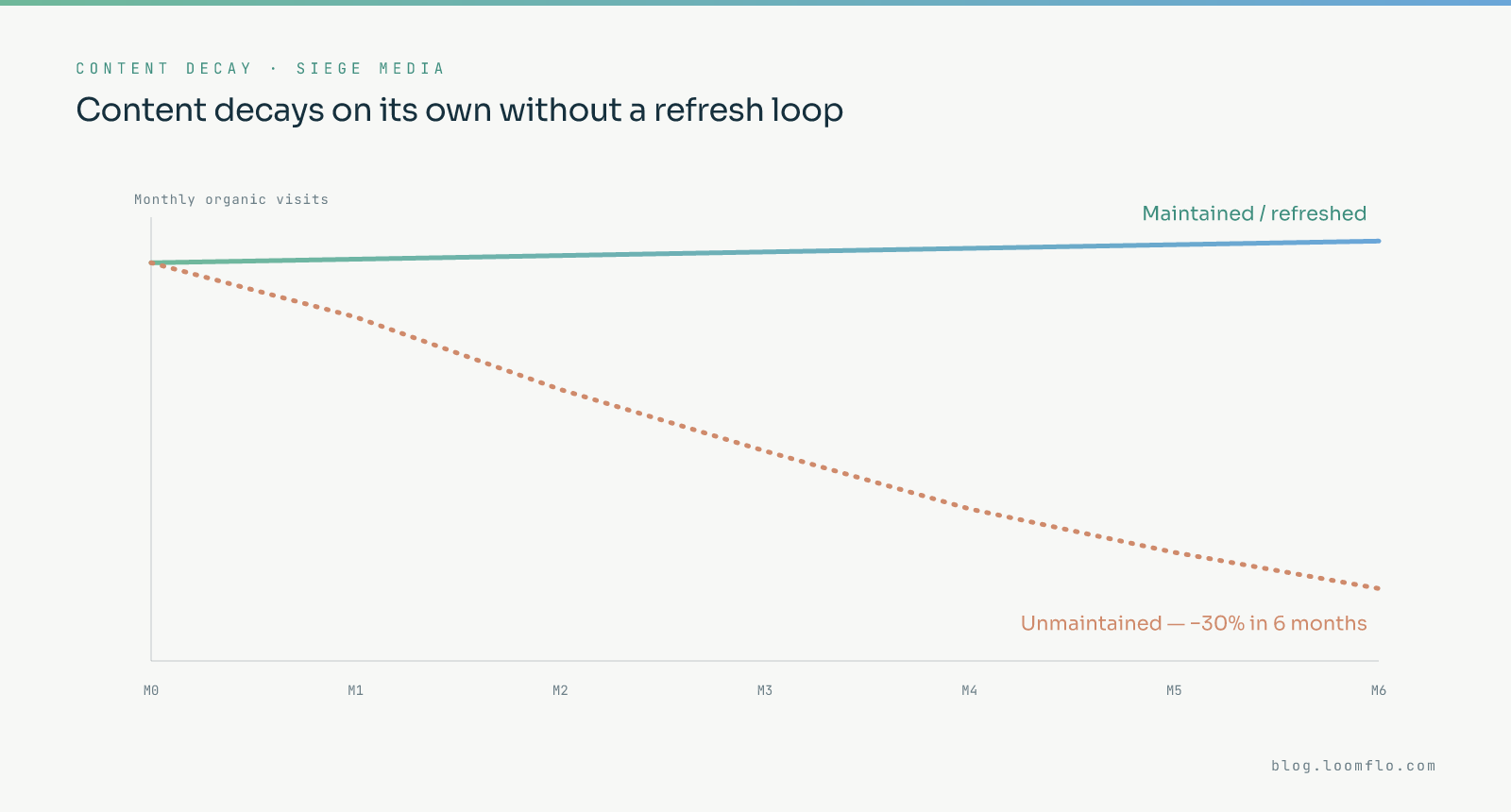
Here is the reality most “publish and forget” content strategies ignore: traffic decays on its own. Siege Media’s data study found that most websites lose 20–30% of their organic clicks every six months when content isn’t maintained, a page pulling 2,500 monthly visits can quietly fall to ~1,600 within half a year.
Left alone, your library doesn’t hold steady; it bleeds.
The same study quantified the cadence required to stay on top. Across 17,800+ keywords, page-one content for competitive terms had typically been updated within the last two years, and for fast-moving categories far sooner (e.g. “best software” pages refreshed roughly every 143 days).
No human team can reliably re-update thousands of pages on a 143-day cycle. A system can.
And refreshing works. Ahrefs documented a ~302% traffic uplift after rewriting and republishing a single post, and a 36% organic lift on another after an update.
The “refresh” half of the loop isn’t housekeeping, it’s one of the highest-ROI moves in SEO. The catch is that it has to happen continuously, which is exactly what automation is for.
What it takes to automate SEO at scale
Most of it — when you connect the stages. Here is the honest breakdown:
- Keyword & competitor research — highly automatable. Software surfaces opportunities, gaps, and intent at a scale no human can match manually.
- Content drafting — largely automatable, with editorial guardrails. AI produces structured, keyword-aligned drafts; quality control and brand voice still need a system around them.
- Internal linking — automatable. Software maps and builds the link structure that distributes authority across your pages.
- Technical & content audits — automatable. Continuous crawling flags decay, thin pages, and ranking drops far faster than periodic manual reviews.
- Content refreshes — automatable. The system detects slipping pages and updates them before they fall out of the rankings.
- Strategy & brand judgment — not fully automatable, and shouldn’t be. The engine handles execution; humans set direction and standards.
Why teams are drowning in manual SEO work
The need for automation shows up clearly in how SEO teams spend their week. A Conductor survey of SEO professionals found their most time-consuming tasks were routine and repeatable, briefing copywriters (~12.6 hrs/week), building reports (~12.2 hrs/week), and coordinating teams (~12.1 hrs/week), and that two-thirds (66%) said they don’t have enough time for the strategic work that actually drives profit.
Separately, B2B content marketers report spending an average of 33 hours a week, about 82% of their working hours, on content creation alone (Casted).
The bottleneck in SEO isn’t ideas, it’s the human hours swallowed by briefing, drafting, reporting and updating. That’s exactly the layer a closed-loop engine removes.
The problem with “tool-stack” automation
Most teams try to automate SEO by buying tools. They end up with a research tool, a writing tool, an audit tool, and a linking tool, none of which talk to each other.
The Aira data backs this up: the average enterprise SEO team now juggles 4.2 different AI tools. A human still has to carry data between them, decide what to act on, and remember to do it again next month.
That is not a system; it is a part-time job with a software bill.
What a closed-loop SEO engine looks like
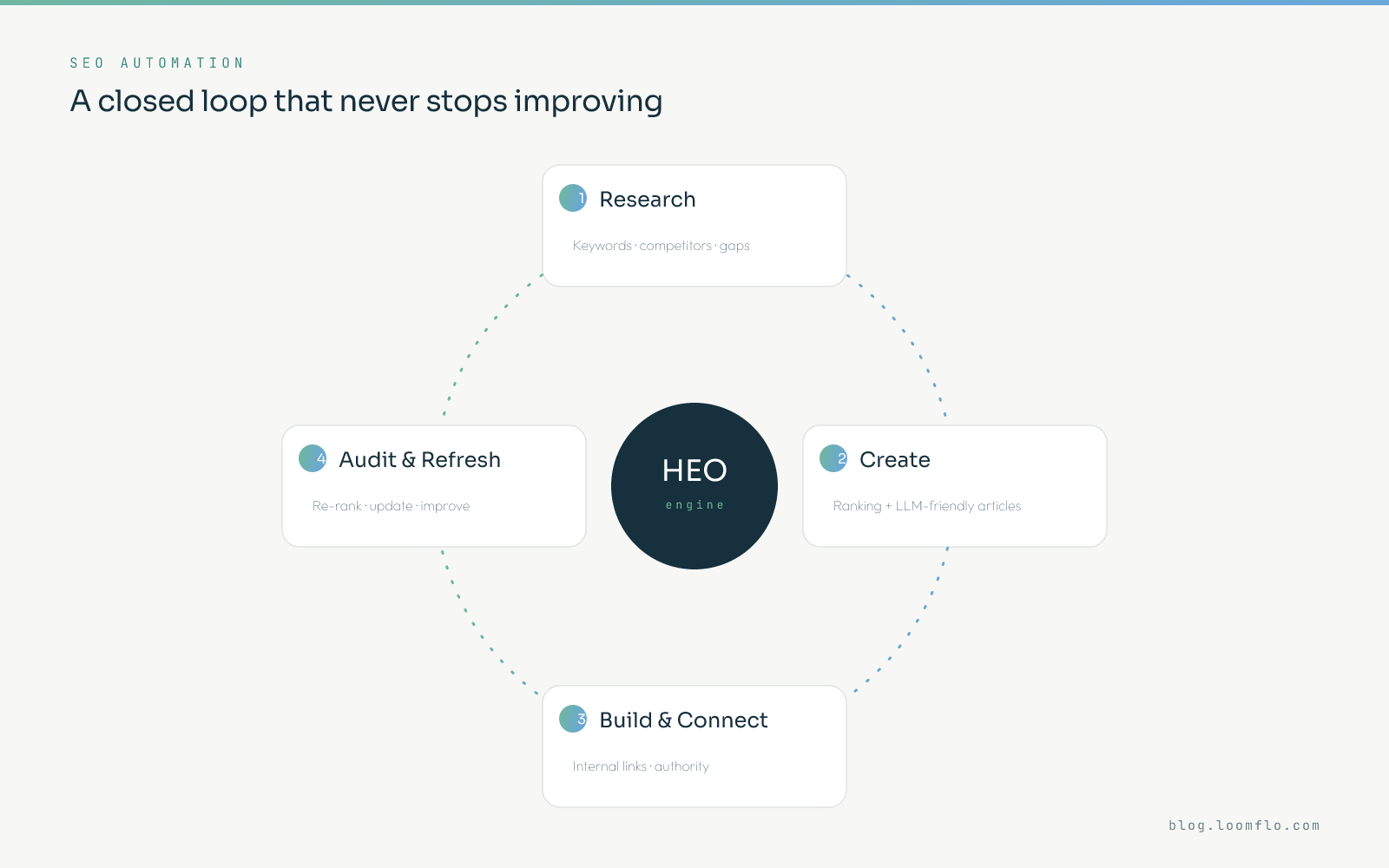
A real engine connects four stages into a cycle, and the cycle never stops:
1. Research
The system continuously mines keywords, competitor coverage, and content gaps, deciding what to write next based on live opportunity, not a static spreadsheet from last quarter.
2. Create
It produces articles engineered to rank and to be cited by AI engines, structured, on-brand, and aligned to real search intent. (For why “cited by AI” now matters, see our guide on AEO vs SEO.)
3. Build & Connect
New content is woven into your site’s internal link structure and supported with authority signals, so every page lifts the others instead of standing alone.
4. Audit & Refresh
The system monitors rankings, detects decay (those 20–30% six-month drops), and feeds what it learns back into research, refreshing pages that slip and doubling down on what works. The output of stage four becomes the input to stage one.
That is the loop.
Does volume actually move the needle? The data says yes
A closed loop doesn’t just maintain content, it lets you publish consistently at a volume manual teams can’t sustain, and consistency compounds. HubSpot’s benchmark study found that companies publishing 16+ blog posts per month generated roughly 4.5× more leads and 3.5× more traffic than those publishing four or fewer.
Businesses with blogs generate 67% more leads than those without. (Both are long-standing HubSpot benchmarks rather than current-year data, but the directional finding, more consistent publishing drives more demand, is well established.)
Automation is what makes that volume realistic. Programmatic SEO already operates at a scale that’s simply impossible by hand: Zapier has built 25,000+ template pages, Canva 30,000+, and G2 over 100,000 pages.
One documented case study produced 735 posts in about 25 hours of work, nearly 29 posts an hour. The point isn’t to spam; it’s that a connected system removes the production ceiling so your strategy, not your headcount, sets the pace.
A necessary caveat: automation needs quality guardrails
Automation is not a licence to flood the web with thin content. Google’s helpful-content systems reward genuine usefulness and punish low-value output, and there are public cautionary tales of sites losing large chunks of organic traffic after scaling low-quality pages.
That’s why the “Create” stage of a real engine keeps editorial standards and human direction in the loop. The goal is to automate the busywork, not the judgment.
Why the loop beats the checklist
A linear SEO checklist is done the moment you finish it, and immediately starts going stale. A closed loop is never “done.” It compounds: every cycle, the engine knows more about what ranks for you, prunes what doesn’t, and reinvests in what does.
Over months, that feedback advantage is the difference between content that quietly decays at 20–30% every six months and traffic that keeps climbing.
What SEO automation actually returns
Automation is only worth it if it moves revenue, and the content data supports the case. The Content Marketing Institute found that 58% of B2B marketers said content marketing increased their sales or revenue, and Semrush reports that 68% of businesses saw higher content-marketing ROI after adopting AI.
The mechanism is simple: automation lets you produce more of the content that already pays back, maintain it so it doesn’t decay, and reinvest human time into the strategic work that 66% of SEO teams say they currently can’t get to.
To know whether your engine is working, watch four numbers rather than vanity metrics:
- Indexed, ranking pages over time — is the library growing and holding position, or just growing?
- Decay rate — what share of pages lost traffic this quarter, and how fast were they caught and refreshed? (Remember the 20–30% per-six-months baseline.)
- Refresh velocity — how many pages were updated, and what lift did the updates produce? Ahrefs’ 36–302% refresh uplifts are the benchmark to chase.
- Assisted conversions / pipeline — is organic content contributing to leads and revenue, not just sessions?
A realistic 90-day rollout
A closed-loop engine isn’t a switch you flip; it’s a system you stand up. In practice the first quarter looks like this:
- Weeks 1–2 — Research & audit. The system maps your existing content, finds decay and gaps, and builds a prioritised keyword and topic plan from live opportunity.
- Weeks 3–6 — Create. The first batch of articles ships, structured to rank and to be cited by AI engines, with human editorial sign-off on voice and accuracy.
- Weeks 5–10 — Build & connect. New and existing pages are internally linked into topic clusters, concentrating authority where it counts.
- Weeks 8–12 — Audit & refresh kicks in. The first ranking data comes back, the system flags early movers and early decay, and the loop closes, feeding what it learned into the next research cycle.
By the end of the quarter you don’t have “some content”, you have a running engine that gets smarter every cycle. That’s the difference between buying SEO work and owning SEO infrastructure.
Frequently asked questions
Can SEO be fully automated?
Execution can be almost fully automated, research, drafting, linking, auditing, and refreshing. Strategy and brand judgment should stay human.
The best setups automate the busywork and keep people on direction and quality. With 86% of SEO pros already using AI (Aira, 2025), partial automation is now the norm.
Does automated SEO content rank?
Yes, when it’s genuinely useful, well-structured, and quality-controlled. Google rewards helpful content regardless of how it was produced, and penalises thin, spammy output, which a closed-loop system with editorial guardrails is built to avoid.
Is SEO automation the same as an AI writing tool?
No. An AI writer automates one stage, drafting. SEO automation connects research, creation, linking, auditing, and refreshing into a system.
The writing tool is one component, not the engine, and the average team already runs 4+ disconnected AI tools, which is the problem a loop solves.
How is this different from hiring an agency?
A traditional agency runs campaigns and bills hours. A closed-loop engine runs continuously as infrastructure, compounding without proportional labour.
(More on that distinction in Campaigns vs Infrastructure.)
Put your SEO on autopilot
Loomflo’s HEO system is the closed loop described above, research, create, connect, audit and refresh, running for you continuously, with human editorial standards built in. First articles live in 30 days, or you don’t pay.