AI video marketing uses AI to script, generate, edit, caption and repurpose video, so you can meet the huge demand for video without a studio or a big team. 82% of marketers say video delivers good ROI (Wyzowl), and 63% of video marketers already use AI tools to make it.
Video is the content format audiences want most and the one teams produce least. The gap is not a lack of ideas, it is the cost and effort of production.
AI video marketing closes that gap. This guide covers why video matters, how AI now handles the hard parts, and how to scale it without losing the authenticity that makes video work.
What is AI video marketing?
AI video marketing is the use of AI across the video process, scripting, generating presenters and voiceovers, editing, captioning, and repurposing long clips into many short ones, to create and scale video content efficiently. It removes the camera, studio and editing bottlenecks that cap most teams.
It is already mainstream. Wyzowl found 63% of video marketers have used AI video tools to help create or edit their marketing videos.
Why video marketing matters
The demand for video is not in question. Wyzowl found 91% of businesses use video and 89% of people want to see more video from brands.
And it converts. 82% of marketers say video gives good ROI, 83% say it increased sales, and 85% say it helped generate leads (Wyzowl).
The problem has always been supply, not demand. Audiences want more video than manual production can deliver, which is exactly the gap AI fills.
How AI is used across video marketing
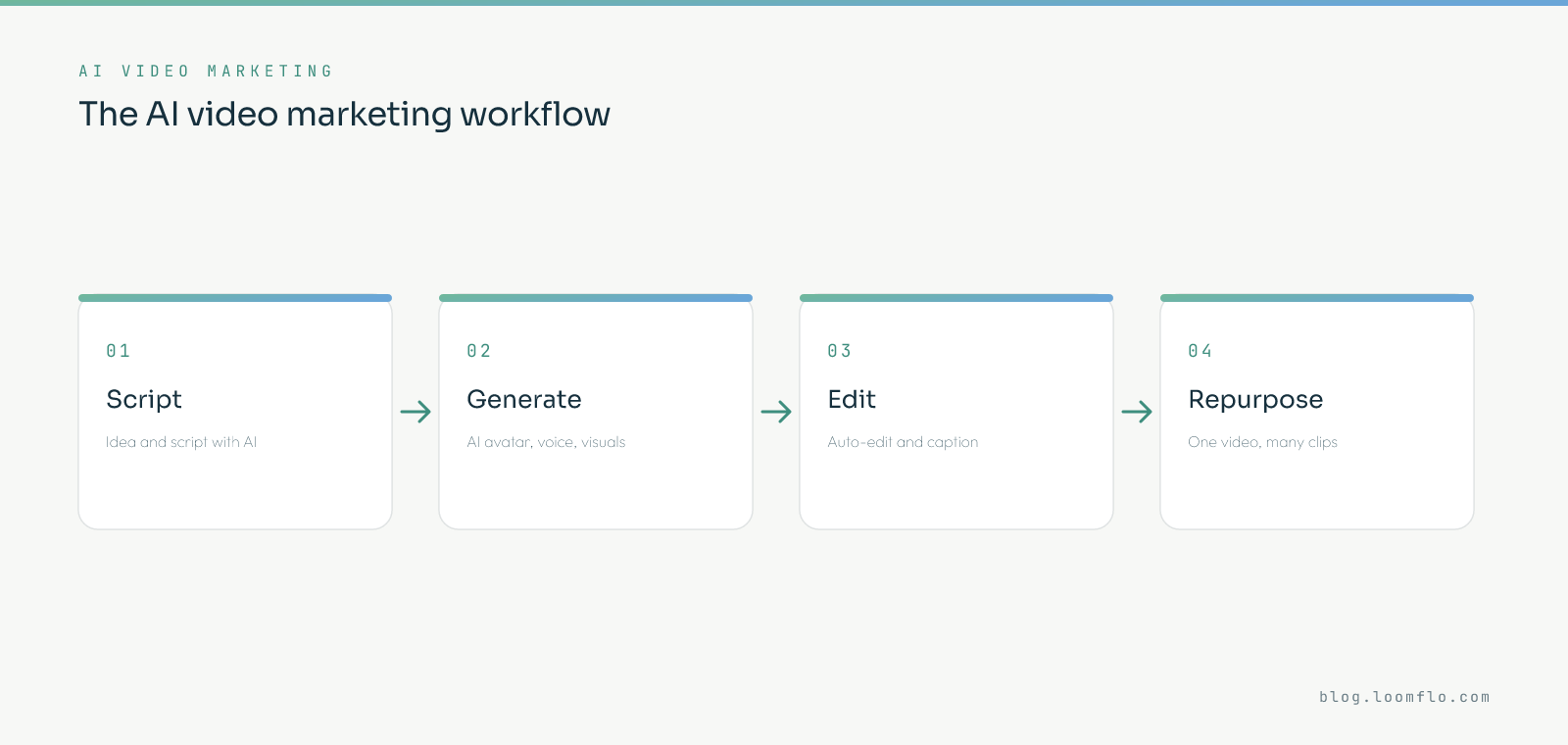
AI now touches every stage of the video process. Each step that used to need a specialist can be accelerated or automated.
1. Scripting and ideas
AI turns a topic into a tight, on-brand script in seconds. It removes the blank-page problem that stalls most video plans.
2. Generation
AI avatars and voices can present a script without a camera, studio or presenter. This is the single biggest unlock for teams that can’t or won’t film.
3. Editing and captions
AI auto-edits footage and adds captions automatically. Captions matter because most social video is watched on mute, so this step is non-negotiable.
4. Repurposing
AI clips one long video into many short ones for every platform. This is the highest-leverage move, since short-form is both the most-used format and the highest-ROI one (HubSpot).
AI video adoption is surging
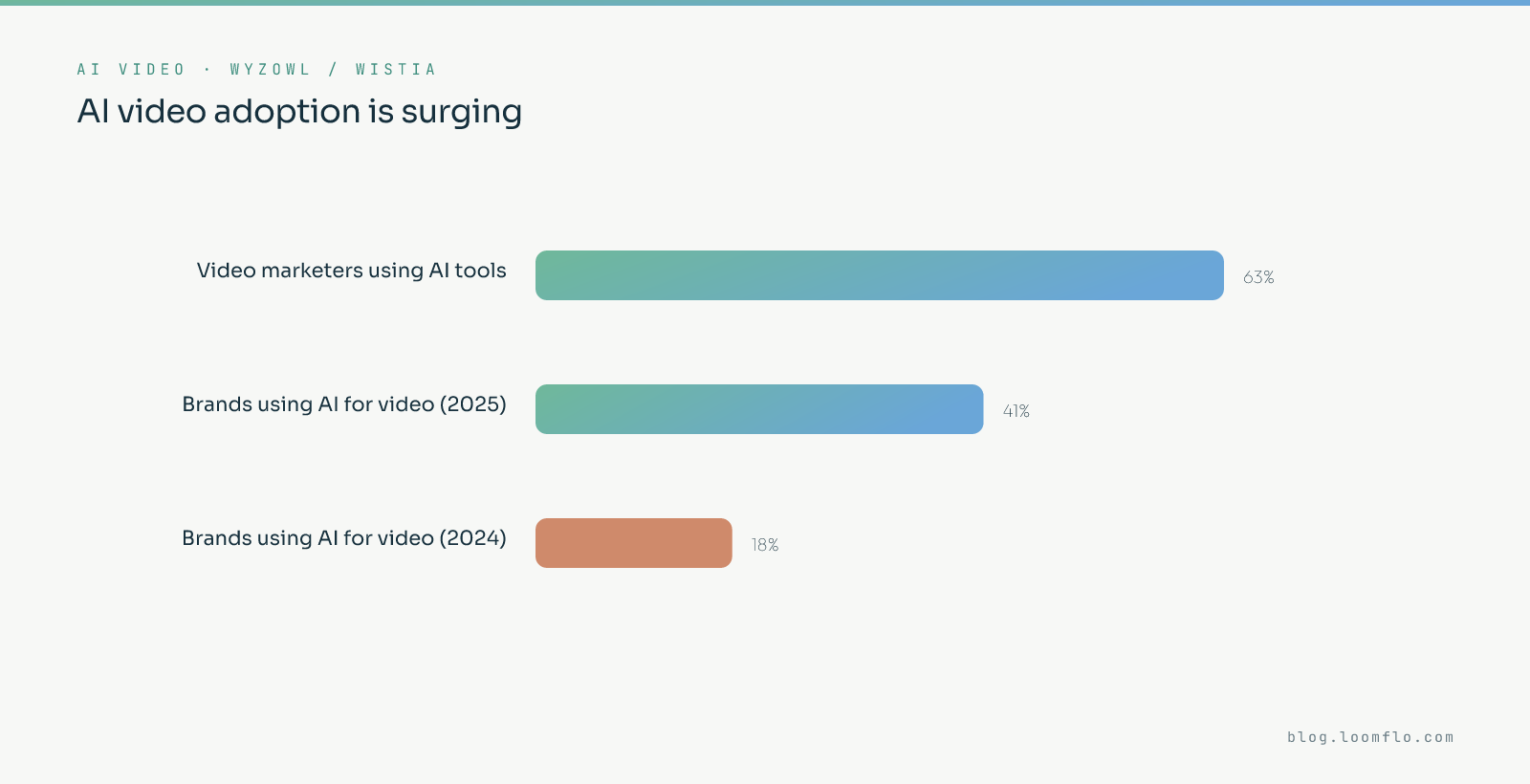
The shift from “experimental” to “standard” has been quick. Wistia’s analysis of millions of videos found 41% of brands now use AI for video, up from 18% the year before.
The tooling market reflects that momentum. Grand View Research valued the AI video generator market at $555 million in 2023, projected to reach nearly $2 billion by 2030 at a ~20% CAGR.
And the savings are concrete. In Synthesia case studies, Zoom created training videos around 90% faster, and Cohesity saved roughly $100,000 in production costs.
Authenticity beats polish
Here is the insight that makes AI video work in your favour. You do not need it to look cinematic.
HubSpot found consumers say it is more important that brands post authentic, relatable content than polished, high-production content. That lowers the bar AI output has to clear.
It also explains why short-form wins. HubSpot found 73% of consumers prefer short-form video to learn about a product, and that it delivers the highest ROI of any video format.
How to do AI video marketing well
The teams getting results follow a clear set of habits. Most are about strategy, not technology.
1. Lead with value, not production
Teach something useful in every clip, because relatable content outperforms polished content. The point is the message, not the gloss.
2. Prioritise short-form and repurpose
Turn one long asset into many short clips, since short-form is the most-used and highest-ROI format. This is where AI repurposing earns its keep.
3. Always add captions
Caption everything, because most social video is watched on mute. AI auto-captions make this effortless and lift comprehension.
4. Stay on-brand and consistent
Keep a consistent voice, presenter and style so your videos compound into a recognisable brand. Consistency is what turns scattered uploads into reach.
5. Be transparent about AI
Disclose synthetic media where appropriate, since consumers increasingly expect it. Deloitte argues clear disclosure protects trust as AI video scales.
6. Measure against real outcomes
Track leads, sales and engagement rather than vanity views. Tie AI video to the business results it is meant to drive.
Where AI video fits in your content system
AI video is most powerful as part of a wider content engine, not a one-off experiment. The same idea can become a video, a set of clips, a post and an email.
That multiplication is the whole point. For the faceless, no-camera version of this, see our guide on building a brand with AI avatars, and for why a consistent content system beats sporadic campaigns, Campaigns vs Infrastructure.
Done that way, AI video stops being a project and becomes infrastructure — a reliable way to meet the demand for video that audiences keep asking for.
AI video marketing use cases
AI video isn’t only for social clips. It fits anywhere video helps, which is almost everywhere.
- Social content. Short, hook-first clips for TikTok, Reels, Shorts and LinkedIn, produced daily.
- Product explainers. Clear walkthroughs that convert, 77% of people have bought after watching a brand video (Wyzowl).
- Training and onboarding. Internal and customer education at a fraction of traditional cost and time.
- Ads. Many creative variations generated and tested quickly, without a reshoot for each.
- Personalised video. Tailored messages at scale for outreach, onboarding or account-based marketing.
- Localisation. AI voiceovers and captions to take one video into many languages.
The common thread is leverage. One idea, produced once, can serve many channels and audiences.
A practical weekly AI video workflow
The leverage comes from a repeatable rhythm, not heroic effort. A realistic week looks like this.
1. Pick one core idea
Choose a single useful point, a tip, a question, a myth to bust. One clear message per video.
2. Generate the base video
Script it and produce it with an AI presenter or footage, captions included. No camera or studio needed.
3. Cut platform-native clips
Repurpose the base into short, native versions for each platform. This is the highest-leverage step.
4. Publish consistently and repurpose further
Ship on a steady schedule, and turn the script into a post and an email too. One idea, a week of presence.
Common AI video marketing mistakes
A few avoidable errors turn an advantage into noise. Most are about strategy, not tools.
- Over-producing. Chasing cinematic polish when audiences reward authenticity and clarity.
- No captions. Forgetting that most social video is watched on mute, so silent viewers miss the point.
- One-and-done. Posting a single long video instead of repurposing it into many clips.
- Generic scripts. Saying nothing original, so the video earns no attention regardless of production.
- No consistency. Sporadic uploads that never compound into a recognisable brand.
Avoid those and AI video becomes a genuine multiplier. The technology is rarely the problem, the strategy around it is.
What to look for in an AI video tool
The market is crowded, so choose by the job you need done. A few criteria separate genuinely useful tools from gimmicks.
Output quality matters most. A presenter or voice that feels stiff undermines the message, however fast it was made.
Repurposing and captioning should be built in. These are the highest-leverage features, so a tool that automates them saves the most time.
Brand control is essential too. Look for consistent styling, fonts and templates so every video reinforces your brand rather than diluting it.
And check the workflow fit. The best tool is the one your team will actually use as part of a repeatable process.
Why AI video closes the demand gap
The core problem in video has always been a mismatch. Audiences want far more video than manual production can supply.
With 89% of people wanting more brand video and most teams managing only a handful a month, the gap is enormous. AI is what finally closes it.
By making the hundredth video nearly as cheap as the first, AI turns video from an occasional project into a steady stream. Supply finally meets demand.
Frequently asked questions
What is AI video marketing?
It is using AI across the video process, scripting, generating, editing, captioning and repurposing, to create and scale video efficiently. It removes the studio and editing bottlenecks that limit most teams.
Does AI video actually perform well?
Yes, because video itself performs, 82% of marketers report good ROI and 83% say it increased sales. AI mainly removes the production barrier so you can publish more of what already works.
Do AI videos need to look professional?
Not overly. Consumers value authentic, relatable content over high production, so a clear, useful AI video can outperform a polished one.
Lead with value, not gloss.
Should I disclose that a video is AI-generated?
Where it could mislead, yes. Consumers increasingly expect disclosure and it protects trust, so be transparent about synthetic presenters or voices.
What’s the highest-leverage AI video tactic?
Repurposing — turning one long video into many short clips for every platform. Short-form is the most-used and highest-ROI format, and AI makes that multiplication nearly free.
Is AI video marketing expensive?
Far less than traditional production. AI video tools turn a per-minute cost of hundreds or thousands into a near-flat subscription, which is why brands report large savings.
Can AI make video without a presenter on camera?
Yes, AI avatars and voiceovers present your script without anyone filming. That’s the core unlock for teams that can’t or won’t appear on camera.
What’s the best type of AI video to start with?
Short-form educational clips. They’re the most-used, highest-ROI format, and AI is especially good at producing and repurposing them at volume.
Does AI video hurt authenticity?
Only if it’s used to deceive. Used transparently to deliver genuine value, it doesn’t, consumers care more about useful, relatable content than how it was made.
How often should I post AI video?
Consistently, a few times a week beats sporadic bursts. AI makes that cadence sustainable because the production cost per video stays low.
Can AI repurpose my existing videos?
Yes. AI clipping tools turn long videos, webinars and podcasts into many short, platform-native clips — one of the highest-leverage uses of all.
What AI video tools are available?
There are tools for AI avatars and voiceovers, auto-editing and clipping, captioning, and full text-to-video generation. Most teams combine a couple to cover creation and repurposing.
Will AI replace video creators?
It’s changing the role more than replacing it. AI handles production grunt work, while humans own strategy, storytelling and brand, the parts that make video worth watching.
How do I keep AI videos on-brand?
Use consistent templates, fonts, colours, a fixed presenter and voice, and a clear style guide. Consistency is what turns individual clips into a recognisable brand.
Is AI video marketing good for small businesses?
Especially so. It gives small teams the video output that used to need an agency, at a fraction of the cost, so even a solo founder can keep a real video presence.
Where should I publish AI video?
Wherever your audience is, TikTok, Reels, YouTube Shorts and LinkedIn for short-form, plus your website and emails. Repurpose one video into native versions for each.
Can AI write video scripts?
Yes, AI is strong at turning a topic into a tight, on-brand script in seconds. Give it your angle and audience, then edit for voice and accuracy.
Scale video without a camera
Loomflo’s AI Avatar Content engine generates, edits and publishes unlimited video across every platform, building your brand on autopilot, no camera required.