
AI avatars turn a single script into publish-ready video a realistic on-screen presenter, voiced and animated by AI so you can produce consistent faceless content for every platform without a camera or studio. The pull is real: 91% of businesses use video and 82% say it delivers good ROI (Wyzowl).
The blocker is real too: 52% of creators have hit burnout (Awin/Vibely). AI avatars remove the production cost that makes consistency impossible.
Short-form video is the most powerful brand-building channel available and the one most businesses quietly skip. The demand is not in doubt.
Wyzowl’s State of Video Marketing found 91% of businesses use video as a marketing tool, 82% say it gives them good ROI, 93% say it has boosted brand awareness, and 83% say it has directly increased sales. HubSpot adds that short-form video is the format consumers most prefer for discovering new products, and that 89% of consumers want to see more video from brands.
So why do most businesses still produce so little of it? The reasons are always the same: no time to film, no desire to be on camera, no studio, and no appetite for editing daily.
AI avatar content removes every one of those blockers. You write (or generate) a script; the system produces a polished video with a realistic presenter and publishes it.
No camera required.
What is AI avatar video?
AI avatar video is video content where a realistic, AI-generated presenter delivers a script on screen with an AI voice and lifelike movement so you can produce professional video without filming a real person. It’s the engine behind “faceless” content: a consistent on-brand presence you can scale to every platform without ever turning on a camera.
This isn’t an experimental category. The AI video market was around $3.86 billion in 2024 and is projected to reach $42.29 billion by 2033 (Grand View Research), a 32% CAGR.
The broader digital-avatar market is growing even faster. And it’s already trusted at the top: AI-avatar platform Synthesia surpassed $100M in annual recurring revenue with 1M+ users and over 70% of the Fortune 100 as customers.
The real problem AI avatars solve: consistency, not creativity
Here’s the insight most “post more video” advice misses. Growth on social isn’t driven by the occasional viral hit it’s driven by consistency, and consistency is a production problem, not an ideas problem.
Buffer’s analysis of more than 100,000 accounts found that regular, consistent posting earns about 5× more engagement per post than sporadic posting, and that accounts posting 3–5 times a week roughly double their follower-growth rate compared to posting once or twice.
Most brands don’t fail at video because their content is bad. They fail because they can’t sustain it.
Automation fixes the sustainability problem, not just the production one.
The thing that kills consistency is human cost. Creating video the traditional way is expensive and slow corporate/training video typically runs $1,000–$5,000 per finished minute and takes one to two months end-to-end (Colossyan).
And doing it yourself on camera burns out the person doing it: surveys find 52% of content creators have experienced career burnout and 37% have considered quitting over it, with creative fatigue the leading cause. The on-camera, do-it-all model simply doesn’t scale on a solo founder’s time.
How AI avatars build a brand on autopilot
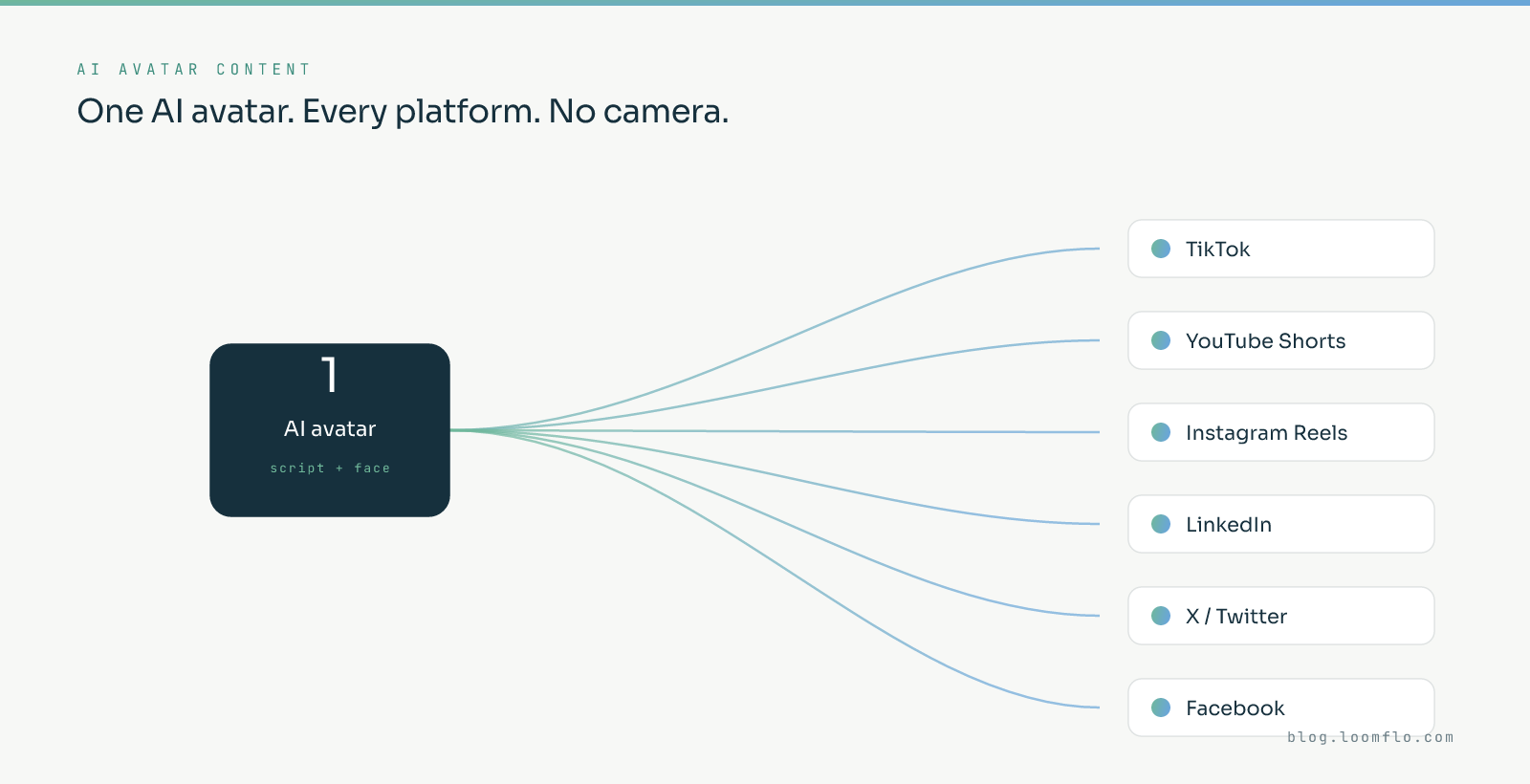
The workflow collapses a whole content team into a repeatable system:
1. Script
Start from an idea or let AI generate scripts aligned to your brand, your audience, and what’s working in your niche at whatever cadence you want to publish.
2. Generate
An AI avatar delivers the script on camera realistic presenter, natural voice, on-brand styling and the video is edited automatically. No filming, no studio, no editing suite.
Real companies report dramatic savings here: using AI avatars, Zoom creates training videos ~90% faster, and Teleperformance saved roughly 5 days and $5,000 per video (Synthesia case studies).
3. Adapt
One piece of content is reformatted for every platform’s native style vertical for TikTok, Reels and Shorts; the right aspect and pacing for LinkedIn, X, and Facebook.
4. Publish
Content ships to every channel on a consistent schedule. As the Buffer data shows, that consistency not virality is what compounds into a recognisable brand, and consistency is exactly what automation guarantees.
Why “no camera” changes the maths
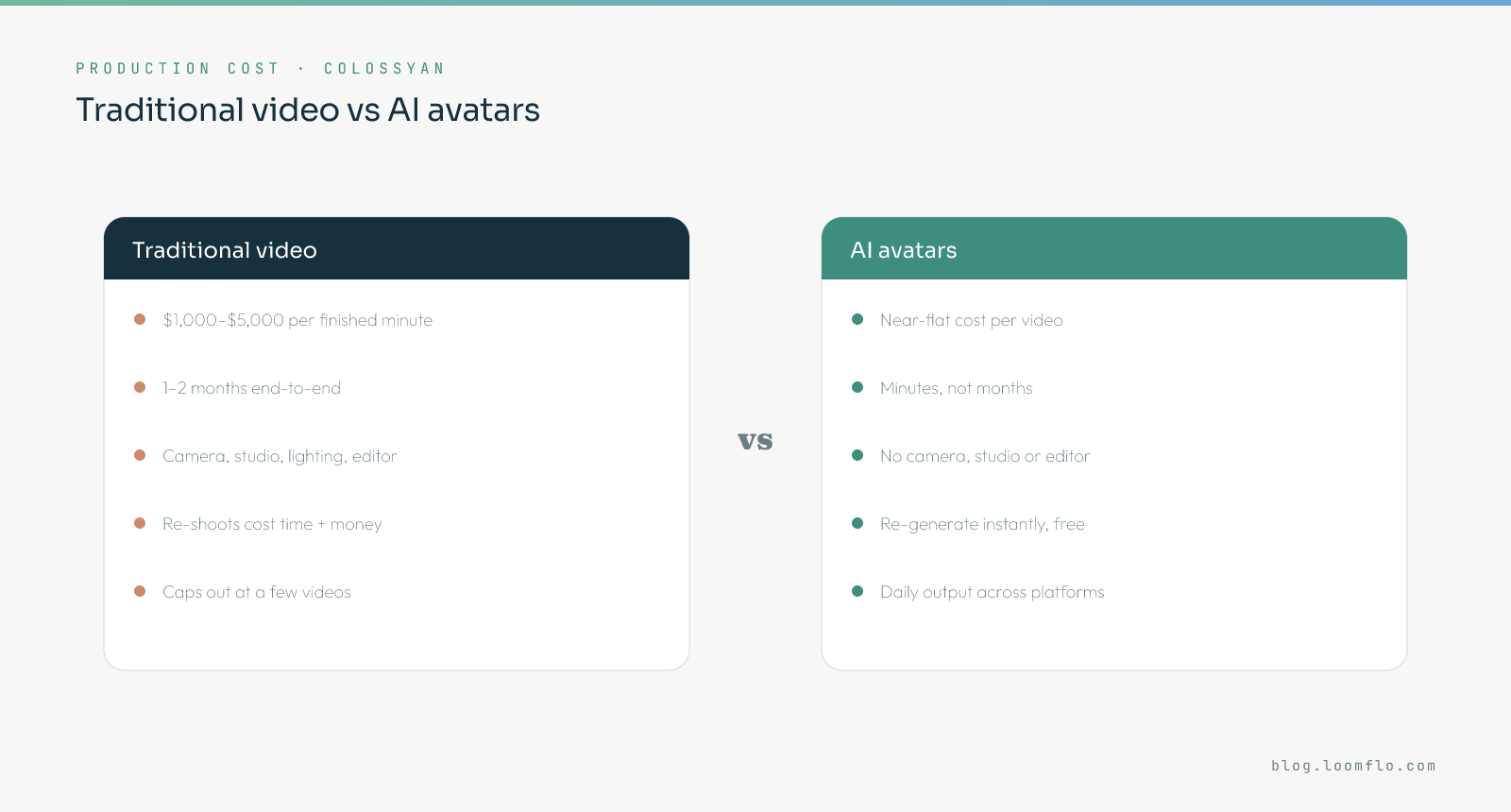
The barrier to video has never really been ideas it’s been production. Filming, re-filming, lighting, editing, and the discomfort of being on camera cap most businesses at a handful of videos before they quietly stop.
Removing the camera removes the bottleneck. When producing the hundredth video costs the same effort as the first — versus $1,000–$5,000 a minute and weeks of post-production daily publishing stops being a heroic act and becomes a setting.
That’s the whole shift: AI avatars convert video from a project (expensive, occasional, exhausting) into infrastructure (cheap per unit, continuous, automatic). And in a channel where 89% of consumers want more brand video and consistency drives 5× the engagement, the business that can simply keep showing up wins.
A practical one-script-many-platforms workflow
The leverage in AI avatar content comes from atomisation turning one idea into many native posts instead of one. A realistic weekly rhythm for a solo founder or lean team looks like this:
- Pick one core idea — a customer question, a myth to bust, a tip, a product angle. One genuinely useful point per video.
- Generate the base video with your AI avatar delivering a tight 30–60 second script. No filming, no retakes.
- Cut platform-native versions — vertical for TikTok, Reels and YouTube Shorts; a slightly longer, hook-first cut for LinkedIn; a captioned square for Facebook; a short clip for X.
- Repurpose beyond video — the script becomes a LinkedIn text post, an email, and a short blog snippet. One idea, a week of presence.
Run that even three times a week and you’re in the posting band Buffer associates with roughly double the follower-growth rate — a cadence almost no business sustains by filming, but a trivial one to sustain when the camera is gone.
Avoiding the “cheap AI” trap
AI avatars fail when they feel generic a stiff presenter reading robotic copy into the void. Avoiding that is mostly craft, not technology:
- Write for the ear, not the page. Short sentences, contractions, a real hook in the first three seconds. The avatar is only as good as the script.
- Lead with value, not your logo. 89% of consumers want more brand video but they want useful video. Teach something in every clip.
- Keep a consistent presenter, voice, and visual style so the content compounds into a recognisable brand rather than a pile of disconnected uploads.
- Be transparent. An AI presenter is a production choice, like an animation or a voiceover not something to hide. Trust is part of the brand you’re building.
How to measure brand-on-autopilot
Because this is a brand play, judge it on brand and consistency signals rather than expecting day-one sales:
- Publishing consistency — posts shipped per week, held steady over months. This is the input everything else depends on.
- Engagement per post — the consistency-driven 5× effect should show up here over time.
- Follower / audience growth rate — the compounding outcome of showing up.
- Branded search & direct traffic — the lagging signal that your presence is turning into recognition.
Where AI avatar content fits and where it doesn’t
- Great for: educational content, tips, product explainers, news commentary, FAQs, and top-of-funnel awareness anywhere a clear talking-head delivery works.
- Great for: founders who want a brand presence without becoming a full-time creator, and teams that need volume across many platforms.
- Less suited to: deeply personal storytelling or content where the audience specifically wants you, your real face, and your unscripted personality.
- Best practice: be transparent and on-brand. AI avatars are a production tool, not a disguise the goal is consistent value, delivered efficiently.
Platform by platform: what actually works where
“Post everywhere” only works if each post respects the platform it lands on. The same AI-avatar clip should be dressed differently for each:
- TikTok — fast hook in the first second, captions on, trend-aware framing. Reward goes to entertainment and pace over polish.
- YouTube Shorts — slightly more substance; Shorts viewers tolerate a teaching beat and often click through to longer content.
- Instagram Reels — clean visuals and a strong on-screen text hook; aesthetic matters more here than on TikTok.
- LinkedIn — lead with the insight, not the gimmick. A captioned talking-head explainer plus a substantive text caption performs; this is where B2B brand-building compounds fastest.
- X / Twitter — short, punchy, often a single claim or stat. Pair the clip with a strong text post.
- Facebook — captioned square video; the audience skews toward clear, useful, no-jargon content.
The AI avatar makes this multiplication cheap, but judgment still sets the strategy: one idea, six native expressions, each tuned to how that audience actually watches. That’s the difference between “spraying the same vertical everywhere” and genuinely showing up native on each platform.
Frequently asked questions
Do AI avatar videos look real?
Modern AI avatars are convincingly lifelike natural voice, expression, and movement and improving fast, which is why over 70% of the Fortune 100 now use a leading avatar platform. For most educational and marketing formats, viewers focus on the value of the content, not the production method.
Do I need to show my own face?
No. That’s the entire point of faceless content. You can use a fully AI-generated presenter and never appear on camera, while still publishing consistent, on-brand video sidestepping the burnout that makes 37% of creators consider quitting.
Will faceless AI content hurt my brand?
Not if it delivers genuine value consistently. Audiences reward useful, reliable content and 89% say they want more video from brands.
The risk isn’t the avatar; it’s publishing low-value content, which is true with or without AI.
How much content can I realistically produce?
Far more than manual filming allows daily, across every platform because the production cost per video is near-flat once the system is set up, versus $1,000–$5,000 per minute traditionally. The constraint becomes strategy, not capacity.
Is AI avatar content good for SEO and AI search too?
Indirectly, yes. Consistent video builds brand mentions and branded search and branded mentions are now the strongest predictor of being cited by AI engines.
Posting avatar videos to YouTube in particular feeds both video discovery and the wider web presence that answer engines weigh. It’s one input into the same compounding brand signal your content and SEO efforts build.
How do I keep AI avatar videos from feeling repetitive?
Vary the format, not just the topic: alternate tips, myth-busts, customer questions, quick demos, and reactions to news in your niche. Because production is near-free, you can afford to experiment with hooks and styles and double down on whatever earns engagement something the expensive, slow traditional workflow never allowed.
The freedom to test cheaply and fail cheaply is itself a competitive advantage most brands can only afford to bet on a handful of videos a quarter, while a faceless AI pipeline lets you run dozens of experiments and let the data, not your budget, pick the winners.
Build your brand without a camera
Loomflo’s AI Avatar Content engine generates, edits and publishes unlimited video across every platform building your brand on autopilot, no camera required, no burnout. Book a discovery call →
Related reading: Campaigns vs Infrastructure: Why Most Growth Tactics Don’t Compound.