Campaigns are one-off pushes that spike and decay when you stop paying, the results stop. Growth infrastructure is a system that compounds.
The data is stark: Google Ads cost-per-lead rose ~25% in a single year to $66.69 (WordStream, 2024), while HubSpot found “compounding” blog posts make up ~10% of posts but drive ~38% of traffic gaining value over time at no extra cost. Most budgets buy campaigns.
The businesses that pull ahead build infrastructure.
Here is the pattern almost every growing business falls into: run a campaign, see a spike, watch it fade, run another. Each push demands fresh budget and effort, and the moment you stop pushing, the results stop too.
You’re sprinting on a treadmill lots of motion, no accumulated distance. The alternative isn’t a better campaign.
It’s a different category of thing entirely: growth infrastructure.
What is growth infrastructure?
Growth infrastructure is a system that generates demand continuously and compounds over time producing more output and better results without requiring proportionally more effort or budget for each new gain. Where a campaign is an event with a start and an end, infrastructure is an asset that keeps working and improving after it’s built.
Think of the difference between renting attention and owning a machine that produces it. A paid ad burst is rented it ends when the spend ends.
A library of ranking content, an autonomous lead engine, or an always-on content system is owned it keeps producing after the work is done.
The campaign treadmill: paid costs only go up
The core problem with campaign-only growth is that the ground keeps shifting under you. The “rented” channels get more expensive every year, structurally, because more advertisers bid for the same attention:
- Average Google Ads cost-per-click rose ~10% year over year to $4.66 in 2024, with CPC increasing across 86% of industries (WordStream/LocaliQ).
- Google Ads cost-per-lead jumped ~25% in a single year to $66.69 — following a 27% increase the year before.
- In 2025, every single industry saw a year-over-year increase in Facebook/Meta CPM, ranging from +8% to +38%.
- Global digital ad spend is forecast to hit ~$799 billion in 2025 and climb toward $910B by 2027 (Statista) meaning more competitors bidding against you every year.
Customer acquisition cost reflects the same trend: ProfitWell’s widely-cited research found CAC rose roughly 60% over five years for both B2B and B2C. When your entire growth model depends on buying attention in an auction that gets pricier every quarter, you’re running up a down escalator.
Campaigns spike. Infrastructure compounds.
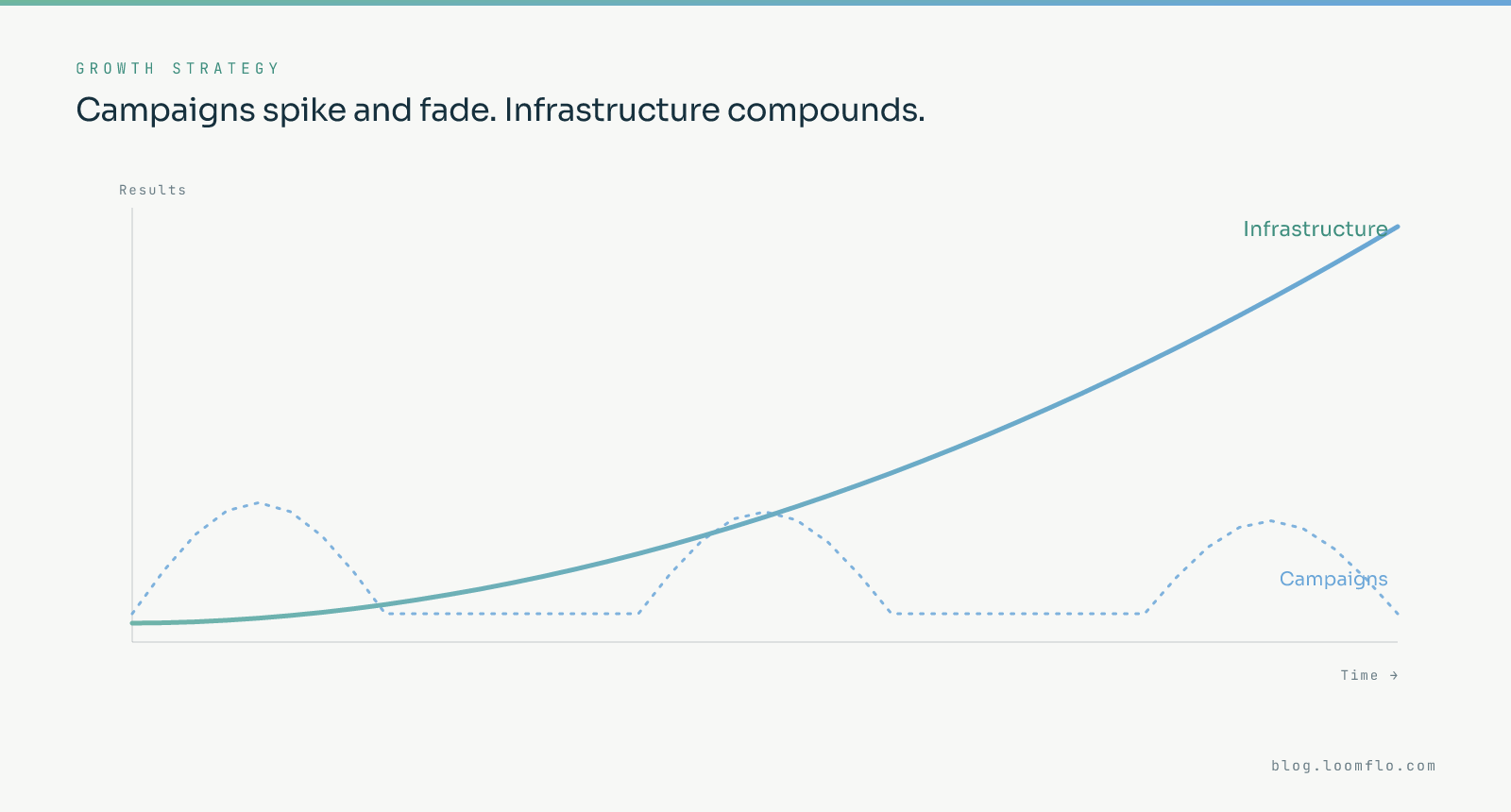
The chart above is the whole thesis in one image, and the data backs it. The defining study comes from HubSpot, which identified what it called “compounding” blog posts posts whose organic traffic grows over time.
They made up only ~10% of posts published but generated ~38% of total blog traffic.
A compounding post drew roughly 2.5× its launch-month traffic six months later, and about 3× two years out with no additional marketing spend. That is the literal opposite of a paid campaign, which delivers its peak the day you pay and decays from there.
- Campaigns are linear. Output is tied directly to input. Want more results? Spend more. Stop spending? Results stop “traffic stops the moment you stop paying.”
- Infrastructure is compounding. Output grows faster than input over time, because the system accumulates assets ranking pages, refined targeting, a content back-catalogue that keep paying off.
- Campaigns decay. The half-life of a push is short. Attention fades, ads stop, the spike flattens.
- Infrastructure appreciates. A well-maintained system is worth more next year than this year.
The economics of owned vs rented channels
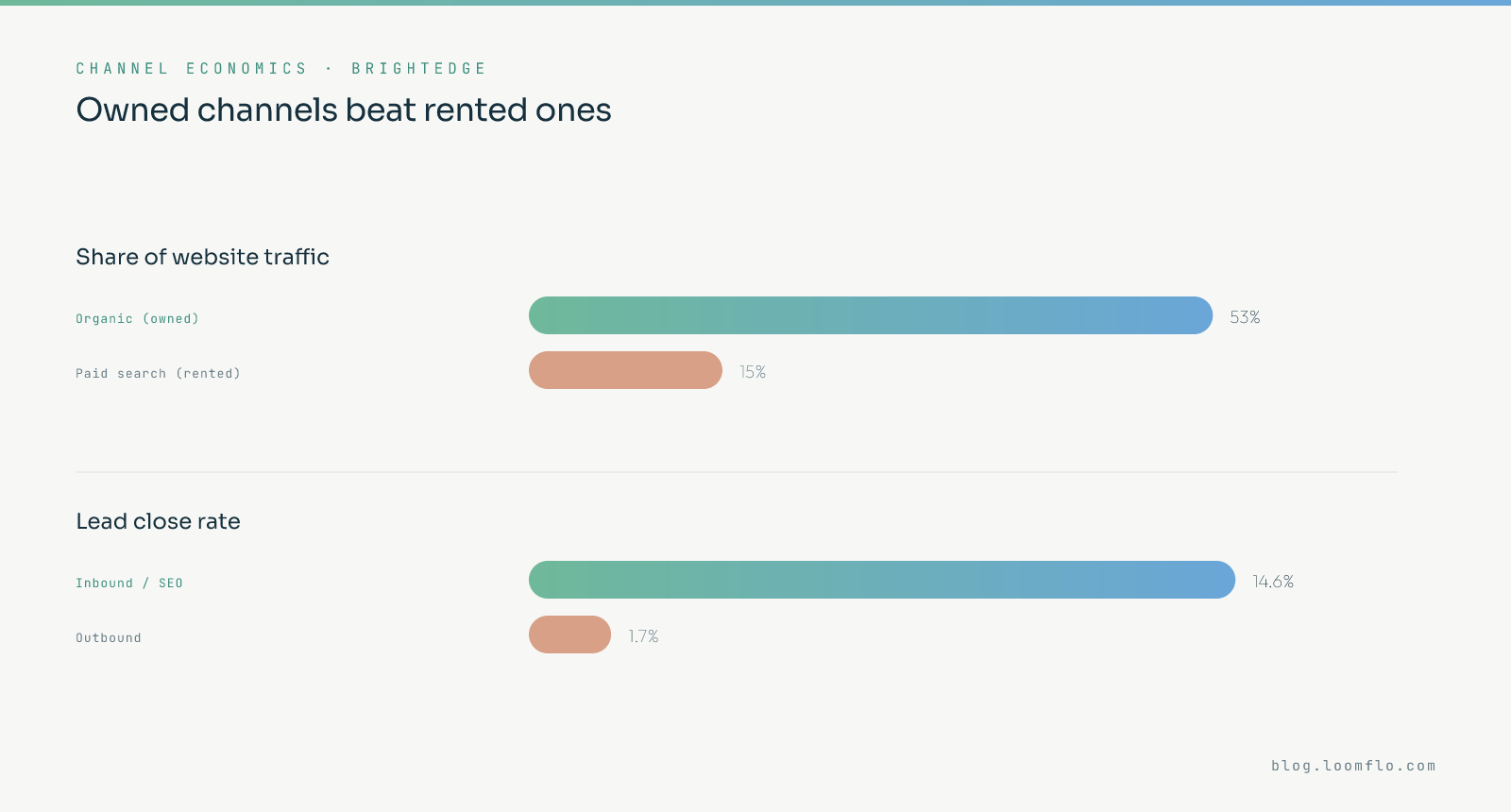
Infrastructure doesn’t just last longer it produces cheaper, higher-converting demand. The numbers consistently favour owned/earned channels over paid ones:
- Organic search drives ~53% of all website traffic, versus ~15% for paid search (BrightEdge) the owned channel is more than 3× the rented one as a traffic source.
- Content marketing generates ~3× as many leads as outbound while costing 62% less (Demand Metric) a long-cited but durable efficiency benchmark.
- Inbound/SEO leads close at ~14.6% versus ~1.7% for outbound roughly 8× higher, because intent is built into how people arrive.
- 49% of marketers say organic search is their most profitable channel (Content Marketing Institute).
None of this means paid channels are worthless. It means relying on them alone with no compounding asset underneath is the expensive way to grow, and it gets more expensive every year.
Why most businesses still buy campaigns
If infrastructure is so much better, why is most budget spent on campaigns? Three reasons.
Campaigns feel safe — the spike is immediate and visible, so it’s easy to justify. Infrastructure feels slow the compounding curve starts below the campaign spike, so it looks worse early even though it wins decisively later (the 2.5×-at-6-months, 3×-at-2-years pattern).
And infrastructure is harder to build — it requires systems, not just spend. The discomfort is real, but it’s also exactly why building infrastructure is a durable advantage: most competitors won’t sit through the slow part.
What AI growth infrastructure looks like
AI is what makes infrastructure affordable for businesses that aren’t enterprises. The same systems that once required whole teams now run autonomously:
- An SEO/AEO content engine that researches, writes, links and refreshes continuously building that library of compounding, citable content. (See Can You Automate SEO?)
- An AI lead-generation system that finds, qualifies and engages prospects 24/7, a pipeline that fills itself. (See AI Lead Generation)
- An AI content engine that builds brand presence across every platform on a consistent schedule without a camera or a content team. (See Build a Brand on Autopilot with AI Avatars)
Each one is an asset, not an expense. Together, they’re a growth machine that keeps running while you sleep which is exactly the point.
The compounding math, made concrete
It’s worth seeing why “compounding” isn’t just a nice word. Take HubSpot’s finding that a compounding post earns ~2.5× its launch-month traffic six months in and ~3× two years later.
Now imagine publishing 10 such assets a month. In month one, you have 10 pages doing modest numbers.
But you don’t stop month two adds 10 more while the first 10 keep climbing. By month twelve you have 120 pages, and the earliest ones are now at 2–3× their original output, with no extra spend on them.
The library isn’t a cost you re-pay each month; it’s a stack of assets that each get more valuable as they age.
Compare that to a paid campaign delivering the same month-one traffic. To get month-twelve traffic, you pay again at next year’s rates, which the benchmarks say will be higher (Google CPL rose 25% in one year; Meta CPM rose across every industry).
One model’s output curves up while its per-unit cost approaches zero; the other’s output is flat and its per-unit cost rises. That gap, compounded over years, is the entire argument.
How to start building infrastructure
You don’t build infrastructure by stopping all campaigns tomorrow you build it by redirecting a slice of spend and effort into assets that last. A sensible sequence:
- Pick one compounding channel first. For most businesses that’s an SEO/AEO content engine the best-documented compounding asset there is. Get one engine running before adding another.
- Fund it from campaign budget, not on top of it. Move 15–25% of paid spend into infrastructure. Campaigns keep the lights on while the compounding curve climbs toward the crossover point.
- Automate so it survives. Infrastructure that depends on heroic manual effort decays the moment attention slips. AI is what keeps the content engine, the lead engine, and the brand engine running without proportional labour.
- Measure on a 12-month horizon. Judging infrastructure on month-one results guarantees you’ll quit during the slow part exactly where most competitors do, which is why finishing it is an advantage.
Are campaigns ever right? Yes, on top of infrastructure
This isn’t an argument to never run a campaign. Campaigns are excellent for time-sensitive moments a launch, a promotion, an event where you need a spike on a specific date.
The mistake is relying only on campaigns with nothing compounding underneath. The strongest strategy runs campaigns on top of a growth-infrastructure base: the infrastructure provides the durable, cheap, high-converting baseline, and campaigns provide the timely peaks.
One without the other is either too slow or too expensive.
Owned audience: the infrastructure most businesses forget
Content and lead engines get the attention, but the most under-rated piece of growth infrastructure is an owned audience, an email list, a subscriber base, a community you can reach without paying a platform for permission. Every paid campaign rents access to people who belong to Google or Meta.
An owned audience belongs to you: the cost to reach them again is effectively zero, and it doesn’t rise 25% next year.
This is why the channels with the best economics organic search closing at ~14.6% versus ~1.7% for outbound, content producing leads at roughly half the cost of paid, all share a trait: they build an asset you keep. A visitor who finds your compounding article, subscribes, and later buys cost you once.
A visitor you bought through an ad that you never converted into an owned relationship cost you, and will cost you again. Infrastructure thinking means always asking: is this spend buying a one-time result, or building an asset I’ll still have next year?
Frequently asked questions
What’s the difference between a campaign and growth infrastructure?
A campaign is a time-bound push that spikes and fades results stop when effort stops. Infrastructure is a system that produces continuously and compounds: HubSpot’s data shows compounding content gaining ~2.5–3× its traffic over time at no extra spend, the opposite of a paid campaign’s decay.
Why does infrastructure look worse at first?
Because compounding curves start low. Early on, a campaign spike outperforms the infrastructure baseline.
The lines cross when accumulation kicks in, and after that, infrastructure pulls away and keeps climbing while paid costs keep rising (Google CPL was up 25% in a single year).
Is paid advertising a waste of money?
No, it’s a powerful tool for timely spikes. The waste is depending on it alone.
Owned channels convert far better (inbound closes ~14.6% vs ~1.7% for outbound) and cost less per lead, so the smart move is campaigns layered on top of infrastructure, not instead of it.
How does AI change the build-vs-buy maths?
AI makes growth infrastructure affordable to build and run autonomously, without the large teams it used to require. That’s what puts compounding systems within reach of lean businesses, not just enterprises.
How long before growth infrastructure pays off?
Expect a slow start and a crossover. In the early months a paid campaign will usually out-perform your infrastructure baseline; the lines typically cross somewhere in the 12–18 month range for content/SEO, after which infrastructure pulls ahead and keeps compounding while paid costs keep climbing.
The businesses that win are the ones that don’t quit during the slow part which is exactly why so few competitors have what you’re building.
Stop renting growth. Start owning it.
Loomflo builds AI growth infrastructure — HEO, AI lead generation, and AI avatar content engines that compound while you sleep. Not campaigns.
Systems. Book a discovery call →