Personalization most often drives a 10–15% revenue lift (McKinsey), and 71% of consumers now expect it 76% get frustrated without it. AI personalization makes that possible at scale, but it lives or dies on unified data and staying the right side of the “creepy” line.
Generic marketing is getting more expensive and less effective at the same time. Buyers tune out anything that doesn’t speak to them and they have more choice than ever.
AI personalization is the answer to that squeeze. This guide explains what it is, the growth it drives, and how to turn your data into relevant experiences without creeping people out.
What is AI personalization?
AI personalization is the use of artificial intelligence to tailor content, products, offers and experiences to each individual based on their data and behaviour automatically and at scale. It’s how one website, email or app can feel custom-built for every visitor.
The mechanics are familiar even if the term isn’t. Product recommendations, dynamic landing pages and tailored emails are all AI personalization in action.
What AI personalization actually does
“Personalization” spans several jobs, all powered by the same data. Here’s where it shows up.
1. Recommendations
AI suggests the products or content each person is most likely to want. It’s the single highest-value use, which is why the giants built their businesses on it.
2. Dynamic content
Websites and apps adapt their messaging, layout and offers to the visitor in real time. One page can speak differently to a first-timer and a returning customer.
3. Personalised email and messaging
AI tailors subject lines, content and timing to each subscriber. Relevance is what turns email from a blast into a conversation.
4. Personalised pricing and offers
AI targets promotions to the people most likely to respond, instead of discounting for everyone. It protects margin while lifting conversion.
The proof: personalization at scale
The clearest evidence comes from the companies that built personalization into their core. Their numbers are staggering.
Amazon attributes roughly 35% of its purchases to its recommendation engine, a long-standing McKinsey benchmark. Netflix says about 80% of what members watch comes from recommendations, a system it estimates saves it $1 billion a year in reduced churn.
Those aren’t marketing experiments they’re the business. Personalization is the product.
Why AI personalization pays
You don’t need Amazon’s scale to see the return. The data is consistent across the board.
McKinsey found personalization most often drives a 10–15% revenue lift, and that faster-growing companies generate about 40% more of their revenue from personalization than slower ones.
It also makes spend more efficient. McKinsey reports personalization can cut acquisition costs by as much as 50% and lift marketing-spend efficiency by 10–30%.
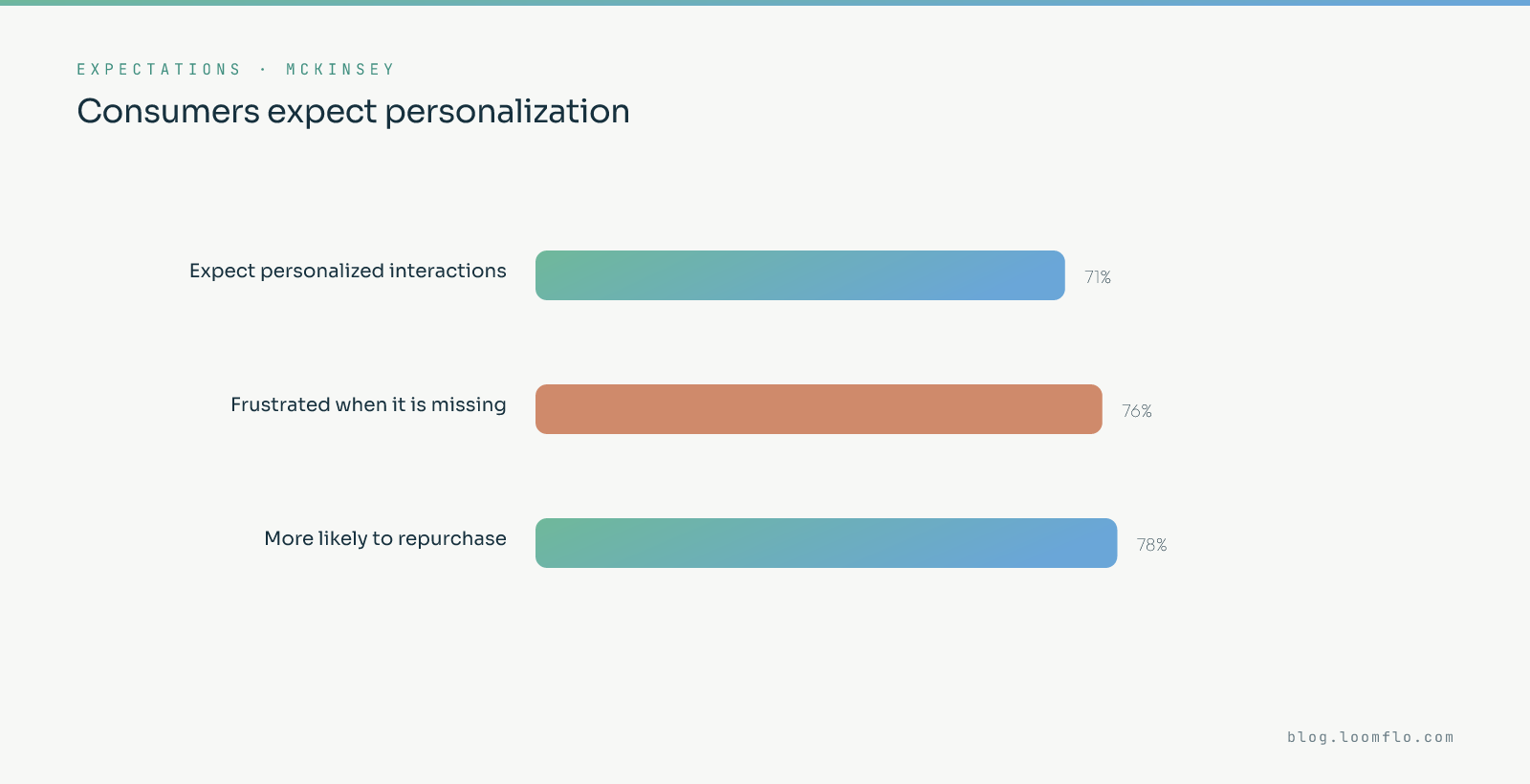
And consumers reward it. 78% say they’re more likely to repurchase from brands that personalise, and they spend 54% more with them (Twilio Segment).
Consumers now expect it
Personalization has shifted from a delight to a default expectation. Missing it is now a penalty, not a neutral.
The numbers are blunt. McKinsey found 71% of consumers expect personalised interactions, and 76% get frustrated when they don’t get them.
So the question isn’t whether to personalise it’s whether you’ll meet the bar your customers already hold.
The catch: data and the creepy line
AI personalization has two failure modes, and both are common. The first is data.
Most brands simply can’t do it well yet. Twilio Segment found only about 16% of brands have the customer data they need to personalise effectively, and McKinsey notes data silos are the top barrier.
The second failure mode is trust. Push too far and personalization feels like surveillance Salesforce found consumer trust that businesses use AI ethically fell from 58% to 42%, and 72% want to know when they’re interacting with AI.
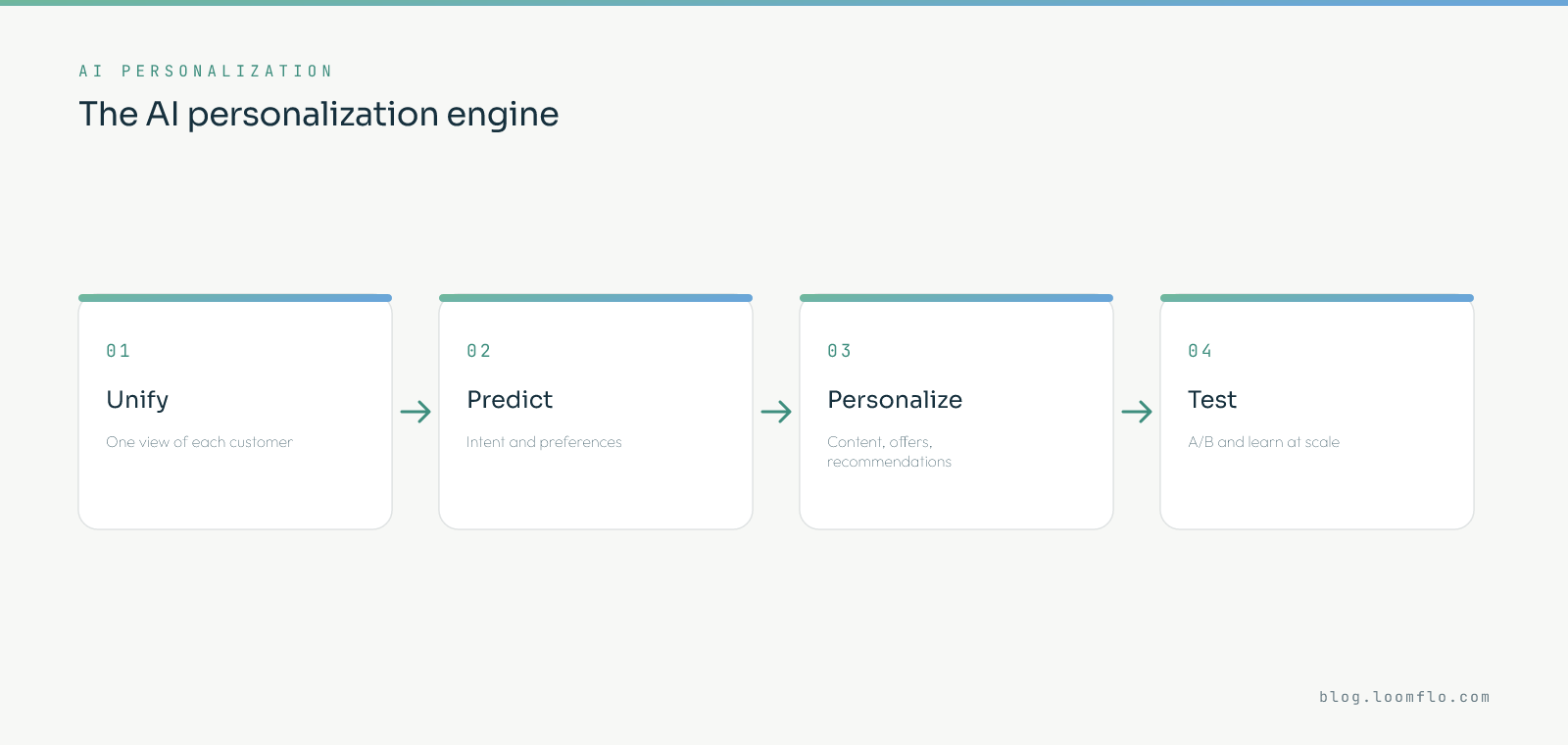
How to do AI personalization well
The leaders follow a clear pattern, and none of it starts with fancy AI. It starts with data and discipline.
1. Unify your data first
Consolidate first-party data into a single customer view before personalising anything. This directly fixes the “only 16% have the data” gap, and it’s the prerequisite for everything else.
2. Start with high-impact use cases
Pick a short list of high-value, low-complexity wins recommendations or an abandoned-cart flow and prove the impact. Expand from results, not ambition.
3. Personalise what people actually value
Focus on relevant recommendations, tailored messaging and useful offers, which consumers rank as the most welcome forms. Skip the gimmicks that feel invasive.
4. Be transparent about data and AI
Disclose how you use data and AI, since 49% of consumers trust brands more when they’re open about it (Twilio Segment). Transparency is how you stay the right side of the creepy line.
5. Test and learn relentlessly
The leaders run hundreds of A/B tests a year in cross-functional teams. Personalization is an experiment that compounds, not a one-time setup.
6. Respect privacy by design
Build robust data controls and honour consent, because trust is the foundation the whole strategy stands on. Lose it and the personalization stops working.
Where to start
You don’t have to personalise everything at once. Begin where the data is cleanest and the impact is clearest.
For most businesses that’s email and on-site recommendations. Both have direct revenue impact and don’t require a perfect data foundation to start delivering.
From there it compounds. Each win funds the next, and the data you gather makes every future experience sharper.
Common AI personalization mistakes
A few avoidable errors turn personalization from an asset into a liability. Most come from skipping the fundamentals.
- Personalising on bad data: Wrong recommendations are worse than none they erode trust instantly.
- Crossing the creepy line: Using data in ways that feel invasive, without transparency or consent.
- Tokenism: Slapping a first name on a generic email and calling it personalised.
- No measurement: Running personalization without testing what actually lifts revenue.
- Boiling the ocean: Trying to personalise everything before proving any one use case.
Avoid those and personalization becomes a durable growth engine. The technology is rarely the problem the data and trust around it are.
How big is the personalization market?
The category is growing fast as expectations rise. Statista valued the personalization-software market at about $1.16 billion in 2023, forecast to reach $5.16 billion by 2030 at a ~24% CAGR.
The stakes are bigger than the software, though. BCG estimated personalization would shift around $800 billion in revenue to the companies that get it right.
The takeaway is simple. The gap between personalization leaders and laggards is widening into a real competitive divide.
Where AI personalization fits in growth
AI personalization isn’t a standalone tactic it’s a multiplier on everything else you do. The same traffic, leads and emails convert better when each one is relevant.
That multiplier effect is why it belongs in a connected system. For how to fill the funnel that personalization then converts, see our guide on AI lead generation, and on building durable systems over one-off campaigns, Campaigns vs Infrastructure.
Done well, personalization turns your data from a cost of doing business into your sharpest growth lever.
AI personalization across channels
Personalization isn’t one feature it works across every touchpoint. Here’s where it delivers most.
- Website: Dynamic homepages, banners and CTAs tuned to each visitor’s stage and behaviour.
- Email: Tailored subject lines, content and send times based on what each person does.
- Product: In-app recommendations and onboarding adapted to how someone uses the product.
- Ads: Audience and creative matched to intent, so spend lands where it converts.
- Search & commerce: Personalised results and recommendations that lift basket size.
The more channels share one customer view, the more consistent and effective the experience becomes.
AI vs rules-based personalization
Personalization isn’t new but AI changed what’s possible. Old systems followed fixed rules; AI learns and predicts.
Rules-based personalization shows segment A one thing and segment B another. It’s better than nothing, but it can’t adapt to the individual in real time.
AI personalization predicts what each person wants and adjusts continuously. That’s the difference between a coarse segment and a genuine one-to-one experience.
Why personalization compounds
Personalization gets better the longer you do it, because it feeds on its own data. Every interaction teaches the system more.
A new visitor gets a decent guess; a returning customer gets an increasingly sharp experience. The data loop turns first impressions into lasting relevance.
That’s why early movers pull ahead. The brands personalising today are building a data and trust advantage that laggards can’t quickly copy.
Frequently asked questions
What is AI personalization?
It’s using AI to tailor content, products, offers and experiences to each individual based on their data and behaviour, automatically and at scale. Recommendations, dynamic content and tailored email are all examples.
Does it actually increase revenue?
Yes, McKinsey links it to a 10–15% revenue lift, and consumers spend about 54% more with brands that personalise. The return depends on data quality and execution.
Why do most personalization efforts fail?
Usually poor or siloed data only about 16% of brands have the data they need and crossing the privacy “creepy line.” Fix your data and be transparent, and the rest follows.
How do I avoid personalization feeling creepy?
Be transparent about data and AI use, get consent, and focus on relevance rather than surveillance. 49% of consumers trust brands more when they’re open about how they use data.
What should I personalise first?
Start with high-impact, lower-complexity use cases like product recommendations and email. They deliver direct revenue impact without requiring a perfect data foundation.
Do I need a lot of data to start?
You need clean, unified first-party data more than huge volumes. A single customer view across channels matters more than sheer quantity.
Is AI personalization only for big companies?
No. The tools have made it accessible to small teams, and starting with one use case like email recommendations is well within reach for any business.
How do I measure personalization?
Test against a control and track revenue per visitor, conversion rate and repeat-purchase rate. The leaders run continuous A/B tests to prove what actually works.
What’s the difference between personalization and segmentation?
Segmentation groups people into buckets; AI personalization tailors to the individual and adapts in real time. AI moves from coarse segments to genuine one-to-one relevance.
Which channels benefit most?
Email, websites and product experiences see the biggest impact, because they’re high-frequency and data-rich. Recommendations and tailored messaging are the highest-value uses.
Is it worth it for small businesses?
Yes, modern tools make it accessible, and starting with email or on-site recommendations delivers quick wins. You don’t need enterprise scale to benefit.
How do I balance personalization and privacy?
Be transparent, get consent, and focus on relevance over surveillance. Nearly half of consumers trust brands more when they’re open about data and AI use.
What data do I need for AI personalization?
Clean, unified first-party data behaviour, purchases, preferences in a single customer view. Quality and integration matter more than sheer volume.
How quickly does it show results?
Some uses like recommendations and abandoned-cart flows show lift within weeks. The biggest gains compound over months as the system learns from more interactions.
Does AI personalization work without third-party cookies?
Yes, it relies on first-party data you collect directly, which is more durable than third-party cookies anyway. A strong first-party data foundation future-proofs your personalization.
Is it the same as a recommendation engine?
A recommendation engine is one type of AI personalization. The broader practice also covers dynamic content, tailored messaging, offers and search all driven by individual data.
Turn your data into growth
Loomflo builds AI growth infrastructure systems that capture, nurture and convert demand with relevance at scale, while you sleep.