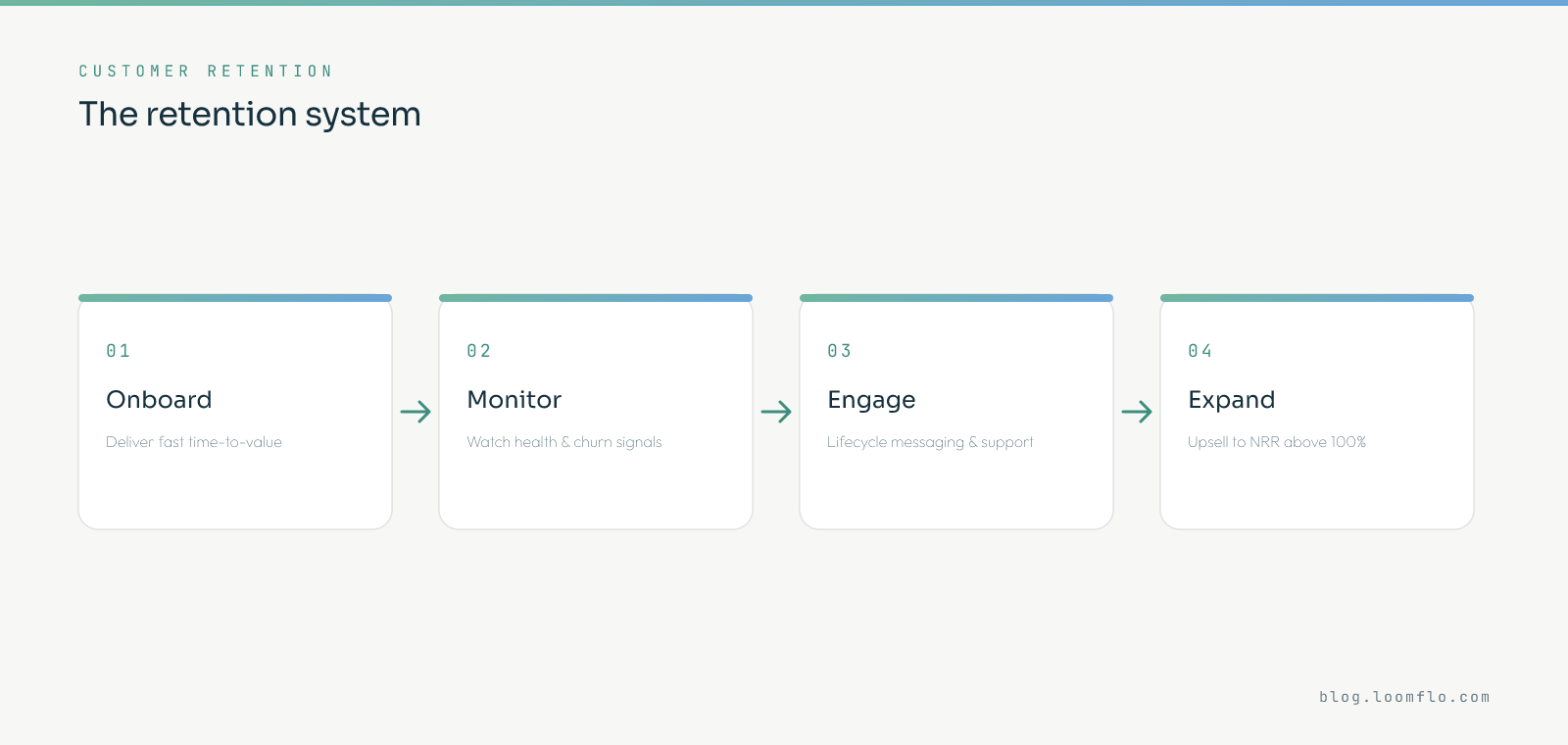
Customer retention is keeping the customers you already won, and it’s the cheapest growth you’ll ever buy. Acquiring a new customer costs 5–25× more than keeping one (HBR), and increasing retention by just 5% can lift profits by 25% or more (Bain & Company).
Most companies pour their budget into the top of the funnel and quietly leak customers out the bottom. It’s like filling a bucket with a hole in it.
Customer retention plugs the hole and the economics are hard to beat. This guide explains what retention is, why it beats acquisition, and how AI turns it from reactive firefighting into a system.
What is customer retention?
Customer retention is a company’s ability to keep its existing customers actively using and paying over time, rather than losing them to churn. In SaaS it’s measured on both a logo (account) and revenue (dollar) basis.
The formula is straightforward. Retention rate = [(customers at end − new customers) ÷ customers at start] × 100.
So if you start with 200 customers, end with 220, and added 40 new ones, you retained 90%. Churn is simply the mirror image the customers you lost.
Why retention beats acquisition
The economics of retention are so lopsided they’re hard to ignore. Keeping customers is simply cheaper than replacing them.
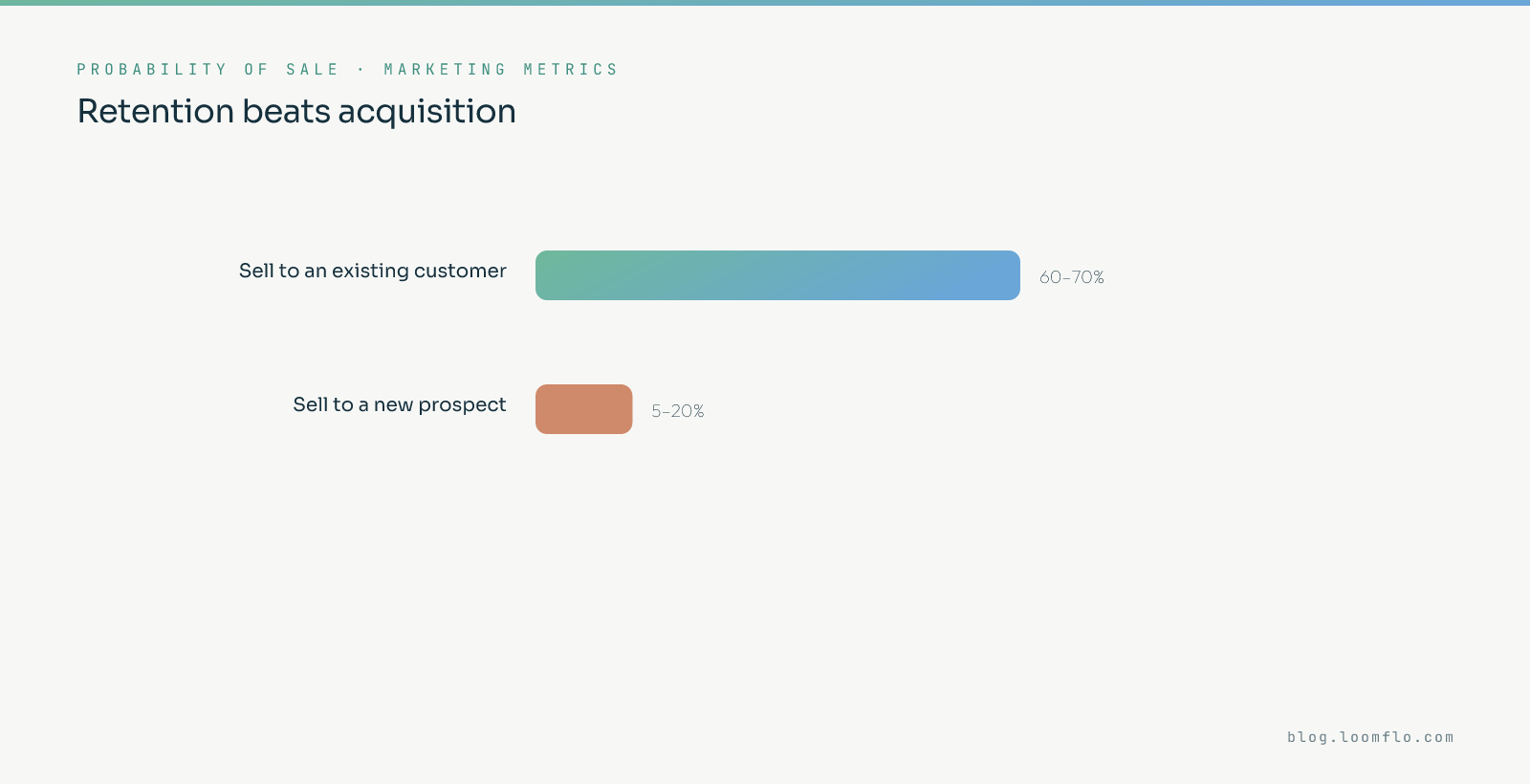
Acquiring a new customer costs five to twenty-five times more than retaining an existing one (Harvard Business Review). And the odds are better too you have a 60–70% chance of selling to an existing customer, versus 5–20% for a new prospect (Marketing Metrics).
The compounding effect is the real prize. Bain & Company’s research, via HBR, found that increasing retention by 5% can raise profits by 25% or more because retained customers buy again, expand, and cost little to serve.
Understanding churn and its causes
You can’t fix retention without understanding why customers leave. Churn comes in two flavors.
Voluntary churn is when a customer chooses to leave usually from weak onboarding, low product adoption, poor support or unclear value. Involuntary churn is when payments simply fail, from expired or declined cards.
Both are bigger than teams assume. Median annual logo churn for B2B SaaS is around 3.5%, of which roughly 0.8 points are involuntary (Recurly) meaning a chunk of your churn is a billing problem, not a product one.
Onboarding: where retention is won or lost
The first weeks decide the relationship. If a customer never reaches value, no amount of later effort saves them.
This is the time-to-value problem the faster a new customer hits their first real win, the more likely they stay. Onboarding that drags, confuses or stalls is the quiet cause of much early churn.
Nail activation and you set up everything downstream. Fumble it and you’re fighting churn you baked in on day one.
The role of customer experience
Retention isn’t only about the product it’s about how it feels to be your customer. Experience is a retention lever.
The tolerance for bad experiences is shrinking fast. Zendesk’s 2025 CX Trends found 63% of consumers will switch to a competitor after a single bad experience, up 9 points year over year, and PwC found 32% will walk away from a brand they love after just one.
Support quality compounds over a relationship. Proactive, helpful experiences build the trust that keeps customers through renewals and price changes.
Retention and expansion strategies
Beyond preventing churn, the best retention programs grow existing accounts. A few strategies do most of the work.
Drive ongoing value
Regularly remind customers of the outcomes they’re getting, through check-ins, reporting and education. Perceived value is what renewals are built on.
Expand the relationship
Upsell and cross-sell to customers already succeeding with you, since they’re your warmest buyers. Expansion revenue is how the best companies push net revenue retention above 100%.
Reward loyalty
Recognize and reward your long-term customers, because loyalty is cheaper to keep than to rebuild. Small gestures of appreciation reduce the temptation to shop around.
How AI improves customer retention
Retention has always been reactive you find out a customer is unhappy when they cancel. AI makes it proactive.
Churn prediction and health scoring
Models score account health from behavior login frequency, feature adoption, support sentiment and payment status. Because most churners show warning signs weeks ahead, this surfaces at-risk accounts while there’s still time; McKinsey found AI can cut churn by up to 15%.
Personalized lifecycle messaging
AI triggers the right message at the right moment onboarding nudges, re-engagement, renewal prompts. McKinsey found personalization lifts revenue 5–15% and marketing ROI 10–30%.
Proactive support
AI detects friction like repeated errors or stalled onboarding and prompts outreach before a ticket is ever filed. Catching problems early is far cheaper than winning back a churned account.
The honest caveat: predictions are probabilistic and need clean data plus a human playbook to act on. Automation without a retention strategy just automates a leaky bucket.
Measuring retention
You manage what you measure, and retention has a few key metrics. Each tells a different part of the story.
Retention rate and its inverse, churn, track how many customers or dollars you keep. Gross revenue retention measures revenue kept excluding expansion, while net revenue retention includes upsell and can exceed 100%.
NRR is the metric investors watch most. Median B2B SaaS NRR sits around 106%, with best-in-class above 130% (Benchmarkit) anything under 100% means you’re shrinking despite new sales.
Where retention fits in growth
Retention is the foundation the rest of growth stands on. Acquisition fills the bucket; retention decides whether it holds water.
That’s why it belongs in your growth system, not just your support team. It pairs naturally with the acquisition engines around it see AI personalization and AI customer service for two of its biggest levers.
Get retention right and every new customer is worth more, because they stay, expand and refer compounding the return on all the acquisition you already paid for.
Frequently asked questions
What is a good customer retention rate?
It varies by model, but for B2B SaaS, annual logo churn under 5% (retention above ~95%) is healthy, and net revenue retention above 100% is the goal. Benchmarks always depend on your segment and price point.
How do you calculate customer retention rate?
Use [(customers at end − new customers) ÷ customers at start] × 100. Starting with 200, ending with 220, and adding 40 new gives 90% retention.
Why is retention cheaper than acquisition?
Acquiring a new customer costs 5–25× more than keeping one, and you’re far likelier to sell to an existing customer (60–70%) than a new prospect (5–20%). Retained customers also expand and refer, compounding their value.
What’s the difference between retention and loyalty?
Retention is behavioral and measurable did the customer stay and keep paying. Loyalty is the emotional preference that drives that behavior over time.
What causes customers to churn?
The main causes are weak onboarding, low product adoption, poor customer experience, pricing, and involuntary payment failures. Much of it shows warning signs before the cancellation.
What’s the difference between gross and net revenue retention?
Gross revenue retention excludes expansion and caps at 100%; net revenue retention includes upsell and can exceed 100%. NRR is the metric that shows whether your existing base is growing on its own.
Can AI reduce churn?
Yes AI predicts at-risk accounts from behavioral signals and triggers proactive outreach, and McKinsey found it can cut churn by up to 15%. It works best paired with a clear human plan to act on the warnings.
Keep the customers you worked to win
Loomflo builds AI growth infrastructure — churn prediction, health scoring and lifecycle automation that turn retention into a system, not a scramble.