AI customer service already handles about 30% of cases, heading to 50% by 2027 (Salesforce) and 80% of common issues by 2029 (Gartner). It resolves faster and cuts costs but over 80% of consumers still want a human for hard problems, so seamless escalation is everything.
Customer service has always faced an impossible trade-off: faster, cheaper, or better pick two. AI is the first thing that genuinely improves all three at once.
But it’s also easy to get wrong in ways that cost you customers. This guide covers what AI customer service does, the results the data supports, and how to deploy it so it helps people instead of frustrating them.
What is AI customer service?
AI customer service is the use of artificial intelligence AI agents, chatbots, self-service and agent-assist copilots to answer questions, resolve issues and support customers automatically or alongside human agents. It spans fully automated resolution and AI that makes human reps faster.
It’s no longer experimental. Salesforce found 83% of service organisations now use AI in some capacity, up from 56% in 2022.
What it does
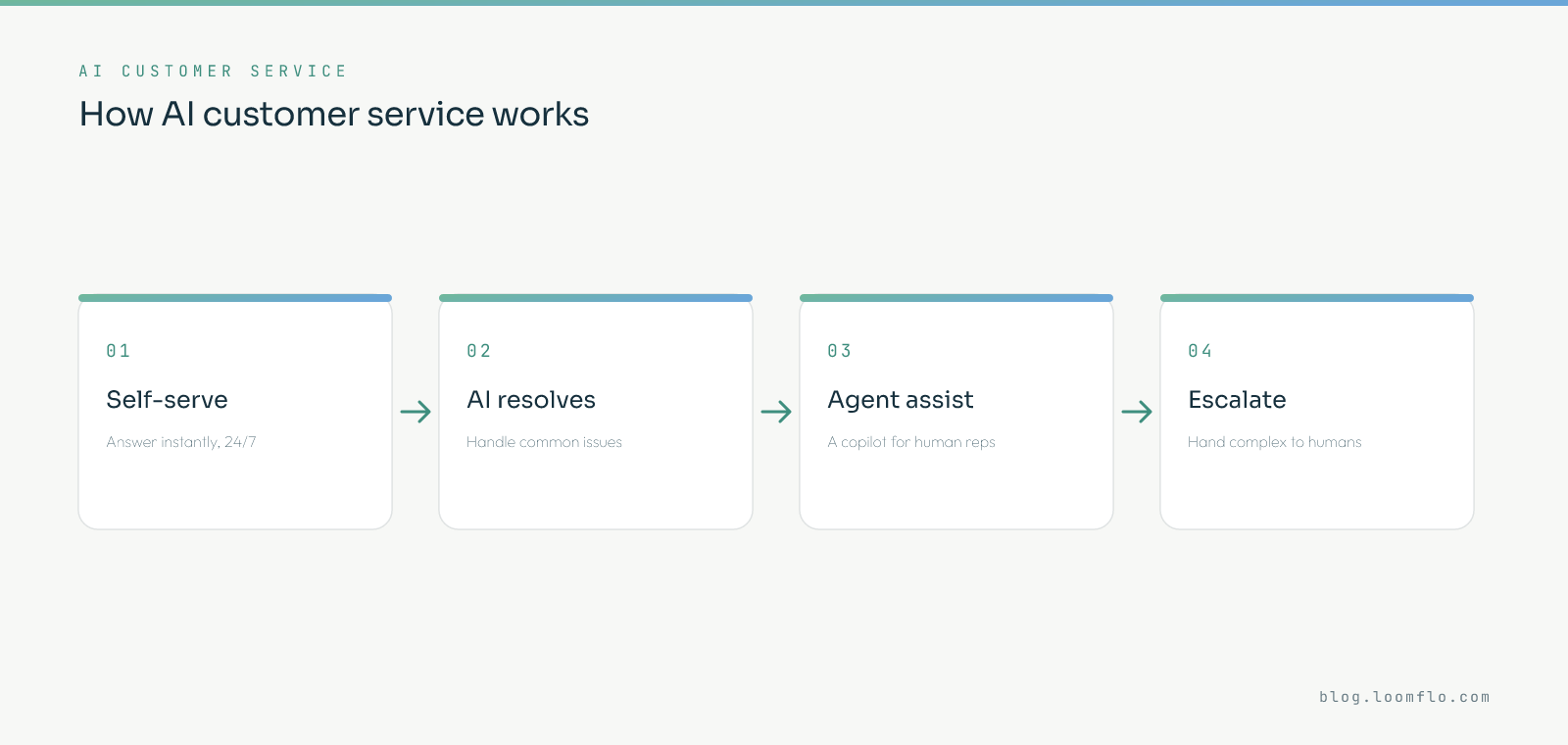
AI shows up across the whole support function, not just in a chat widget. Each role removes a different kind of friction.
1. Self-service
AI answers common questions instantly, 24/7, so customers resolve issues without waiting. It deflects the routine volume that clogs queues.
2. AI agents
Autonomous agents resolve whole tickets end to end, from billing questions to order changes. They handle the cases that don’t need a human at all.
3. Agent assist
AI copilots draft replies, surface knowledge and summarise conversations for human reps. This is often the safest, highest-ROI place to start.
4. Routing and escalation
AI triages and routes each issue, handling what it can and escalating the rest. Done right, the customer never feels the handoff.
The results: resolve more, faster, for less
The evidence spans cost, speed and resolution and it’s strong. This is the core of the business case.
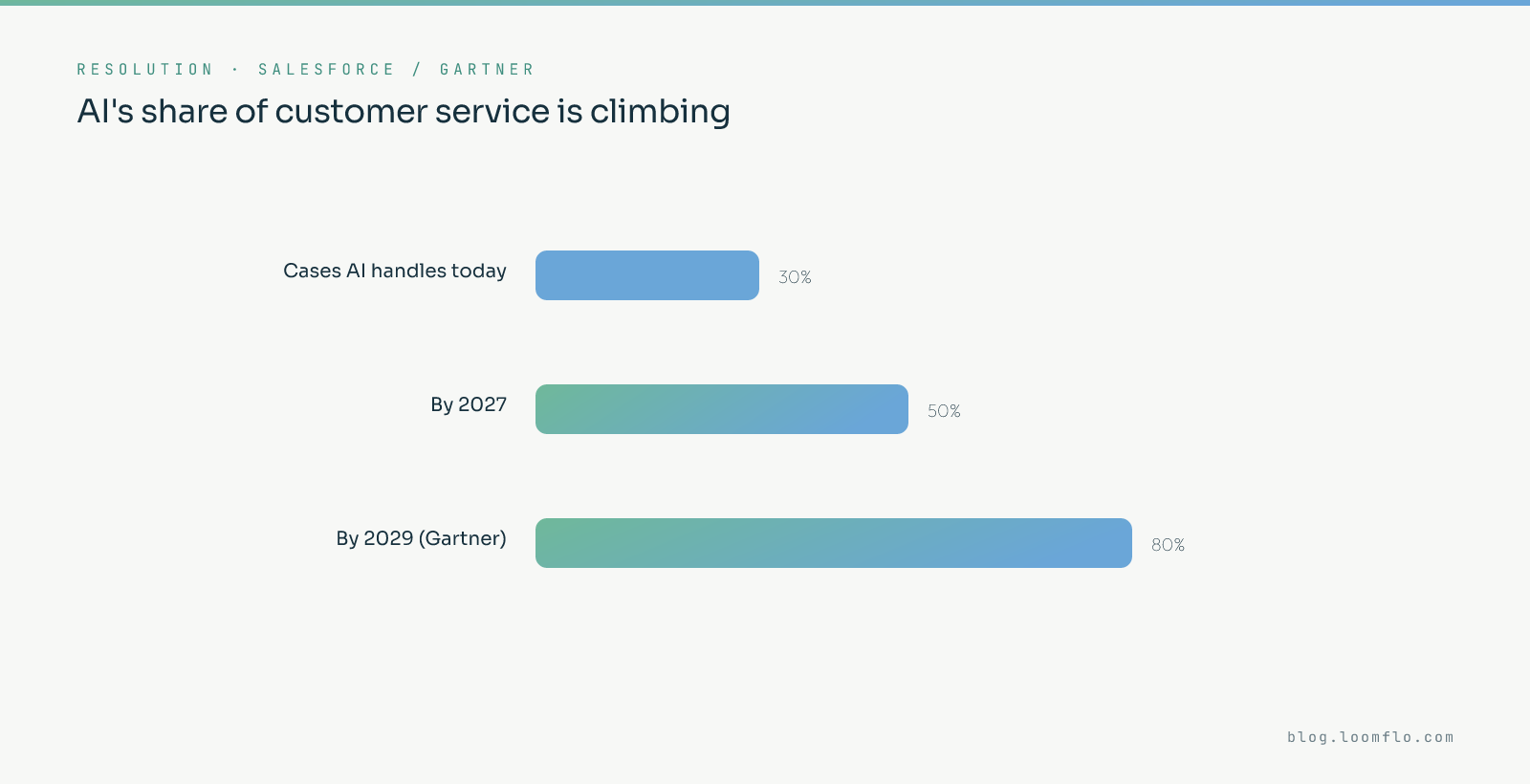
The trajectory is steep. AI handles about 30% of service cases today, projected to reach 50% by 2027 (Salesforce), and Gartner predicts agentic AI will autonomously resolve 80% of common issues by 2029, cutting operational costs 30%.
Real deployments back it up. Intercom’s Fin agent reached a 67% average resolution rate across 40M+ conversations, and McKinsey found gen AI lifted care productivity by 30–45%.
Speed and agent experience improve too. One 5,000-agent deployment saw 14% more issues resolved per hour, 9% lower handling time and 25% less agent attrition (McKinsey).
It’s not just cost savings
The bigger story is that good AI service drives revenue, not just efficiency. The leaders treat it as a growth lever.
Zendesk found businesses integrating AI into customer service reported 33% higher acquisition, 22% higher retention and 49% higher cross-sell revenue. Service quality, done well, compounds into loyalty and expansion.
That reframes the investment. AI customer service isn’t a cost centre to shrink it’s a customer-experience advantage to build.
The catch: people still want people
Here’s the tension every deployment has to navigate. Customers like fast answers but distrust being trapped with a bot.
The preference is clear. Metrigy found 84.7% of consumers would prefer a human over an AI agent, and 80% still prefer a human even when told the bot would resolve their issue.
And the cost of a bad experience is high. PwC found roughly a third of customers will walk away from a brand they love after one bad experience so a confidently wrong AI answer can lose the relationship.
Design for trust, not just deflection
The fix isn’t less AI it’s better-designed AI. Tone and transparency matter as much as resolution rate.
Zendesk found 64% of consumers trust AI agents more when they’re friendly and empathetic, and that 95% want to know why AI made a decision yet only 37% of companies explain it.
So treat the AI as part of your brand, be transparent it’s AI, and make a human always reachable. Trust is the metric under all the others.
How to deploy AI customer service well
The difference between a support upgrade and a customer-loss machine is a handful of choices.
1. Build seamless human escalation
Never trap customers in a bot loop route routine queries to AI and hand complex or emotional ones to humans. With 80%+ still wanting a human for hard issues, escalation is non-negotiable.
2. Start with agent assist
Use AI to make human reps faster before fully automating, since copilots lift productivity 30–45% at lower risk. It’s the smoothest on-ramp.
3. Tune the knowledge base
Resolution rate is a function of content quality Fin climbed toward 67% through continuous tuning. Feed and refine the knowledge base relentlessly.
4. Be transparent and set expectations
Disclose AI use and explain its reasoning, because customers increasingly demand it. Honesty builds the trust that makes automation work.
5. Measure resolution and CSAT together
Track deflection and resolution rate alongside satisfaction, not cost alone. A high deflection rate with falling CSAT is a warning, not a win.
Common mistakes to avoid
The same patterns sink otherwise good deployments. They’re all avoidable.
- No escape hatch: Forcing customers through a bot with no fast path to a human.
- Over-automating: Pushing AI onto complex, emotional issues it can’t handle.
- Confident wrong answers: Prioritising coverage over accuracy, which erodes trust.
- Hiding the AI: Pretending a bot is human, which backfires when discovered.
- Measuring only cost: Optimising deflection while satisfaction quietly falls.
Avoid those and AI service genuinely improves the experience. The technology is rarely the failure the design around it is.
Where AI customer service fits
AI customer service is part of the same instant, always-on engine as modern sales and lead capture. Fast, helpful responses don’t just resolve issues they convert and retain.
That speed advantage runs through the whole funnel. For how instant response wins on the sales side, see our guide on AI lead generation, and on the economics of automating front-line work, AI vs Human SDRs.
Deployed well, AI customer service lets you resolve more, faster, for less without trading away the human touch that earns loyalty.
Use cases at a glance
AI helps across the whole support operation, not just live chat. The main use cases:
- Instant answers: Resolving FAQs and common issues 24/7 without a queue.
- Ticket triage: Classifying, prioritising and routing incoming issues automatically.
- Agent copilots: Drafting replies and surfacing knowledge so reps respond faster.
- Self-service: Powering help centres and in-product guidance that deflect tickets.
- Post-contact work: Summarising conversations and updating records automatically.
The pattern is consistent: AI takes the repetitive load so humans handle the cases that need judgment and empathy.
Build vs buy
Most businesses don’t need to build AI customer service from scratch. The decision is usually which platform, not whether to build.
Off-the-shelf AI agents and copilots from established CX vendors deploy fast and improve continuously. They’re the pragmatic path for most teams.
Custom builds make sense only at scale or for unusual needs. Even then, the hard part isn’t the model — it’s the knowledge base and escalation design.
How to measure AI customer service
Measure the experience, not just the savings. The right metrics keep automation honest.
Track resolution and deflection rate to see how much AI handles, and customer satisfaction to make sure it’s handling it well. A high deflection rate with falling CSAT is a red flag, not a win.
Watch escalation rate too healthy handoffs are a sign of good design, not failure. And tie it all to retention and revenue, since good service compounds into loyalty.
AI plus humans, not AI instead of humans
The winning model isn’t AI replacing your team it’s AI making your team better and your customers faster to help. The two are complementary, not competing.
AI handles volume and speed; humans handle empathy, nuance and the moments that build loyalty. Let each do what it’s best at.
That balance is why the leaders see AI lift retention and revenue, not just cut costs. Service becomes a growth driver when AI and humans work together.
Frequently asked questions
What is AI customer service?
It’s using AI agents, chatbots, self-service and agent-assist copilots to answer questions and resolve issues automatically or alongside human reps. It spans full automation and AI that just makes humans faster.
How much can AI resolve on its own?
AI handles about 30% of cases today, heading to 50% by 2027, and Gartner predicts 80% of common issues by 2029. Real agents like Intercom’s Fin already resolve around 67%.
Does it save money?
Yes Gartner projects roughly 30% lower operational costs, and McKinsey found 30–45% productivity gains. Good AI service also lifts retention and revenue, not just efficiency.
Will AI replace human support agents?
No it handles the routine and frees humans for complex, emotional cases. Over 80% of customers still want a human for hard issues, so the best model is hybrid.
Do customers actually like it?
When it’s fast, accurate and easy to escalate, yes. But most still prefer a human for difficult problems, so a seamless handoff is essential to a good experience.
What’s the biggest risk?
A confidently wrong answer or a bot with no human escape hatch about a third of customers leave after one bad experience. Accuracy and easy escalation protect the relationship.
Where should I start?
Begin with agent assist AI that helps human reps then add self-service for common questions. It’s lower risk and delivers fast productivity gains.
How do I measure success?
Track resolution and deflection rate alongside customer satisfaction and escalation rate. Watch them together, since deflection without satisfaction is a false win.
Is it expensive?
It ranges from affordable tools to enterprise platforms, but the return usually outweighs the cost through deflection, faster resolution and retention. Agent assist is a low-cost place to start.
Can it work for small businesses?
Yes off-the-shelf tools let small teams offer 24/7 support without hiring around the clock. Start with self-service and FAQs, then expand.
Does it hurt customer satisfaction?
Only when it’s poorly designed with no escalation. Done well it lifts satisfaction through instant answers; done badly it frustrates, so escalation and accuracy are key.
What channels can it cover?
Chat, email, help centres, voice and in-product support. Modern platforms handle multiple channels with a shared knowledge base for consistency.
What is agentic AI in customer service?
Agentic AI can reason and take actions to resolve issues autonomously, not just answer questions. Gartner predicts it will resolve 80% of common issues by 2029.
Will it improve over time?
Yes resolution rates climb as you tune the knowledge base, as Intercom’s Fin did toward 67%. It’s a system that gets better with iteration, not a fixed tool.
How does it affect support agents?
It removes repetitive work and helps newer agents perform like experienced ones, and deployments have shown lower attrition. Agents move up to complex, rewarding cases.
Does it work for B2B?
Yes B2B support benefits from instant answers, ticket triage and agent copilots just as B2C does. The hybrid model with human escalation fits complex B2B issues well.
What makes it succeed?
A strong knowledge base, seamless human escalation, transparency, and measuring CSAT alongside resolution. The technology matters less than the design around it.
Can AI handle complex support issues?
Not the most complex or emotional ones those should escalate to humans. AI excels at the high-volume routine cases, which is where most of the value is anyway.
How accurate are the answers?
Accuracy depends on the knowledge base behind the system well-tuned agents resolve most common issues correctly. Scope the bot to what it knows well and escalate the rest.
Resolve more, for less
Loomflo builds AI growth infrastructure always-on systems that respond, qualify and support customers instantly, so no one waits and no lead slips.