Customer lifetime value (CLV) is the total revenue you can expect from one customer over the whole relationship. It’s the metric that decides whether your growth is sustainable a healthy business needs an LTV:CAC ratio of at least 3:1 (David Skok), or you’re spending more to acquire customers than they’re worth.
Most companies fixate on the cost of acquiring a customer and ignore what that customer is actually worth. That’s how you end up scaling a business that loses money on every sale.
It’s the other half of the equation. This guide covers what it is, how to calculate it, and how to grow it.
What is customer lifetime value?
Customer lifetime value is the total net revenue a business can expect from a single customer across the entire duration of their relationship. It reframes a customer from a one-time sale into a long-term asset.
Paired with customer acquisition cost, it tells you whether your growth model works. A customer worth far more than they cost to acquire is a business that compounds.
Ignore it and you fly blind. You can’t tell profitable growth from expensive churn without it.
How to calculate customer lifetime value
There are two common formulas depending on your model. Both are straightforward once you have the inputs.
For most businesses: CLV = Average Purchase Value × Purchase Frequency × Customer Lifespan. For subscription and SaaS: CLV = (Average Revenue Per Account × Gross Margin %) ÷ Churn Rate.
Here’s a worked SaaS example. If ARPA is $1,500 a year at 80% gross margin with 25% annual churn, CLV = ($1,500 × 0.80) ÷ 0.25 = $4,800.
The LTV:CAC ratio
CLV means little in isolation it matters relative to what you paid to acquire the customer. That relationship is the LTV:CAC ratio.
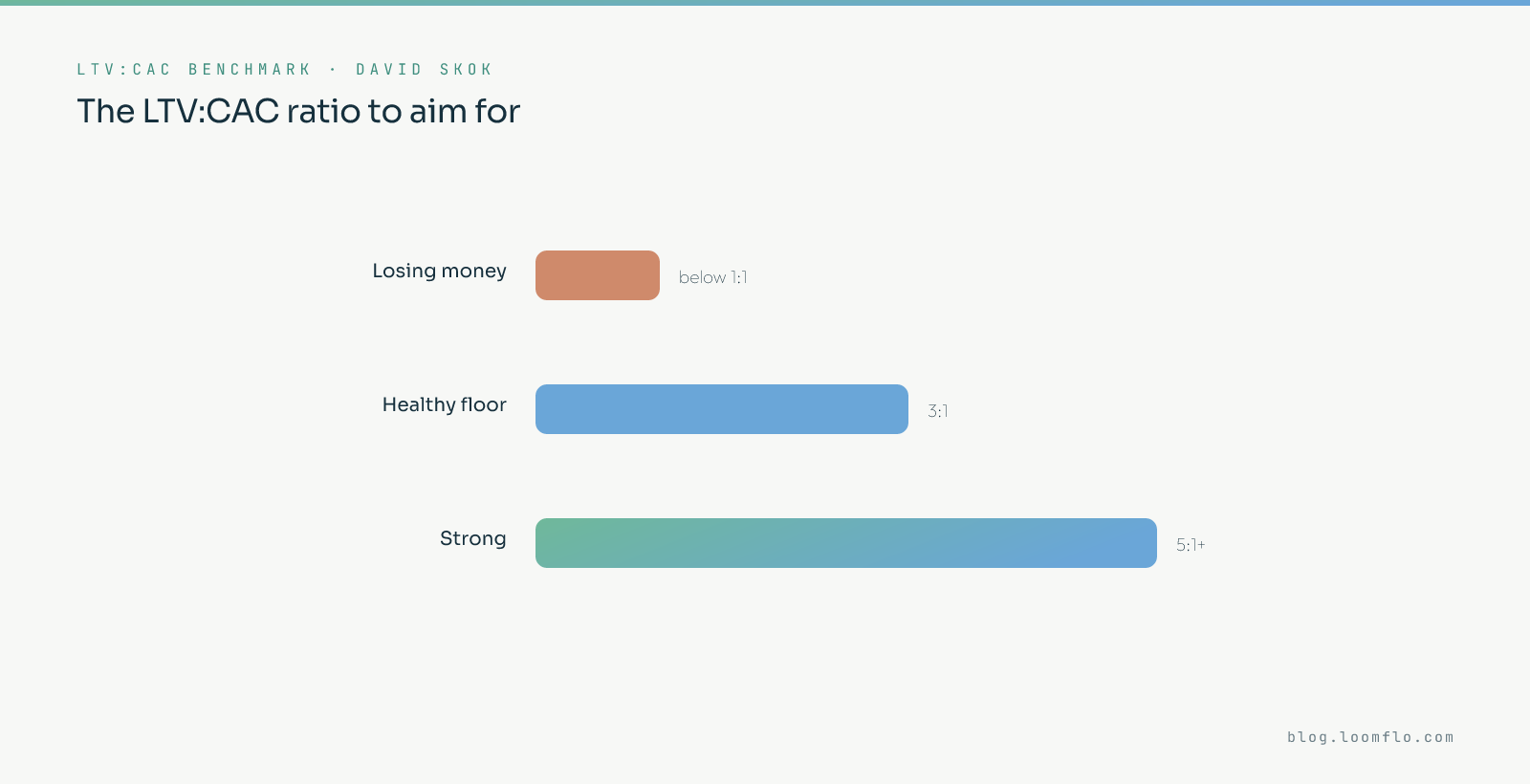
David Skok’s widely used benchmark puts 3:1 as the healthy floor, and top performers run 5:1 or higher. Below 1:1 you lose money on every customer.
There’s a twist, though. A ratio far above 3:1 can mean you’re under-investing in growth you could acquire faster by spending more.
Continuing the earlier example, a $4,800 CLV against a $2,000 acquisition cost is a 2.4:1 ratio. That’s below the floor, signaling you need to cut CAC, reduce churn, or raise revenue per account.
Why CLV beats chasing new customers
Focusing on lifetime value shifts attention to a cheaper, more reliable source of growth: the customers you already have. The economics are lopsided.
Acquiring a new customer costs 5 to 25 times more than retaining one (Harvard Business Review), and you’re far likelier to sell to an existing customer, 60–70% versus 5–20% for a new prospect (Marketing Metrics). Retention compounds, too a 5% increase can lift profits by 25% or more (Bain & Company).
The market has caught on. Gartner found 73% of chief sales officers are prioritizing growth from existing customers for 2025.
The four levers that drive CLV
Increasing CLV comes down to four levers. Move any of them and CLV rises.
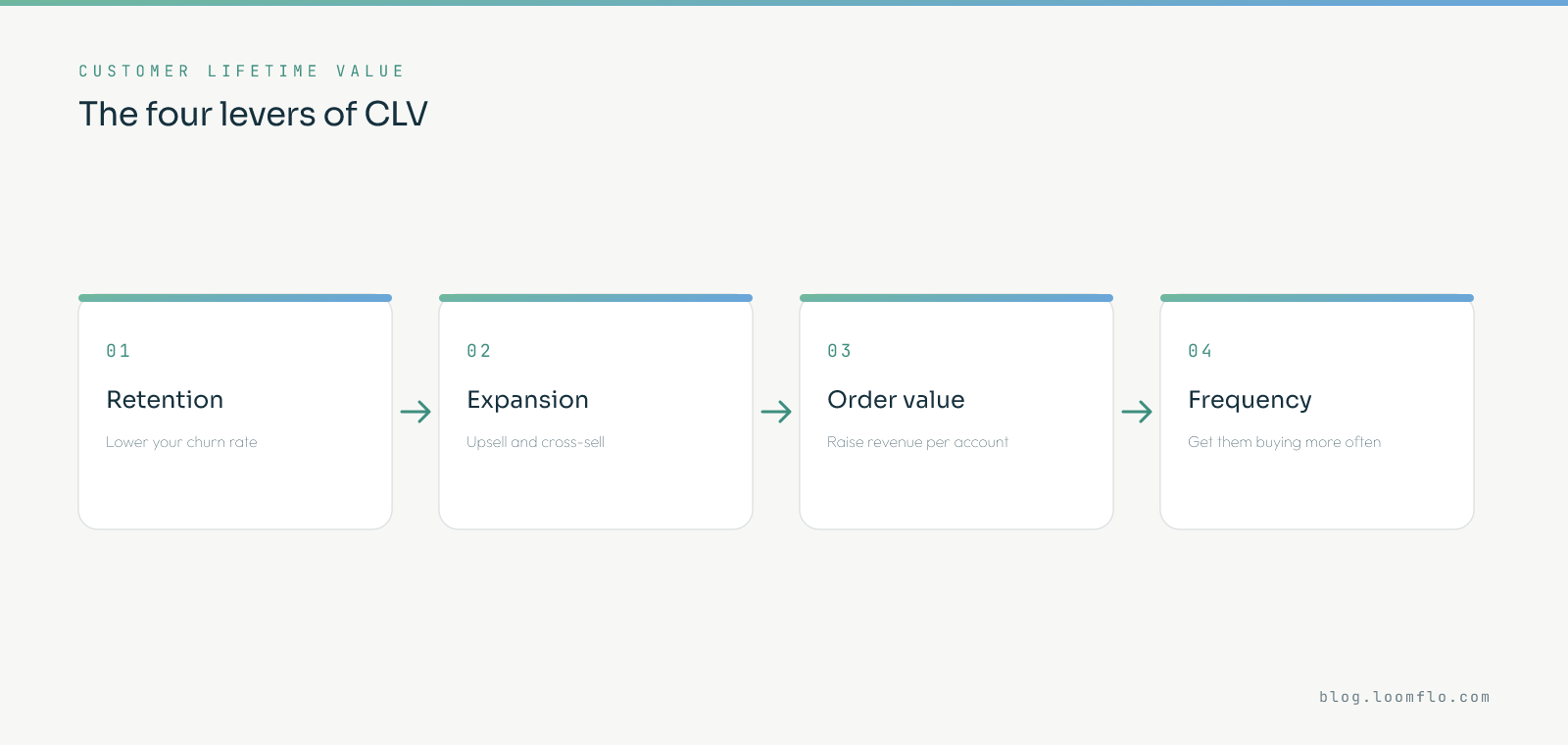
Retention
Because churn sits in the denominator of the SaaS formula, lowering it directly extends lifespan and lifts CLV. It’s the single most powerful lever.
Expansion
Upsells and cross-sells grow the value of customers you already have. This is how the best companies push net revenue retention above 100%.
Order value and frequency
Raising average revenue per account and getting customers to buy more often both add directly to lifetime value. Small gains here compound over the relationship.
Common CLV mistakes
A few errors make CLV misleading or useless. Watch for these.
- Using revenue, not margin: Ignoring gross margin overstates what a customer is really worth.
- Ignoring churn: Churn dominates SaaS CLV, so leaving it out breaks the number.
- Measuring it once: CLV shifts as retention and pricing change, so it needs updating.
- Treating all customers equally: Value varies widely, and averages hide your best and worst segments.
Only about 17% of marketers say their firm measures CLV well (CMO Council and Deloitte). Getting it right is itself an advantage.
How AI increases customer lifetime value
AI raises CLV by making retention and expansion earlier and more precise. It doesn’t invent loyalty — it acts on the levers faster.
Churn-prediction models flag at-risk accounts from usage and engagement signals, so you intervene before they cancel. Since CLV is inversely tied to churn, small reductions compound directly into value.
Propensity models identify which existing customers are ready for an upsell, leveraging that 60–70% sell-to-existing probability. Predictive LTV models even estimate a customer’s likely value early, so you route high-value accounts to better care and target look-alikes in acquisition.
The honest framing: AI makes existing retention, expansion and targeting motions faster and more accurate. The compounding math of CLV is what makes those marginal gains financially significant.
Where CLV fits
CLV is the metric that ties retention, pricing and acquisition together. It tells you how much you can afford to spend and where growth really comes from.
It connects directly to the systems that raise it. See how customer retention extends lifespan and how customer onboarding gets customers to value faster.
Measure CLV honestly, watch the LTV:CAC ratio, and pull the four levers that’s how you build growth that compounds instead of leaking.
Frequently asked questions
What is customer lifetime value?
It’s the total net revenue you can expect from one customer over the entire relationship. It reframes customers as long-term assets rather than one-time transactions.
How do you calculate CLV?
For most businesses, multiply average purchase value by purchase frequency by customer lifespan. For SaaS, use (average revenue per account × gross margin %) ÷ churn rate.
What is a good LTV:CAC ratio?
3:1 is the widely accepted healthy floor, and 5:1 or higher is strong. Below 1:1 means you lose money on each customer, while a very high ratio can signal under-investment in growth.
Why is CLV important?
It tells you whether your growth is sustainable and how much you can afford to spend acquiring customers. It also shifts focus to retention and expansion, which are far cheaper than acquisition.
How do you increase CLV?
Pull the four levers: reduce churn, expand accounts with upsell and cross-sell, raise average revenue per account, and increase purchase frequency. Better onboarding and personalization support all four.
What’s the difference between CLV and CAC?
CLV is the value a customer brings over their lifetime; CAC is the cost to acquire them. The ratio between them tells you whether your growth is profitable.
Grow the value of every customer
Loomflo builds AI growth infrastructure churn prediction, personalized expansion and lifecycle automation that lift retention and CLV, so each customer is worth more.