Customer acquisition cost is what you spend to win one new customer. It decides whether growth is profitable or just expensive the median B2B SaaS company takes 16 months to earn its CAC back (First Page Sage), and a healthy business needs to recover it well before the customer leaves.
Plenty of companies grow revenue while quietly losing money on every new customer. They just don’t know it yet.
The number that reveals it is CAC. This guide covers how to calculate it properly, what good looks like, and how to bring it down.
What is customer acquisition cost?
Customer acquisition cost is the total amount you spend on sales and marketing to acquire one new customer over a given period. It’s the price tag on growth.
The formula is simple: CAC = total sales and marketing spend ÷ number of new customers acquired.
Here’s a worked example. Spend $50,000 in a quarter and sign 25 new customers, and your CAC is $2,000.
What actually counts in the calculation
Most teams understate this badly by counting only ad spend. A real figure includes everything that went into winning the customer.
- Advertising and media spend: across every paid channel.
- Salaries: for sales and marketing staff, including a share of leadership.
- Tools and software: CRM, automation, data, analytics.
- Agencies and contractors: including freelancers and consultants.
- Commissions and bonuses: tied to closing new business.
Leave salaries out and you’ll get a comfortable number that’s simply wrong. Understating it leads directly to overspending.
Blended, paid and channel CAC
One number hides too much, so most teams track three views. Each answers a different question.
Blended CAC divides all spend by all new customers, including those who arrived organically. Paid CAC counts only paid spend and paid-sourced customers, which is the honest measure of what buying growth costs.
Channel CAC breaks it down per channel, and it’s where the real decisions live. It’s how you find that one channel is quietly three times more expensive than the rest.
What’s a good CAC?
There’s no universal target, because CAC only means something relative to what a customer is worth. Two ratios give it context.
The first is LTV:CAC. David Skok’s widely used benchmark puts 3:1 as the healthy floor, with strong companies at 5:1 or higher below 1:1 you lose money on every customer.
For scale, average B2B SaaS acquisition costs have been climbing toward roughly $1,200 per customer in recent benchmarks, and Google Ads cost per lead now averages around $70 (WordStream).
CAC payback period
The second ratio is arguably more useful day to day. It asks how many months of revenue it takes to earn the money back.
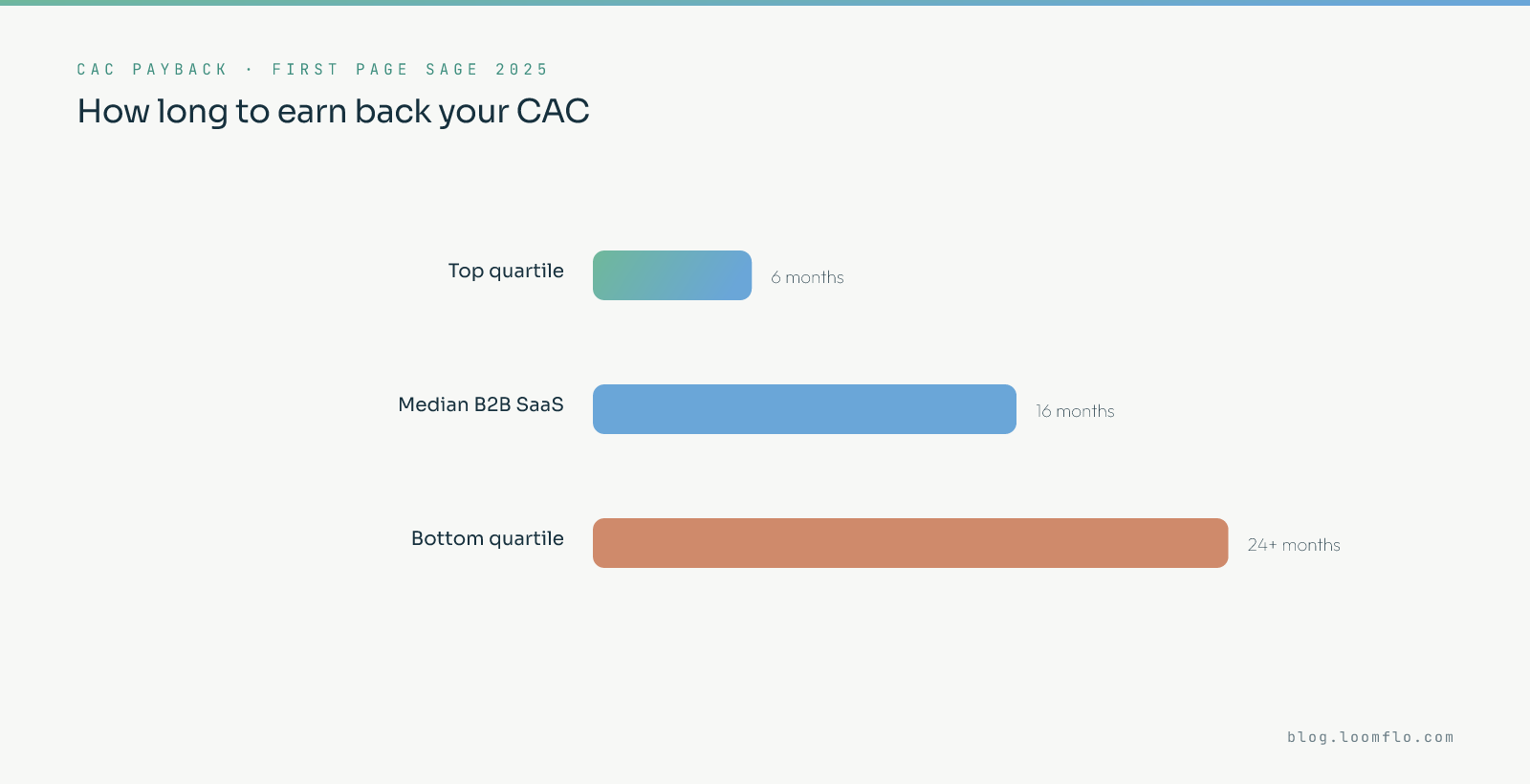
First Page Sage’s 2025 benchmarks put the median B2B SaaS payback at 16 months, with the top quartile recovering in six months or less and the bottom quartile taking 24+ months.
Under 12 months is generally considered efficient, because it means growth largely funds itself. Past 24 months you’re financing every customer for two years before seeing a profit.
Why acquisition keeps getting more expensive
If your customer acquisition cost is rising, you’re not alone the trend is structural. Several forces push in the same direction.
Paid channels get more competitive and more expensive every year, privacy changes have made targeting less precise, and B2B buying committees and sales cycles keep growing. Buying attention simply costs more than it used to.
That’s exactly why the levers below matter more each year.
How to reduce it
You lower acquisition costs by making each dollar and each lead go further. Five levers do most of the work.
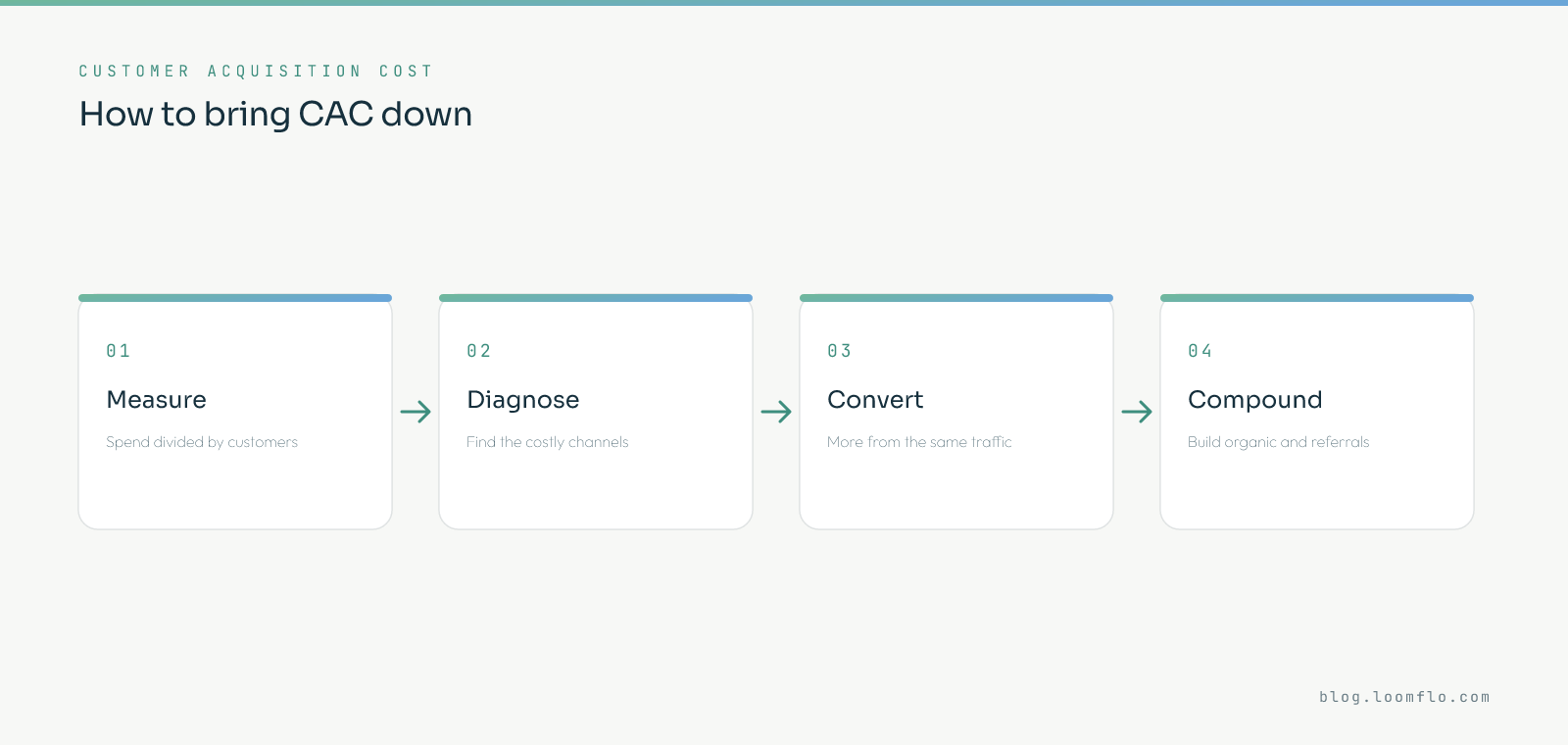
1. Convert more of the traffic you already have
Improving conversion rate lowers CAC across every channel simultaneously, because you pay the same for traffic and get more customers. It’s the fastest lever available.
2. Respond faster
Speed to lead turns existing leads into more customers without buying a single extra click. Same spend, more conversions, lower cost.
3. Target better
Scoring and enrichment concentrate spend and rep hours on prospects who actually look like your best customers. Less waste on people who were never going to buy.
4. Build compounding channels
Content and search keep producing after you stop paying, which drags blended CAC down over time. Paid stops the day the budget stops.
5. Retain and get referred
Retention isn’t usually filed under acquisition, but it belongs there acquiring a customer costs five to twenty-five times more than keeping one (Harvard Business Review), and referrals arrive at near-zero cost.
Common mistakes
A few errors make this number misleading. Each is easy to avoid.
- Excluding salaries and tools: The most common way to flatter the figure.
- Only tracking blended: Organic customers mask how expensive paid really is.
- Ignoring the payback period: A workable ratio can still create a cash crisis.
- Mismatched time windows: Comparing this month’s spend to this month’s customers ignores the sales cycle.
- Optimizing it in isolation: The cheapest customers are sometimes the ones who churn fastest.
How AI lowers customer acquisition cost
AI reduces CAC mostly by removing waste, not by finding cheaper ads. The mechanisms are concrete.
Predictive scoring and enrichment point spend and rep time at prospects likeliest to buy, so less budget lands on poor fits. Faster, automated lead response converts more of the traffic you already paid for.
Automating manual sales and marketing work reduces the labor cost baked into every deal. And AI-scaled content builds the organic channels that pull blended cost down as they compound.
An honest caveat: none of this makes acquisition free, and results depend on clean data and a real offer. AI shifts the efficiency curve it doesn’t repeal it.
Where CAC fits
Acquisition cost is only half the equation. On its own it tells you nothing it’s meaningful against customer value and payback time.
That’s why it pairs with the metrics around it. See customer lifetime value for the other side of the ratio, and conversion rate optimization for the fastest way to bring the number down.
Measure it honestly, watch the payback clock, and build channels that compound that’s how growth stops being expensive.
Frequently asked questions
What is customer acquisition cost?
It’s the total sales and marketing spend required to win one new customer in a given period. It tells you what growth actually costs.
How do you calculate CAC?
Divide total sales and marketing spend by the number of new customers acquired in the same period. Include salaries, tools, agencies and commissions not just ad spend.
What is a good CAC?
There’s no universal number; it depends on what a customer is worth. Aim for an LTV:CAC ratio of at least 3:1 and payback under 12 months.
What is a good LTV to CAC ratio?
3:1 is the widely used healthy floor and 5:1 or better is strong. Below 1:1 means you lose money on every customer you win.
Why is my CAC so high?
Usually over-reliance on paid channels, weak conversion rates, poor targeting, slow lead follow-up, or long sales cycles with heavy manual effort. Rising ad costs make all of these worse.
How do you reduce it?
Improve conversion rates, respond to leads faster, target better with scoring, build compounding organic channels, and invest in retention and referrals. Conversion and speed usually pay off fastest.
Make growth cheaper
Loomflo builds AI growth infrastructure better targeting, instant lead response and compounding content engines that lower what it costs you to win a customer.