Conversion rate optimization is how you get more revenue from the traffic you already have, instead of paying for more. The math is brutal: for every $92 companies spend acquiring visitors, only $1 goes toward converting them (Econsultancy) so small improvements compound across every channel at once.
Most teams try to grow by buying more traffic. That’s the expensive way, especially as acquisition costs keep climbing.
There’s a cheaper lever sitting untouched: converting more of the visitors you already pay for. This guide explains conversion rate optimization, the process behind it, and the fixes that move the needle most.
What is conversion rate optimization?
Conversion rate optimization (CRO) is the systematic process of increasing the percentage of visitors who take a desired action a purchase, signup, demo request or form fill without needing more traffic. It extracts more value from every visit you’ve already earned.
The core formula is simple. Conversion rate = (conversions ÷ total visitors) × 100.
So 50 signups from 2,000 visitors is a 2.5% conversion rate. CRO is the discipline of moving that number up, deliberately and repeatably.
Why CRO matters more in 2026
The case for CRO gets stronger every year, because the alternative keeps getting pricier. Buying growth is a losing race.
Customer acquisition costs have risen sharply over the past five years, and paid clicks keep inflating WordStream put the average Google Ads cost per lead around $70 in its recent benchmarks. Every dollar of traffic buys less than it used to.
CRO flips the equation. A higher conversion rate lowers your effective cost per acquisition across paid, SEO and email simultaneously it’s the one lever that improves every channel at once.
What counts as a good conversion rate?
The honest answer is that it depends on your industry, traffic source and offer. But benchmarks give you a sense of the field.
Average ecommerce conversion sits near 1.8% (IRP Commerce, via Smart Insights), with 2–4% considered solid. Landing pages average around 4.4%, while the top 10% convert above 11% (Unbounce).
Device matters too. Desktop converts roughly 1.7–1.9× higher than mobile even though mobile drives most traffic (Contentsquare), which tells you where friction is hiding.
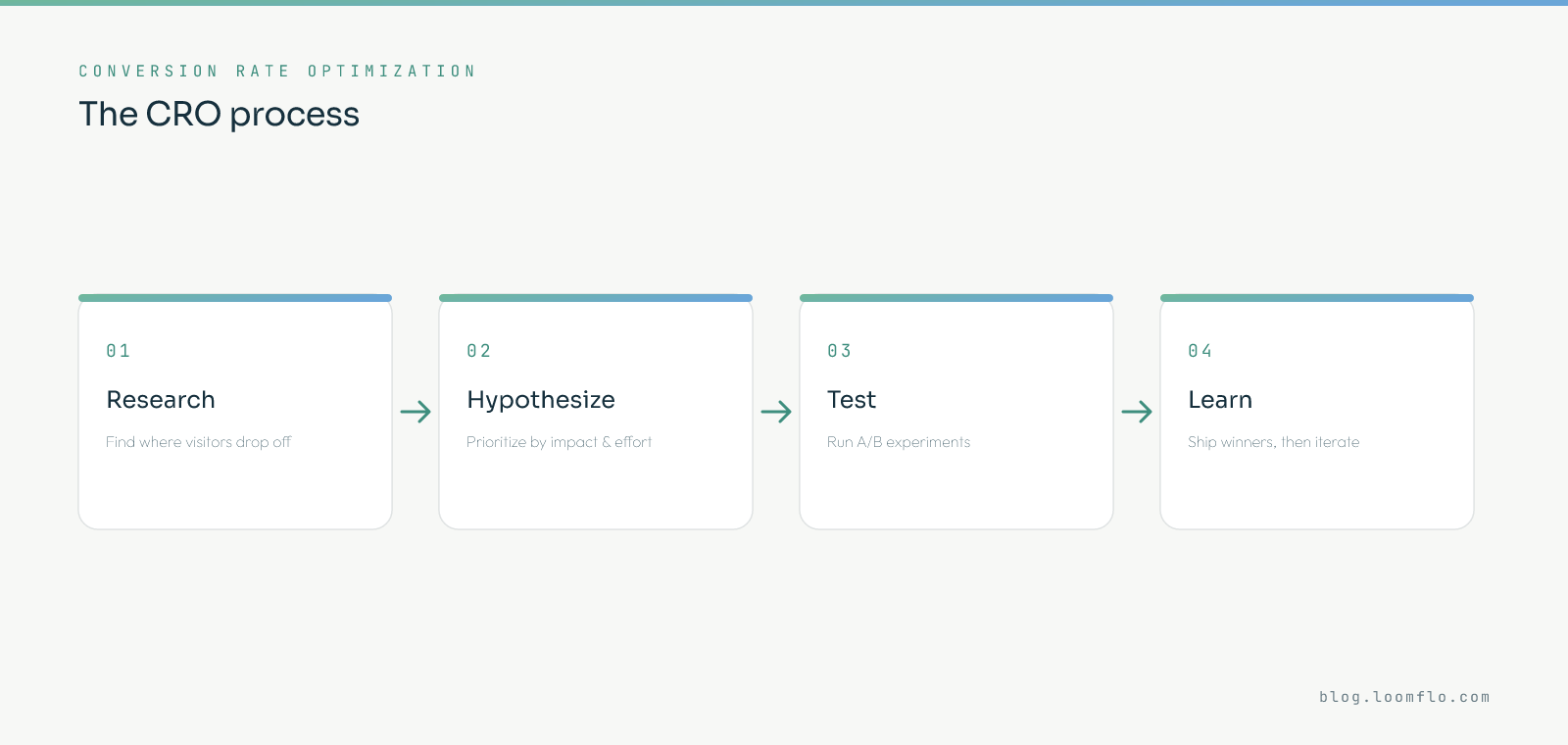
The CRO process
CRO isn’t guessing at button colors. It’s a repeatable loop that turns opinions into evidence.
1. Research
Start by finding where visitors struggle using analytics, heatmaps, session recordings and funnel drop-off. You can’t fix friction you haven’t found.
2. Hypothesize and prioritize
Turn each problem into a testable hypothesis, then rank them by expected impact and effort. Frameworks like ICE or PIE stop you from testing trivial things first.
3. Test
Run an A/B test that sends traffic to the current version and a variant. Let real behavior, not the loudest opinion, pick the winner.
4. Learn and iterate
Ship the winner, document what you learned, and feed it into the next hypothesis. The compounding comes from never stopping the loop.
A/B testing, done right
A/B testing is the engine of CRO, and also where most teams go wrong. The mistakes are predictable.
The biggest one is calling a test too early. A variant that “looks” ahead after two days can easily reverse you need statistical significance and ideally a full business cycle, usually two to four weeks.
The second is testing without enough traffic. If a page gets a trickle of visits, you’ll never reach significance, so fix the obvious problems directly instead of testing them.
The highest-impact CRO fixes
Some changes move conversions far more than others. If you’re starting out, start here.
Speed up your pages
Speed is money. Google and Deloitte found a 0.1-second improvement in mobile load time lifted retail conversions by 8.4%, and Google’s research shows 53% of mobile visitors abandon a site that takes over three seconds to load.
Shorten your forms
Every extra field costs you conversions. HubSpot’s analysis of over 40,000 landing pages found reducing a form from four fields to three lifted conversions by about 50%.
Remove checkout friction
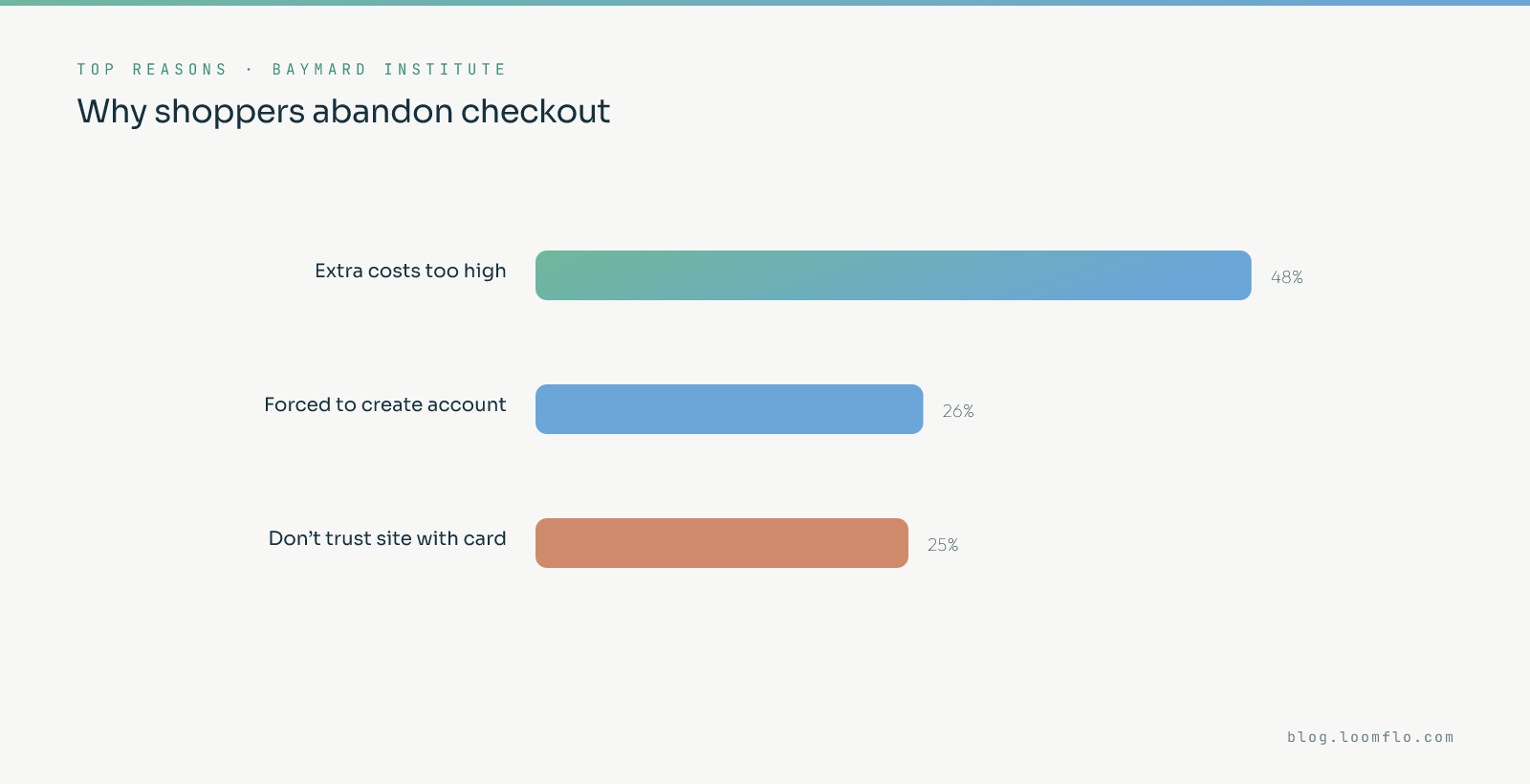
Around 70% of online carts are abandoned (Baymard Institute). The top reason is unexpected extra costs, cited by 48% of shoppers, followed by forced account creation at 26%.
Add trust and clarity
Clear value propositions, obvious calls to action and visible social proof reduce hesitation. Confused or skeptical visitors don’t convert they leave.
How personalization lifts conversions
Showing every visitor the same page leaves money on the table. Relevance converts better than generic.
McKinsey found personalization typically drives a 10–15% revenue lift, can cut acquisition costs by up to 50%, and improves marketing ROI by 10–30%. Matching the message to the visitor’s source, segment or behavior is one of the most reliable gains in CRO.
The catch is bandwidth. Hand-building variants for every segment is impossible for a small team which is exactly where automation earns its place.
How AI improves conversion rate optimization
The two things that throttle CRO are research bandwidth and testing velocity. AI attacks both.
It reads session recordings, heatmaps and funnel data at scale to surface friction humans miss, so you test the right things first. That turns weeks of manual review into hours.
It also generates headline, CTA and layout variants in minutes, expanding the number of ideas you can actually test. More quality experiments per month is the single best predictor of faster growth.
An honest caveat matters here. AI amplifies a disciplined CRO process it doesn’t replace strategy, brand judgment, or the traffic you need for valid results. Reported 15–25% uplifts are potential, not promises.
Common CRO mistakes to avoid
Most failed CRO programs share the same handful of errors. Each one is avoidable.
- Ending tests early: Calling a winner before statistical significance is the most common and costly mistake.
- Copying competitors: Their audience and funnel aren’t yours, so their “winner” may lose for you.
- Testing with too little traffic: Low-traffic pages can’t reach significance fix them directly.
- Optimizing vanity metrics: Chasing clicks instead of revenue optimizes the wrong outcome.
- Ignoring qualitative data: Numbers show what happens; recordings and surveys show why.
Avoid these and your win rate climbs. Fall into them and you’ll conclude “CRO doesn’t work,” when the process was the problem.
Where CRO fits in growth
CRO isn’t a rival to SEO or ads it’s the multiplier on both. SEO grows the quantity of traffic; conversion rate optimization grows the share of it that turns into revenue.
That’s why it belongs in a system, not a one-off project. For the traffic side of the equation, see our guide to increasing organic traffic, and for the strategy that ties it together, campaigns vs infrastructure.
Run always-on, CRO compounds because every point of conversion you win keeps paying on all the traffic that follows.
Frequently asked questions
What is conversion rate optimization?
It’s the systematic process of increasing the percentage of visitors who complete a desired action, without needing more traffic. It gets more value from the visits you already have.
How do you calculate conversion rate?
Divide conversions by total visitors and multiply by 100. For example, 50 conversions from 2,000 visitors is a 2.5% rate.
What is a good conversion rate?
Ecommerce averages around 1.8–2%, with 2–4% considered solid and top performers above 5%. “Good” always depends on your industry, traffic source and offer.
What’s the difference between CRO and SEO?
SEO increases the quantity of traffic; CRO increases the percentage of that traffic that converts. They compound each other rather than compete.
How long should an A/B test run?
Until it reaches statistical significance and covers a full business cycle, typically two to four weeks with enough conversions per variant. Ending early is the top testing mistake.
How much does page speed affect conversions?
A lot Google and Deloitte found a 0.1-second speed gain lifted retail conversions by 8.4%, and 53% of mobile users leave sites that take over three seconds to load.
Can AI improve conversion rates?
Yes, mainly by accelerating research, personalization and test velocity. Results depend on having enough traffic and a disciplined process AI amplifies a good process rather than replacing it.
How much should I invest in CRO?
Most companies spend under 5% of budget on it despite outsized returns the classic “$92 to acquire, $1 to convert” imbalance. Shifting even a little toward conversion usually pays back fast.
What tools do I need to start?
At minimum, analytics plus a heatmap or session-recording tool to find friction, and an A/B testing tool to validate fixes. You can add personalization once the basics are working.
Turn your existing traffic into revenue
Loomflo builds AI growth infrastructure always-on systems that find friction, test fixes and personalize at scale, so your conversion rate keeps climbing while you sleep.