Your ideal customer profile is the description of the companies most likely to buy, stay and expand and it’s the highest-leverage decision in go-to-market. Get it loose and you pay for it downstream: reps already spend about 70% of their time on non-selling work (Salesforce), and a fuzzy target only makes that worse.
Most go-to-market problems trace back to one upstream mistake: chasing the wrong companies. Everything after that messaging, spend, rep time gets harder.
Your ideal customer profile fixes it at the source. This guide covers what an ICP really is, how it differs from a persona, and how to build one that actually gets used.
What is an ideal customer profile?
An ideal customer profile is a description of the type of company that is the best possible fit for your product the accounts most likely to buy quickly, get real value, stay, and expand. It answers a blunt question: which companies should we go after, and which should we ignore?
It’s defined mostly by firmographics industry, company size, revenue, and geography. Add technographics (the tools they run) and operational traits like growth stage and budget authority.
ICP vs buyer persona
These two get confused constantly, and the difference matters. One is a company, the other is a person.
An ideal customer profile describes the account the kind of organization worth targeting. A buyer persona describes the individual human inside that account you sell to and through.
One ICP account usually contains several personas the economic buyer, the champion, the technical evaluator, the blocker. The ICP tells you which doors to knock on; personas tell you who answers and what they care about.
Why your ICP is the highest-leverage call you make
A loose target quietly taxes everything downstream. The evidence is stark.
Salesforce found reps spend roughly 70% of their time on non-selling work, so the scarce selling time you do have shouldn’t be spent on bad-fit prospects. And most leads never convert anyway MarketingSherpa’s long-cited benchmark puts it around 79%.
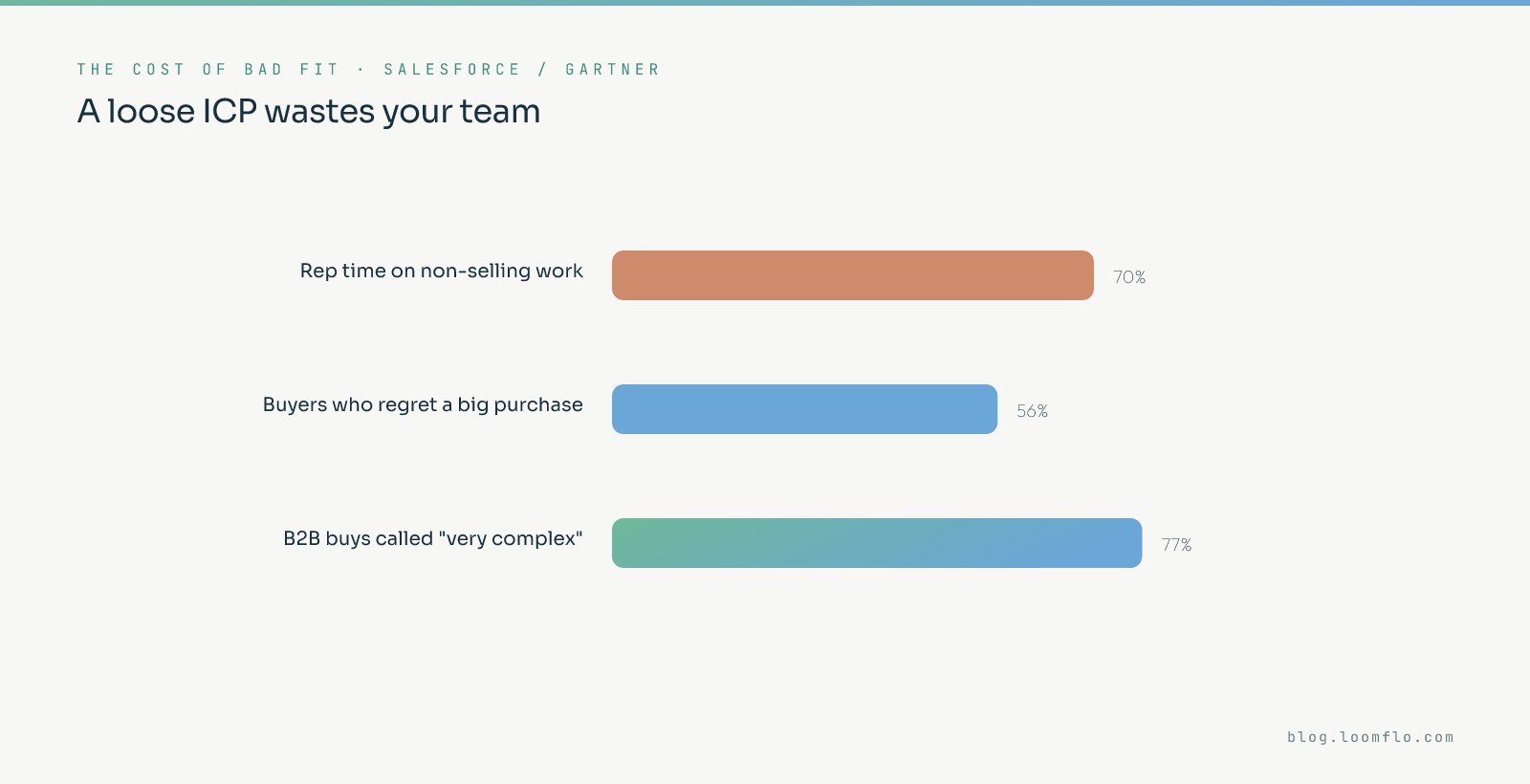
Bad fit doesn’t just lose deals it wins the wrong ones. Gartner found 56% of organizations highly regret their largest recent tech purchase, and those regretful, poor-fit customers are the ones who churn.
What goes into an ICP
A useful ICP has four layers. Skip any of them and it gets vague fast.
- Firmographic: Industry, company size, revenue, geography, growth stage the basics of who fits.
- Technographic: The tools and platforms they run, which signal both fit and integration readiness.
- Behavioral: Buying triggers, budget, org maturity, and how intensely they’d use your product.
- Negative traits: The anti-ICP who to actively exclude, like companies too small to buy or verticals you can’t serve.
That last layer is the one most teams skip. Naming who you don’t want is what keeps the profile sharp.
How to build your ICP
A good ICP is derived from data, not opinion. Build it in four steps.
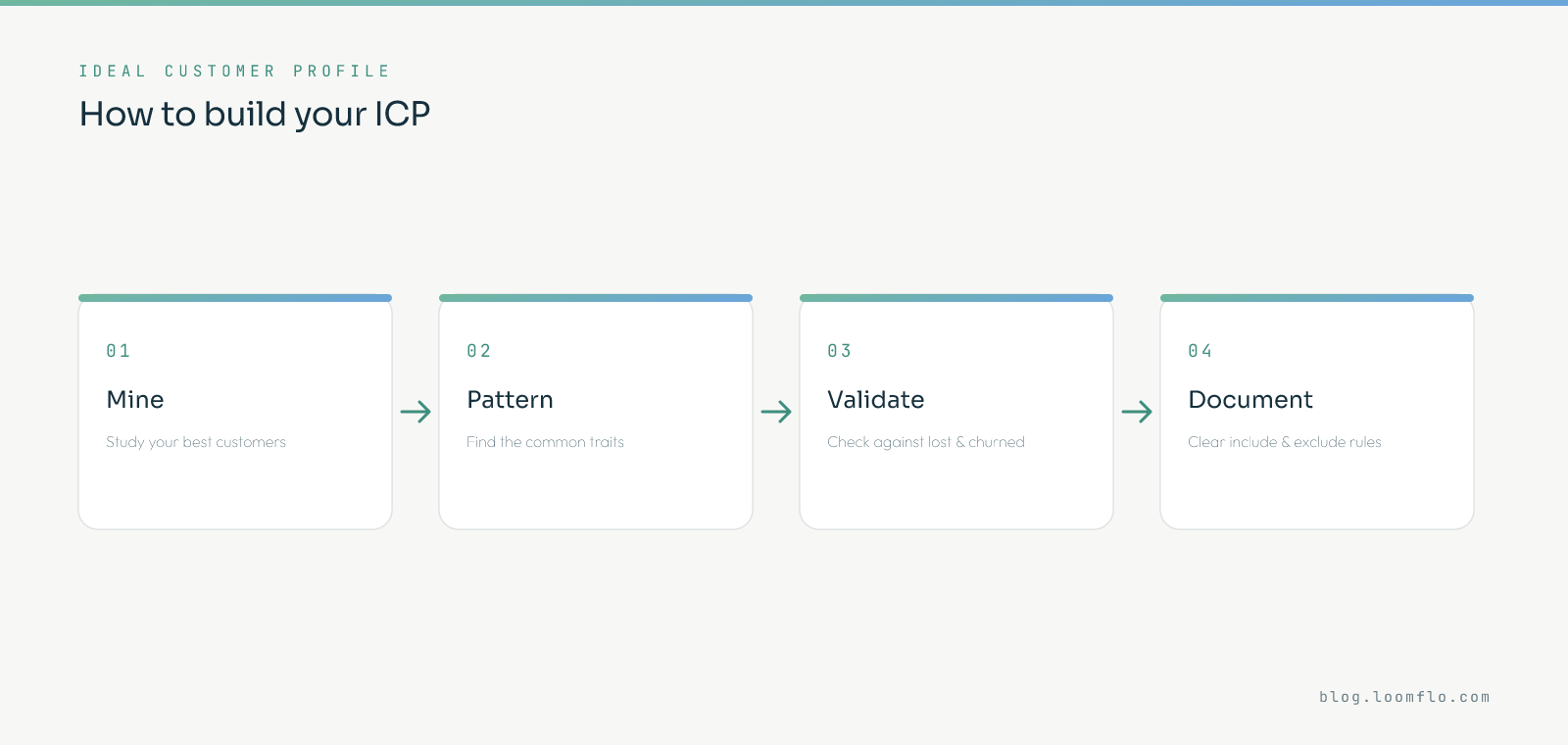
1. Mine your best customers
Start with your strongest accounts highest lifetime value, fastest to close, lowest churn, best references. They hold the pattern.
2. Find the common traits
Look for the firmographic, technographic and behavioral traits those winners share. That overlap is your draft profile.
3. Validate against losses
Check the pattern against closed-lost and churned accounts to see what breaks. This is where your negative criteria come from.
4. Document it
Write it as one shareable page with clear include and exclude rules. An ICP nobody can find or apply isn’t an ICP.
How to actually use it
An ICP earns its keep when it drives decisions, not when it sits in a slide. Point it at four things.
Use it to build target lists, to score leads and accounts, and to prioritize where reps spend their limited selling time. It’s also the prerequisite for account-based marketing ITSMA found 87% of marketers say ABM delivers higher ROI than any other approach, and that starts with knowing exactly which accounts to target.
Common ICP mistakes
Most weak ICPs fail in the same few ways. Each is fixable.
- Too broad: “Any company that could use us” is not a target it’s the absence of one.
- Built on opinion: Guessing instead of mining closed-won data produces a flattering, useless profile.
- No exclusion criteria: Without an anti-ICP, sales chases everyone again.
- Confusing ICP with persona: Targeting a job title instead of an account type misses the buying group.
- Set and forget: Your best-fit segment shifts as you grow, so a stale ICP slowly stops matching reality.
How AI keeps your ICP sharp
The hard part of an ICP isn’t writing it once it’s keeping it evidence-based and current. That’s where automation helps.
AI mines your closed-won data to surface the firmographic and technographic combinations that actually correlate with good outcomes, replacing gut feel with patterns. It enriches thousands of accounts with firmographic and technographic data so your criteria can be applied at scale.
It then scores inbound and target accounts against the ICP automatically, and finds look-alike companies that resemble your best customers. As new won, lost and churn data lands, the analysis re-runs so the profile updates continuously.
The honest caveat: this only works on reasonably clean CRM data, and AI sharpens judgment rather than replacing it. Garbage in still means a garbage ICP out.
Where the ICP fits
The ideal customer profile is the foundation the rest of your funnel stands on. Aim it correctly and targeting, scoring and messaging all get easier.
It connects directly to the systems that act on it. See how it powers account-based marketing and feeds your lead scoring model.
Define who to chase and who to ignore and every dollar and hour after that works harder.
Frequently asked questions
What is an ideal customer profile?
It’s a description of the type of company that’s the best fit for your product defined by firmographics, tech stack and behavior. It’s the accounts most likely to buy, stay and expand.
What’s the difference between an ICP and a buyer persona?
An ICP describes the company you target; a buyer persona describes the individual person inside it. B2B needs both one picks the account, the other guides the conversation.
How do you create an ICP?
Analyze your best existing customers, extract the traits they share, validate against lost and churned deals, add negative criteria, and document clear include and exclude rules.
What should an ICP include?
Industry, company size and revenue, geography, growth stage, tech stack, and buying triggers plus the disqualifying traits that define who to exclude.
Why is an ICP important?
It concentrates limited sales and marketing effort on accounts that convert and retain, cutting the wasted rep time and bad-fit customers that a loose target creates.
How often should you update it?
Treat it as a living document revisit it quarterly and whenever you move upmarket, launch a product or enter a new segment. Re-derive it from fresh won, lost and churn data.
Point your team at the right accounts
Loomflo builds AI growth infrastructure closed-won analysis, enrichment and account scoring that turn a static ICP slide into a living targeting system.