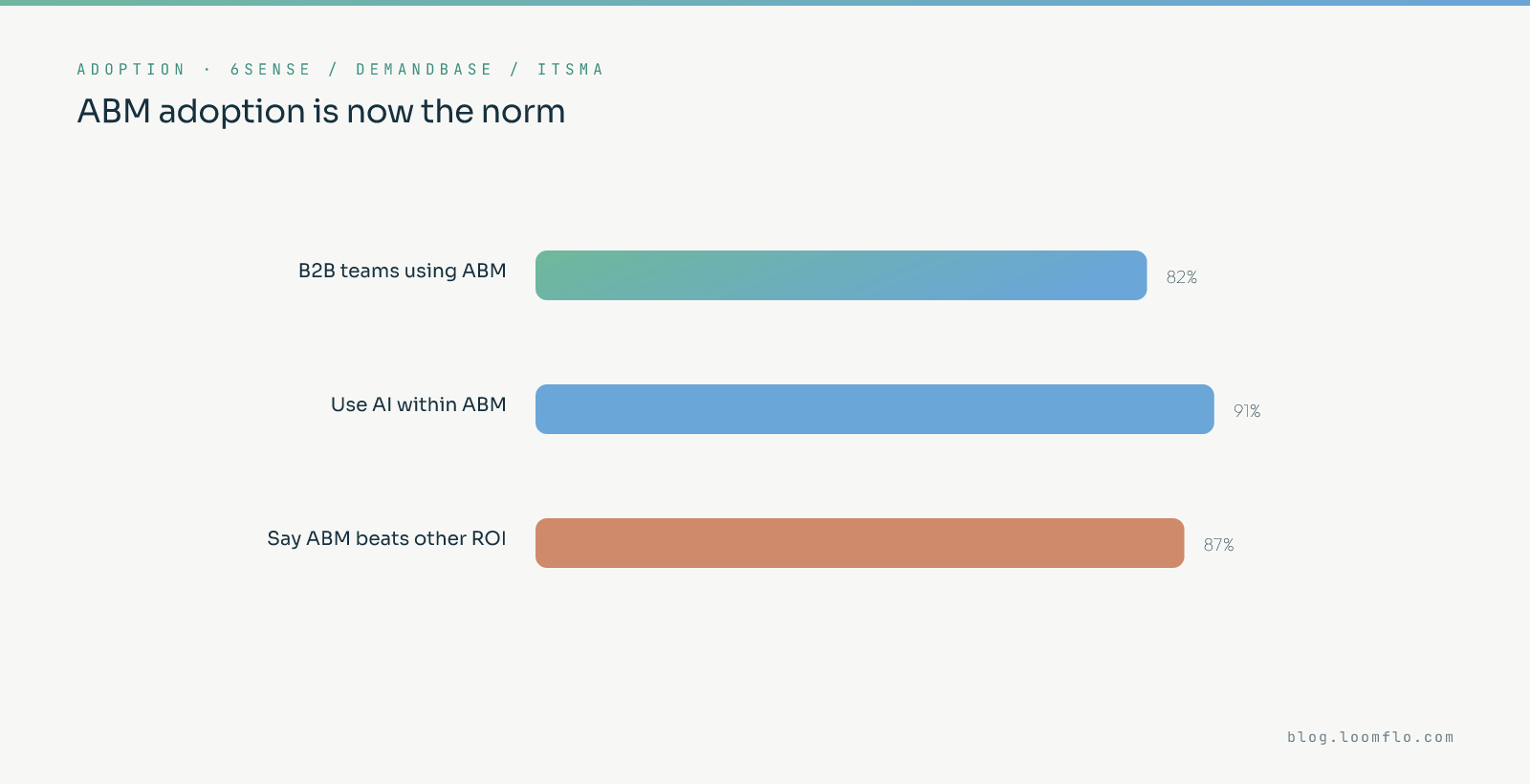
Account-based marketing flips the funnel: instead of chasing as many leads as possible, you pick your best-fit accounts and market to the whole buying group inside them. It’s now mainstream 82% of B2B teams use ABM (6sense), and 87% say it delivers higher ROI than any other strategy (ITSMA).
Traditional B2B marketing casts a wide net and hopes a few good leads fall out. But most of those leads never fit, and the ones that do are buried in noise.
Account-based marketing takes the opposite approach. This guide explains what ABM is, how it works, and why AI is what finally makes it scale beyond a handful of accounts.
What is account-based marketing?
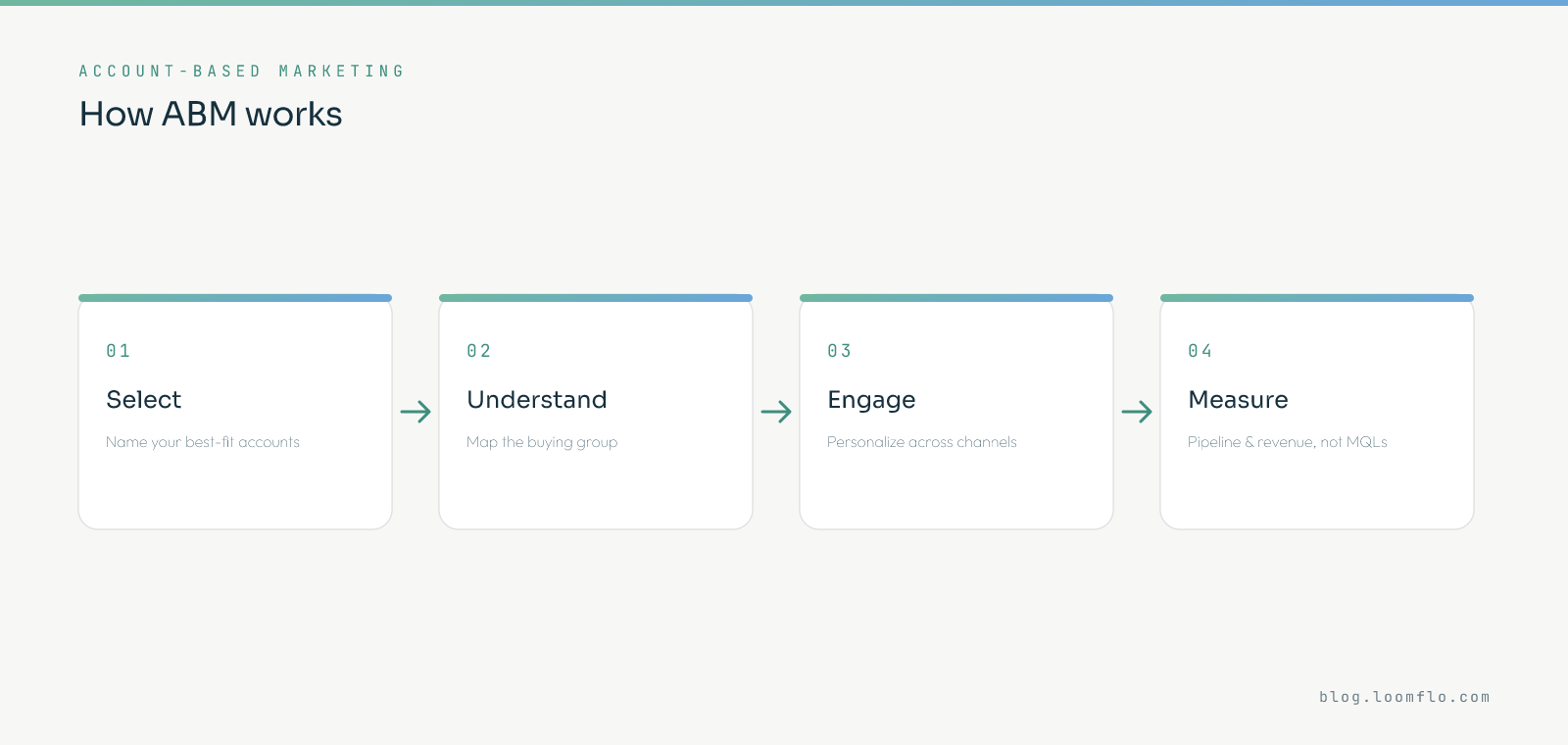
Account-based marketing is a B2B strategy where sales and marketing jointly pick a finite set of high-value target accounts, then run coordinated, personalized campaigns at the entire buying committee inside each one. You treat each account as a market of one.
It inverts the traditional funnel. Instead of starting wide with leads and filtering down, you start narrow with named accounts and expand engagement within each.
The shift is from “more leads” to “the right accounts” and from measuring lead volume to measuring pipeline and revenue.
Why the traditional funnel is breaking
ABM is spreading because buyer behavior broke the old model. Two facts explain why.
First, buyers self-educate before they ever talk to you 84% of B2B buyers have already chosen a preferred vendor before contacting sales (6sense). By the time a lead raises its hand, the real decision is largely made.
Second, nobody buys alone. B2B purchases involve buying groups of three or more people in roughly 92% of cases, with around 11 people in larger deals (Forrester and 6sense). Chasing one contact ignores the other ten who decide.
ABM vs demand generation
People often frame ABM against demand gen, but they’re complements, not rivals. They answer different questions.
Demand generation creates and captures interest across your whole market it’s about volume and reach. Account-based marketing concentrates effort on a defined list of accounts it’s about focus and depth.
The strongest programs run both. Demand gen builds awareness in the market; ABM converts your highest-value slice of it with precision.
The three tiers of ABM
ABM isn’t one tactic it scales in three tiers, based on how many accounts you target and how deep you personalize.
1:1 strategic ABM
A handful of your biggest accounts get bespoke, deeply researched campaigns. High cost, high personalization, reserved for whale deals.
1:few ABM lite
Small clusters of similar accounts share tailored campaigns built around a common industry or need. It balances relevance with efficiency.
1:many programmatic ABM
Hundreds or thousands of accounts are targeted using intent data and automation, with personalization driven by segment. This is the tier AI unlocks.
Intent data and account selection
The whole game in ABM is targeting the right accounts at the right time. Intent data is how you do it.
At any moment, only about 5% of your target accounts are actively in-market (Demandbase). Spraying all of them wastes budget on the 95% who aren’t ready.
Intent signals what accounts research across the web, review sites and your own properties tell you which ones are heating up. That’s why 74% of ABM teams now track opportunities sourced from third-party intent (6sense).
Sales and marketing alignment
ABM lives or dies on whether sales and marketing actually work as one team. It’s the make-or-break factor.
Because both functions target the same named accounts, they need a shared list, shared goals and shared account intelligence. When marketing chases MQLs and sales chases accounts, ABM falls apart.
Done right, the two operate from one account plan marketing warms the committee, sales works the relationships, and both measure the same pipeline.
Measuring ABM the right way
ABM fails when it’s measured like lead gen. The metrics have to change with the strategy.
Instead of raw lead counts, ABM tracks account engagement, pipeline created, win rate, deal size and velocity. Fittingly, ABM teams track about 50% more metrics than non-ABM teams 5.2 versus 3.4 on average (6sense).
How AI makes ABM scale
ABM used to be capped at a few dozen accounts because the manual work research, monitoring, personalization didn’t scale. AI removes those ceilings.
Adoption is already near-universal: 91% of B2B marketers use AI within their ABM programs, though only 19% have a formal plan for it (Demandbase and ForgeX). The gap between using AI and using it well is where the advantage sits.
Predictive account selection
Models weigh firmographics, technographics, hiring activity and engagement to rank which accounts are most likely to buy. It replaces static ICP lists and 87% of leaders now call predictive account selection essential (Demandbase).
Real-time intent alerts
AI monitors buying signals across the web and flags spikes, so sales acts while intent is live. Timing precision is the whole point when only 5% of accounts are in-market at once.
Personalization at scale
Generative AI drafts account-specific messaging, pages and sequences, so 1:many programs approach the relevance of 1:1. That’s the long-promised “market of one, at scale.”
Is ABM only for enterprises?
A common myth is that ABM needs an enterprise budget. It doesn’t.
Programmatic and 1:few ABM scale down well, and any company with a clear ideal customer and high-value deals can run it. The bar isn’t budget it’s knowing exactly which accounts are worth winning.
Common ABM mistakes
A few patterns quietly sink ABM programs. Each is fixable.
- Too many accounts: A bloated list dilutes personalization until it’s just spam with a company name inserted.
- No sales alignment: If sales isn’t bought in, the campaigns never convert to conversations.
- Ignoring the buying group: Targeting one champion misses the committee that actually decides.
- Fake personalization: A merged first name isn’t relevance the content has to reflect the account’s real situation.
- Measuring MQLs: Lead-volume metrics hide whether you’re actually moving target accounts.
Avoid these and ABM concentrates your effort where the revenue is. Fall into them and it becomes expensive spray-and-pray.
Where ABM fits
Account-based marketing is the focus layer on top of your demand engine. Demand gen makes the market aware; ABM wins the accounts you most want.
That coordination is a system, not a campaign. For the wider market play, see demand generation, and for the outreach engine that works your target accounts, AI lead generation.
Built with the right data and automation, ABM turns your best-fit accounts from a wish list into a pipeline.
Frequently asked questions
What is account-based marketing in simple terms?
It’s picking your most valuable target accounts and marketing to the whole buying group inside them, instead of chasing a broad pool of individual leads. Each account is treated as a market of one.
What’s the difference between ABM and lead generation?
Lead generation maximizes the number of leads and filters down; ABM starts with named accounts and expands engagement within them. ABM trades volume for focus and depth.
Is ABM only for large enterprises?
No, programmatic and 1:few ABM scale down to startups and SMBs. Any company with a clear ideal customer and high-value deals can run it.
How do you measure ABM success?
Track account engagement, pipeline created, win rate, deal size and velocity not raw lead counts. The goal is revenue from target accounts, not MQL volume.
What tools do you need for ABM?
Typically an ABM or intent-data platform, a CRM, enrichment data and channels like LinkedIn and email. The essentials are account data, intent signals and a way to personalize outreach.
How much budget do you need to start ABM?
Less than most think you can start 1:few with a tight account list and existing channels. Budget matters less than choosing the right accounts and aligning sales with marketing.
How does AI change account-based marketing?
AI powers predictive account selection, real-time intent alerts and personalization at scale, removing the manual limits that once capped ABM. It’s what lets programmatic ABM reach thousands of accounts with relevance.
Win your best-fit accounts
Loomflo builds AI growth infrastructure the data, scoring and automated plays that make account-based marketing scale, so you engage the right accounts at the right moment.