AI content creation is now mainstream, 55% of marketers use AI to make content, and it reliably boosts speed. But it does not automatically improve quality, so the winning approach keeps a human in the loop to edit, fact-check and add original value.
AI can write a 1,500-word draft in seconds. That speed is seductive, and it is exactly why so much AI content is quietly mediocre.
The opportunity is real, but so is the risk to your brand and your rankings. This guide covers how to use AI content creation to scale output while keeping the quality that actually performs.
What is AI content creation?
AI content creation is the use of generative AI to produce or assist with content, drafting articles, outlines, summaries and variations, usually as part of a human-guided workflow rather than fully automated publishing. The best results treat AI as an assistant, not an author.
It is no longer a niche experiment. HubSpot found 55% of marketers use AI for content creation, making it the single most popular AI use case in marketing.
How widely is AI content creation used?
Adoption is broad and accelerating. The Content Marketing Institute found 89% of content marketers now use generative AI tools somewhere in their workflow.
It reaches well beyond big teams. Semrush reports 67% of small business owners use AI for content marketing or SEO.
And it mirrors a wider shift. McKinsey found 65% of organisations now regularly use generative AI, with marketing and sales the function where adoption more than doubled.
The catch: AI lifts speed, not automatically quality
This is the most important nuance in the data, and most teams miss it. AI is great at output and weak at judgment.
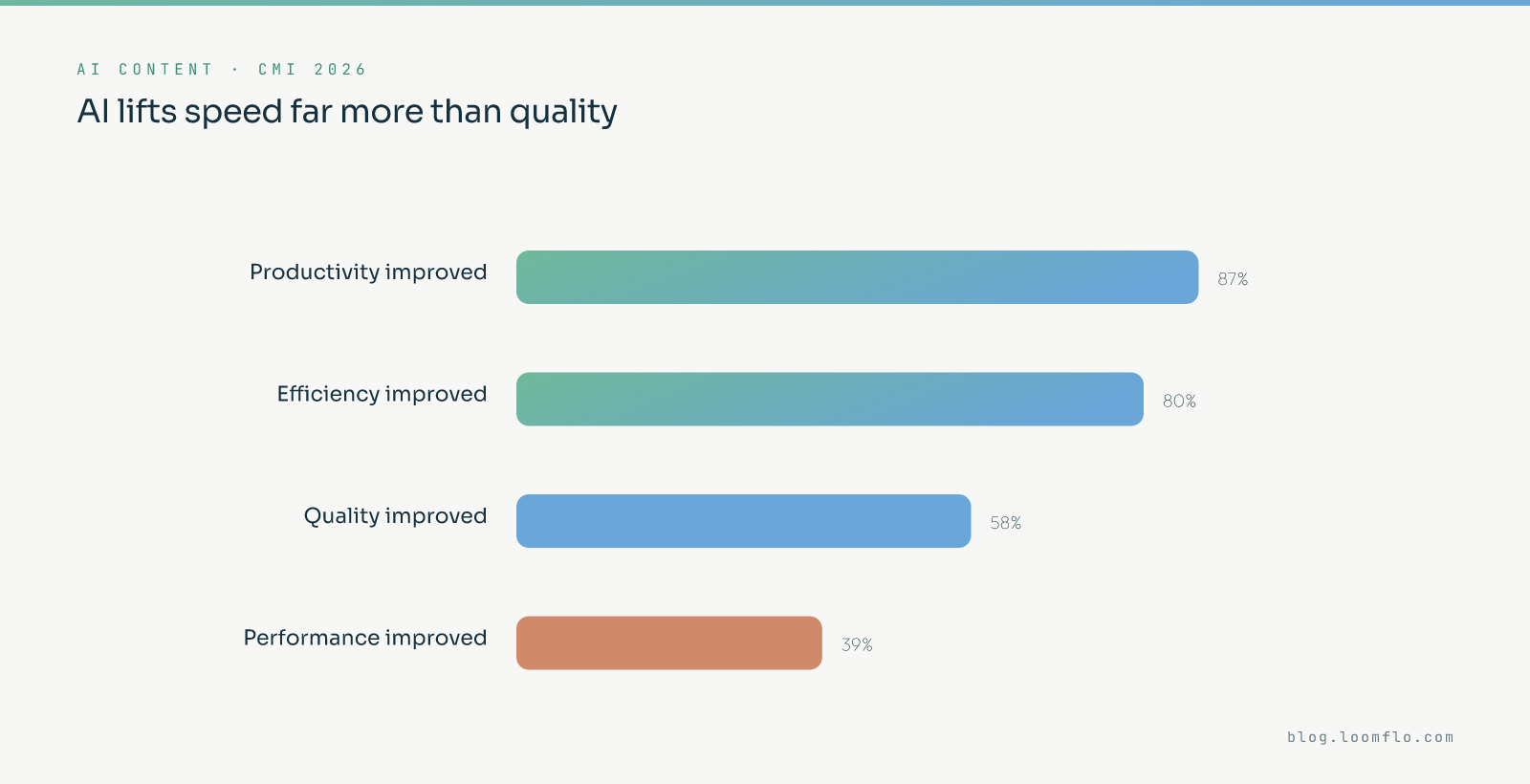
The Content Marketing Institute quantified the gap precisely. 87% of marketers say AI improved productivity and 80% say efficiency, but only 58% say quality improved, and just 39% say performance did.
So speed is not the goal. Used alone, AI makes more content faster without making it better, which is how brands end up with a high volume of forgettable pages.
The teams that win use it deliberately. The same research found 61% of high-performing content teams use AI extensively, versus 38% of underperformers, the difference is how they use it, not whether they do.
Google’s stance, and the real risk
Google does not penalise AI content for being AI. Its position is clear: using automation, including generative AI, is only spam when the primary purpose is manipulating rankings.
But it does penalise low-value content at scale. Google’s March 2024 core update aimed to cut low-quality, unoriginal content by 40%, and later reported a 45% reduction.
The cautionary data is stark. An Originality.ai analysis of that update found 837 sites fully deindexed, accounting for over 20.7 million monthly visits, all showing signs of AI-generated content, half of them 90–100% AI-written.
The lesson is not “avoid AI.” It is “don’t publish unedited, low-value AI content at scale.”
How to do AI content creation right
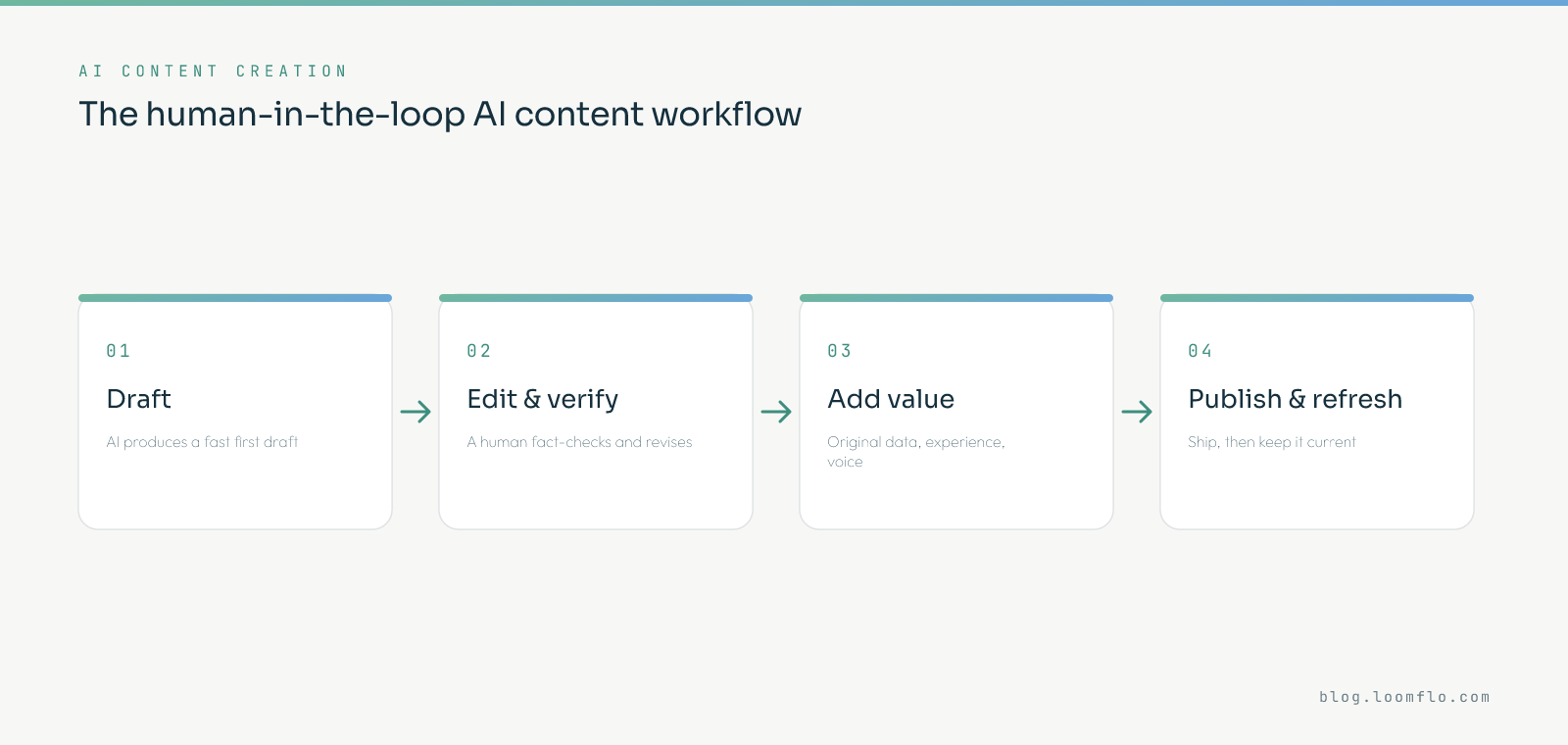
The safe, effective approach is a human-in-the-loop workflow. AI accelerates the work, but people own the quality.
1. Always edit before you publish
Editing is near-universal among successful AI users. HubSpot found only 7% of marketers publish AI content unedited, while 56% significantly revise it.
2. Fact-check everything
Hallucination is the headline risk. HubSpot found 43% of marketers struggle with AI generating inaccurate information, and 34% cite bias, so verification is non-negotiable.
3. Add original value
Commodity AI text ranks poorly because everyone can make it. Add named authors, first-hand experience, original data and a real point of view to satisfy quality and E-E-A-T signals.
4. Use AI as an assistant, not the author
The 89% who use generative AI mostly use it for brainstorming, summarising, drafting and optimisation, not finished output. That is the brand-safe pattern.
5. Don’t scale for the sake of it
Volume produced to manipulate rankings is exactly what Google’s scaled-content policy targets. Quality and helpfulness keep you safe; sheer quantity does not.
Where AI content creation fits in a system
AI content works best inside a process, not as a shortcut around one. The quality the data rewards comes from the editorial layer wrapped around the AI.
That is the model behind our closed-loop SEO engine, AI handles production, humans set standards, and the system refreshes content over time.
Done that way, the same content can also earn AI citations, as covered in our guide on generative engine optimization. The market is moving fast, with the AI content-creation tools sector projected to grow from $14.8 billion in 2024 to $80 billion by 2030.
Where AI content creation helps most
AI is not equally good at every task, so point it where it shines. Its strengths are speed and breadth, not judgment and originality.
It excels at ideation and outlines. Brainstorming angles and structuring a draft is fast, low-risk work where a wrong turn costs nothing.
It excels at repurposing. Turning one article into a newsletter, social posts and a script is mechanical work AI does in seconds.
It excels at first drafts and editing. A rough draft to react to beats a blank page, and AI is useful for tightening and reformatting existing copy.
It struggles with original thinking. Genuine insight, first-hand experience and a distinct point of view still have to come from a human.
A practical AI content creation workflow
The goal is to capture AI’s speed without inheriting its weaknesses. A simple loop does that.
1. Brief the AI properly
Give it your angle, audience, key points and brand voice. A vague prompt produces vague, generic content.
2. Generate a draft, not a final
Treat the output as raw material. The draft is a starting point to shape, never the thing you publish.
3. Edit, cut and sharpen
Remove the filler, tighten the language, and make sure every paragraph earns its place. This is where quality is created.
4. Fact-check and add proof
Verify every claim and add real data, examples and sources. This protects your credibility and your rankings.
5. Add original value and a human voice
Inject experience, opinion and specifics only you can offer. This is what separates your content from the commodity AI output everyone else publishes.
How to keep AI content on-brand
Generic is the default failure mode of AI writing. Keeping it on-brand takes a little structure.
Give the AI a voice guide. Feed it examples of your best writing, your tone rules and words to avoid, so the output sounds like you.
Standardise your prompts. A reusable prompt template that encodes your brand keeps quality consistent across writers and pieces.
Keep a human editor as the gatekeeper. The editor is what guarantees a consistent voice, the one thing AI alone cannot reliably maintain.
Metrics that matter for AI content
Judge AI content on outcomes, not output. Producing more is easy; producing more that performs is the point.
- Organic traffic and rankings — is the content actually earning visibility, or just filling the calendar?
- Engagement — time on page and scroll depth reveal whether readers find it genuinely useful.
- Conversions — the content’s real job is to move people toward becoming customers.
- Editing effort — how much a draft needs reworking tells you whether your AI process is improving.
If those trend up, your AI workflow is working. If volume rises while engagement falls, you are just scaling mediocrity.
AI content mistakes that hurt rankings
A few avoidable errors turn an AI advantage into a liability. The biggest is publishing on autopilot.
- Publishing unedited. Only 7% of marketers do it, because raw AI output is generic and error-prone.
- Scaling thin content. Mass-producing low-value pages is exactly what Google’s scaled-content policy penalises.
- Skipping fact-checks. With 43% of marketers hitting AI inaccuracies, unverified claims are a brand and ranking risk.
- Sounding like everyone else. Commodity AI prose has no edge, so it rarely earns links, citations or trust.
- Ignoring E-E-A-T. Without authorship, experience and originality, AI content struggles on the exact signals Google rewards.
Avoid those and AI becomes a genuine multiplier. The technology is not the risk, using it without judgment is.
AI content creation and search visibility
A common worry is whether AI content can rank at all. The honest answer is that it can, when it meets the same quality bar as great human content.
Google judges the result, not the method. A useful, accurate, original piece ranks regardless of how it was drafted, while a thin one fails regardless of who wrote it.
The same is true for AI answer engines. Clear, well-sourced content gets cited by ChatGPT and Google AI Overviews whether a human or an AI produced the first draft.
What does not work is commodity output. Generic AI text that says nothing original earns no links, no citations and little trust, so it quietly underperforms.
This is why the editorial layer is decisive. The human edits, facts and voice are what lift AI content from “indexable” to “competitive.”
Treated that way, AI content creation is a visibility advantage, not a risk. It lets you cover more topics, faster, without surrendering the quality that earns rankings and citations.
Frequently asked questions
Does Google penalise AI content?
No, not for being AI. Google penalises low-value content produced to manipulate rankings, whether written by humans or AI, so well-edited, genuinely useful AI content is safe.
Is AI-generated content good quality?
On its own, often not. Only 58% of teams say AI improved their content quality, and just 17% of B2B marketers rate AI output as excellent, which is why editing and fact-checking are essential.
Should I edit AI content before publishing?
Always. Just 7% of marketers publish AI content unedited, while the rest revise it, editing is the single most common practice among teams that succeed with AI.
Will AI content hurt my brand?
Only if it is unedited, generic or inaccurate. Add a human editor, fact-checking and original value, and AI content can scale your output while protecting your brand.
Can AI-written content rank on Google?
Yes, when it is genuinely useful, accurate and original. Google judges content by quality and helpfulness, not whether a human or AI wrote the first draft.
How much should I edit AI content?
Enough to make it accurate, original and on-brand, most marketers significantly revise it. The 7% who publish unedited are the exception, not the model to follow.
What is the best AI tool for content creation?
The differentiator is rarely the model, it is the editorial process around it. A strong brief, human editing and fact-checking matter more than which AI you pick.
Will AI replace content writers?
It is changing the role more than replacing it. AI handles drafting and grunt work, while humans move up to strategy, editing, originality and brand voice.
How do I make AI content sound less generic?
Feed it your voice, examples and a specific angle, then edit hard and add real experience. Generic output comes from generic prompts and no human shaping.
Is it cheaper to use AI for content?
Per draft, yes, AI slashes production time and cost. But budget for the human editing and fact-checking that turn a draft into something worth publishing.
How do I keep AI content original?
Add what AI cannot: first-hand experience, proprietary data, customer stories and a clear point of view. Originality is what separates content that ranks from the commodity output everyone else publishes.
Can AI help with content strategy, not just writing?
Yes, AI is useful for keyword research, topic clustering and analysing what performs. Just keep the final strategic calls with a human who understands your business and audience.
Scale content without losing quality
Loomflo’s HEO system pairs AI production with human editorial standards, so you publish more without diluting your brand. First articles live in 30 days, or you don’t pay.