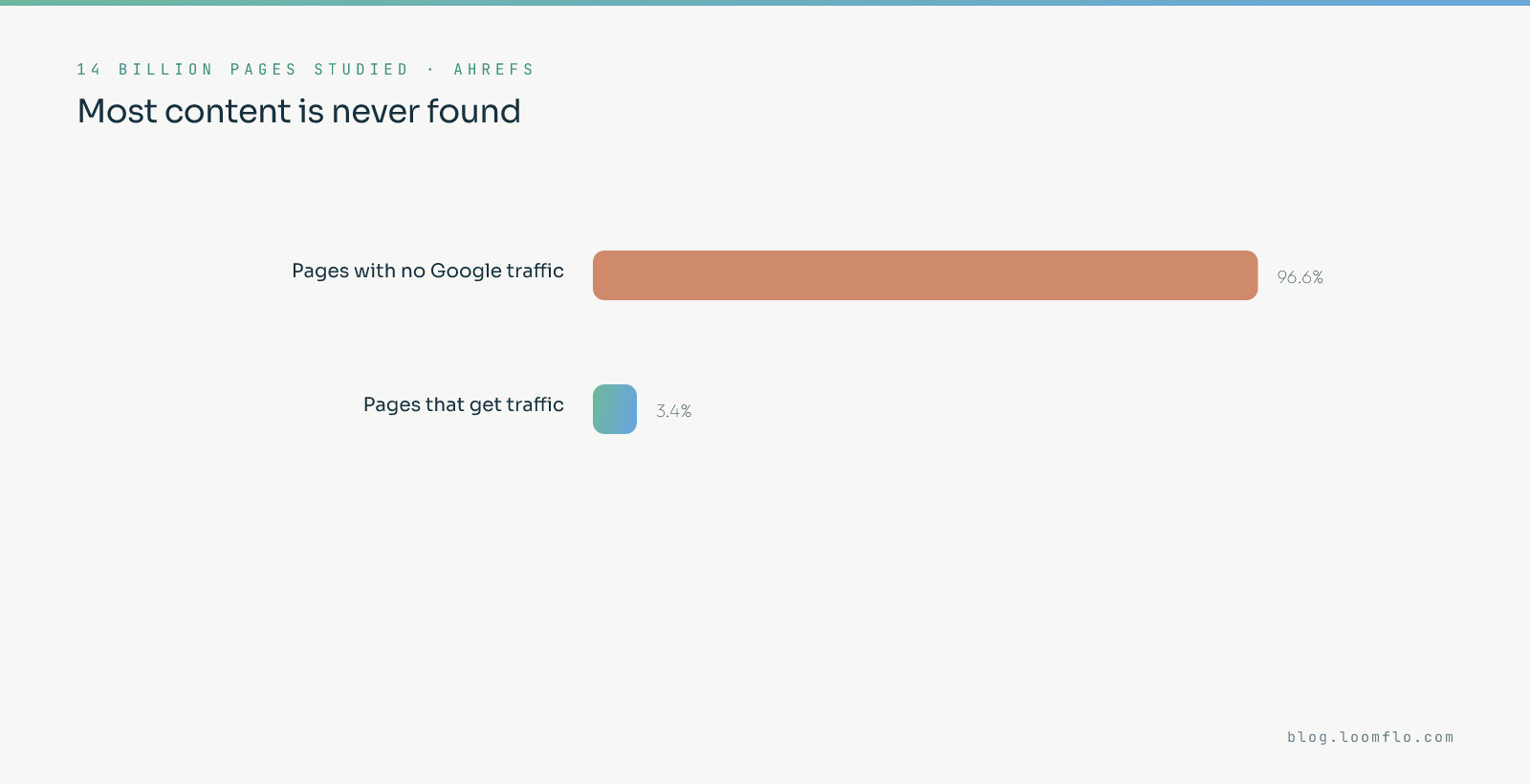
Topical authority means being the most complete, trustworthy source on a subject rather than chasing one keyword at a time. It matters because most content is invisible Ahrefs studied 14 billion pages and found 96.55% get no traffic from Google at all.
Publishing one article on a topic and hoping it ranks is how most content dies quietly. Search rewards depth of coverage, not isolated attempts.
This guide explains what the concept actually means, what’s evidenced versus SEO folklore, and how to build it deliberately.
What is topical authority?
Topical authority is being recognized by search engines and by readers as a comprehensive, trustworthy source on a subject, rather than a site that ranks for one isolated keyword. You cover the whole territory, not a single spot on the map.
The practical difference is structure. Instead of one post about “email marketing,” you publish a core guide plus focused pieces on deliverability, segmentation, automation and metrics, all interlinked.
Search engines increasingly understand topics as entities and relationships, not just strings of words. Covering a subject thoroughly signals genuine expertise.
Let’s be accurate about the ranking factor question
Here’s where most articles on this subject go wrong, so it’s worth being precise. Google has never confirmed “topical authority” as a named ranking factor.
Similarly, E-E-A-T experience, expertise, authoritativeness and trustworthiness comes from Google’s Quality Rater Guidelines. It’s how human raters assess results to evaluate the algorithm; it is not a direct ranking signal you can optimize like a meta tag.
What is documented is Google’s stated preference for helpful, reliable, people-first content that demonstrates real depth. Broad topical coverage is a means to that end, not a switch you flip.
Treat anyone quoting a precise “topical authority boosts traffic by X%” figure with suspicion that number almost always traces back to a blog citing another blog.
Why it matters more now
Two shifts have raised the stakes. Both reward depth.
First, the sheer volume of content means being marginally relevant isn’t enough 96.55% of pages get no Google traffic whatsoever (Ahrefs). Thin coverage is effectively invisible.
Second, AI answer engines synthesize responses from sources they judge reliable. A site that covers a subject comprehensively is far likelier to be the one cited.
The pillar-and-cluster model
The practical structure for this is pillar-and-cluster, popularized by HubSpot’s own content strategy. It’s simple to execute.
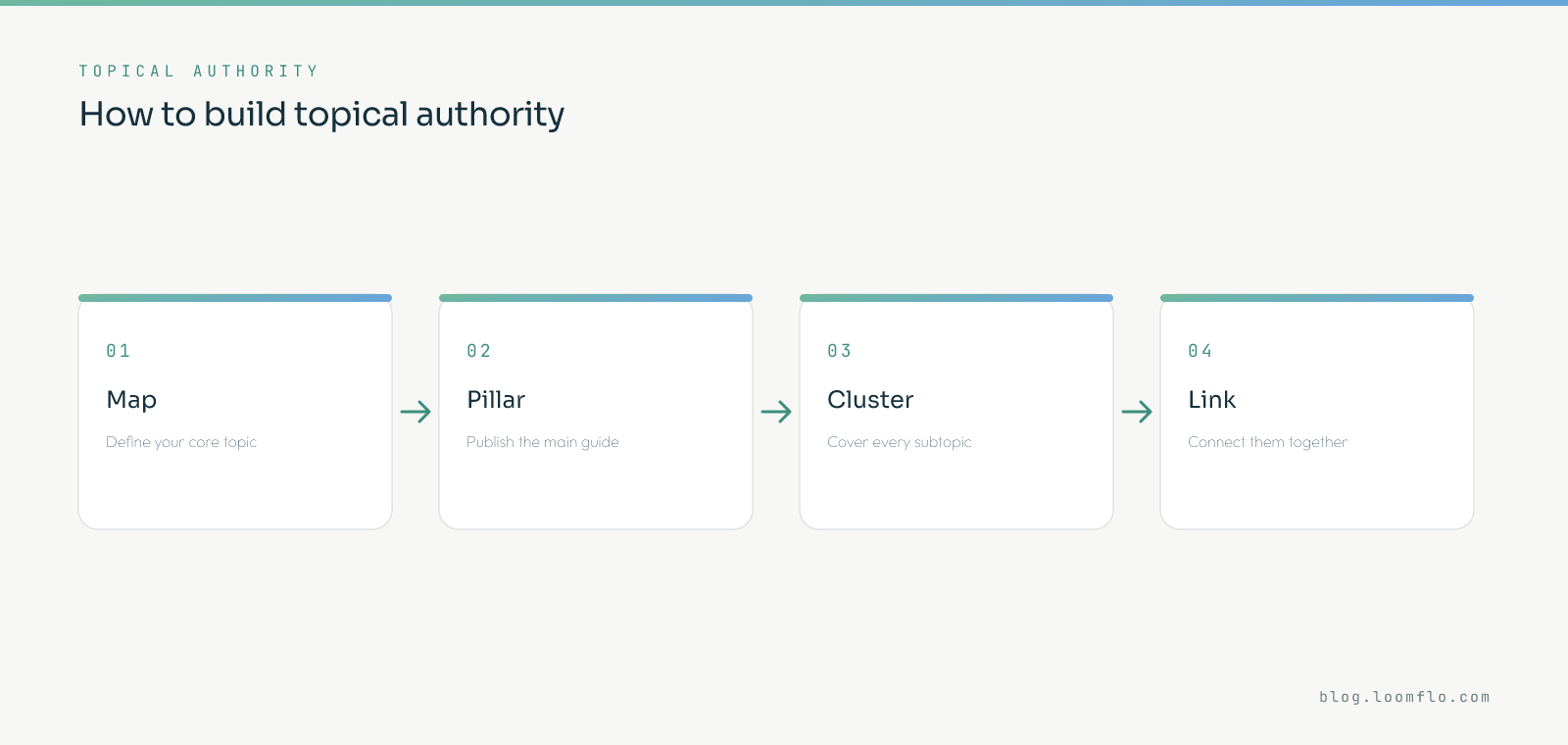
A pillar is a broad, thorough guide to your core subject. Cluster pieces each cover one subtopic in depth and link back to the pillar, which links out to them.
That internal linking is what turns a pile of posts into a structure search engines can read as coherent coverage.
How to build it, step by step
Building this is methodical work, not a growth hack. Four steps get you there.
1. Map the topic
List every question, subtopic and adjacent problem a buyer has in your space. This map is your publishing roadmap.
2. Publish the pillar
Write the definitive guide to the core subject the piece you’d want someone to read first. Make it genuinely complete.
3. Fill the cluster
Work through the map, giving each subtopic its own focused article. Prioritize by search demand and buying intent.
4. Link deliberately
Connect every cluster piece to the pillar and to relevant siblings. Orphaned articles contribute nothing to the structure.
Depth beats volume
A common mistake is treating this as a word-count or page-count race. Mass-producing thin content actively hurts you.
Google’s helpful content guidance explicitly targets content made primarily to rank rather than to help. Twenty genuinely useful articles beat two hundred shallow ones.
The test is simple: would a knowledgeable person in your field find this worth reading? If not, publishing more of it makes things worse.
How it helps you get cited by AI
This is the newest reason to care. AI engines assemble answers from sources, and they favor material that is comprehensive, consistent and verifiable.
A site with deep, interlinked, factually careful coverage is a better candidate for citation than one thin page. Building real coverage is now the same work as being quotable.
How to measure it
There’s no single authority score to check, so measure it indirectly. A few signals tell the story.
Track how many keywords in your topic you rank for (not just one), your share of the cluster’s total search visibility, rankings for unlinked related terms, and whether new posts in the topic rank faster than they used to.
That last one is the real signal. When new cluster pieces start ranking quickly, the structure is working.
How AI speeds this up
The bottleneck here has always been production volume and research time. That’s exactly what automation compresses.
AI maps topics and entities at scale, surfacing subtopics and questions you’d otherwise miss. Gap analysis against competitors shows which cluster pieces are missing.
It drafts briefs and first versions so the cluster fills in weeks instead of quarters, suggests internal links across a growing library, and flags decaying posts that need refreshing.
The honest caveat: quality and editing still decide the outcome. AI removes the production bottleneck it doesn’t remove the need for genuine expertise, and thin AI content published at scale is precisely what Google’s guidance targets.
Where this fits
Topical authority is the compounding asset underneath your whole content program. Each piece makes the next one rank more easily.
It’s the strategy behind the tactics elsewhere on this blog. See how it powers SaaS SEO and how it determines whether you get cited by AI engines rather than just ranked.
Pick one topic you deserve to own, cover it completely, and connect it that’s the whole method.
Frequently asked questions
What is topical authority?
It’s being recognized as a comprehensive, trustworthy source on a subject rather than ranking for a single keyword. In practice it means covering a topic completely and interlinking that coverage.
Is it an official Google ranking factor?
No, Google has never confirmed it as a named ranking factor, and E-E-A-T comes from the Quality Rater Guidelines rather than being a direct signal. What Google does document is a preference for helpful, in-depth, people-first content.
What is a topic cluster?
A pillar page covering a broad subject, surrounded by focused articles on its subtopics, all interlinked. The structure signals coherent, complete coverage.
How do you build it?
Map every subtopic and question in your space, publish a thorough pillar guide, fill in cluster articles for each subtopic, and link them together deliberately.
How long does it take?
Usually months, since it depends on publishing consistent depth rather than a single change. The signal you’re succeeding is new posts in the topic ranking faster than they used to.
Does it help with AI search?
Yes, AI engines synthesize answers from sources they judge reliable, and comprehensive, well-structured coverage is more likely to be cited. Depth is now the path to both ranking and citation.
Own your topic completely
Loomflo builds AI growth infrastructure topic mapping, gap analysis, cluster production and internal linking that turn scattered posts into compounding search visibility.