SaaS customer acquisition costs keep rising the median SaaS now spends $2.00 to acquire $1.00 of new ARR (Benchmarkit). SaaS SEO is the antidote: organic converts B2B visitors at 2.6% vs 1.5% for paid search, and it compounds instead of stopping when you stop paying.
Paid acquisition has a structural problem for SaaS: it gets more expensive every year, and the traffic vanishes the moment you stop spending. That’s a brutal model for a business built on lifetime value.
SaaS SEO flips it. This guide explains why organic search is the most efficient growth channel for SaaS, how to turn it into sign-ups, and how to do it without wasting a year on traffic that never converts.
What is SaaS SEO?
SaaS SEO is the practice of using organic search to drive sign-ups and revenue for a software company through keyword strategy, product-led content, technical SEO and often programmatic pages built around real search demand. The goal isn’t traffic; it’s qualified users.
It differs from generic SEO in its focus. SaaS SEO is judged on pipeline and sign-ups, not pageviews which changes everything about how you do it.
Why SaaS SEO matters now
The case starts with economics. Acquisition is getting more expensive, fast.
Benchmarkit found the median SaaS “CAC ratio” rose 14% in 2024 to $2.00 spent for every $1.00 of new ARR, and broader research puts customer acquisition costs up roughly 60% over five years.
Meanwhile, organic remains the biggest channel. BrightEdge found organic search drives 53% of all website traffic and 64% for B2B, versus about 15% from paid.
Organic converts better than paid
The myth is that paid converts and organic just builds awareness. The data says the opposite.
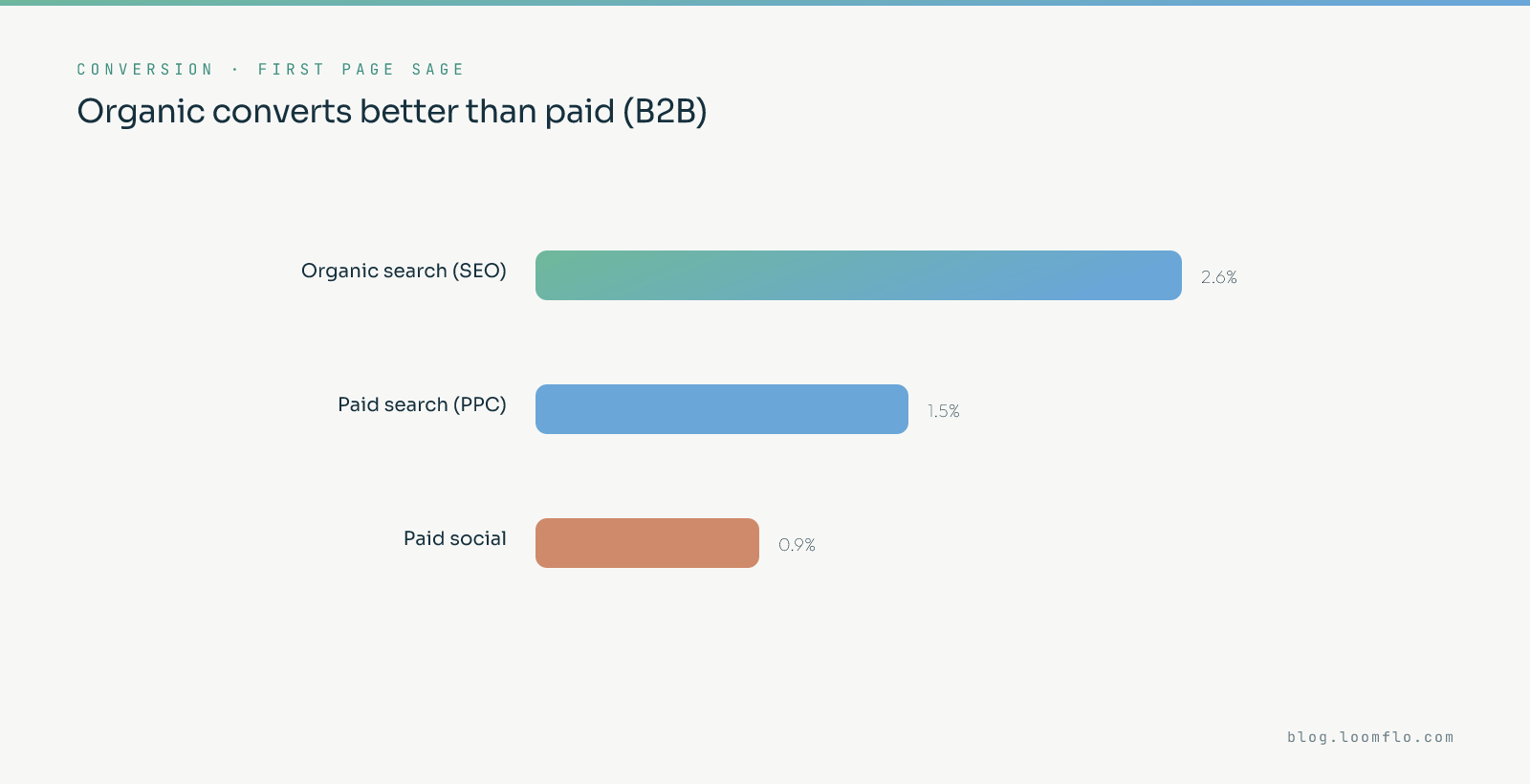
First Page Sage found organic search converts B2B visitors at 2.6%, versus 1.5% for paid search and 0.9% for paid social. Organic isn’t just cheaper it converts better.
The gap widens further downstream. The frequently cited Digital Third Coast study put SEO close rates at 14.6% versus 1.7% for outbound roughly 8x higher.
SEO compounds; paid doesn’t
This is the structural advantage that makes it worth the patience. Paid is rented; organic is owned.
HubSpot’s research found “compounding” posts about 10% of posts generate 38% of total blog traffic, returning roughly 6x the lifetime traffic of an average post.
That’s the opposite of paid, where traffic stops the instant the budget does. SaaS SEO builds an asset that keeps producing sign-ups long after the work is done.
Buyers research before they ever contact you
The modern SaaS buyer is self-directed, which makes organic visibility decisive. By the time they talk to you, the decision is mostly made.
Gartner found B2B buyers spend just 17% of their time with sales reps, and 67% prefer a rep-free buying experience. Forrester adds that 81% choose vendors before contacting sales.
So if you’re not discoverable in search during that research, you’re not on the shortlist. SaaS SEO is how you get considered before the sales conversation.
How it drives sign-ups
The mechanics that turn search demand into users are specific to SaaS. A few moves do most of the work.
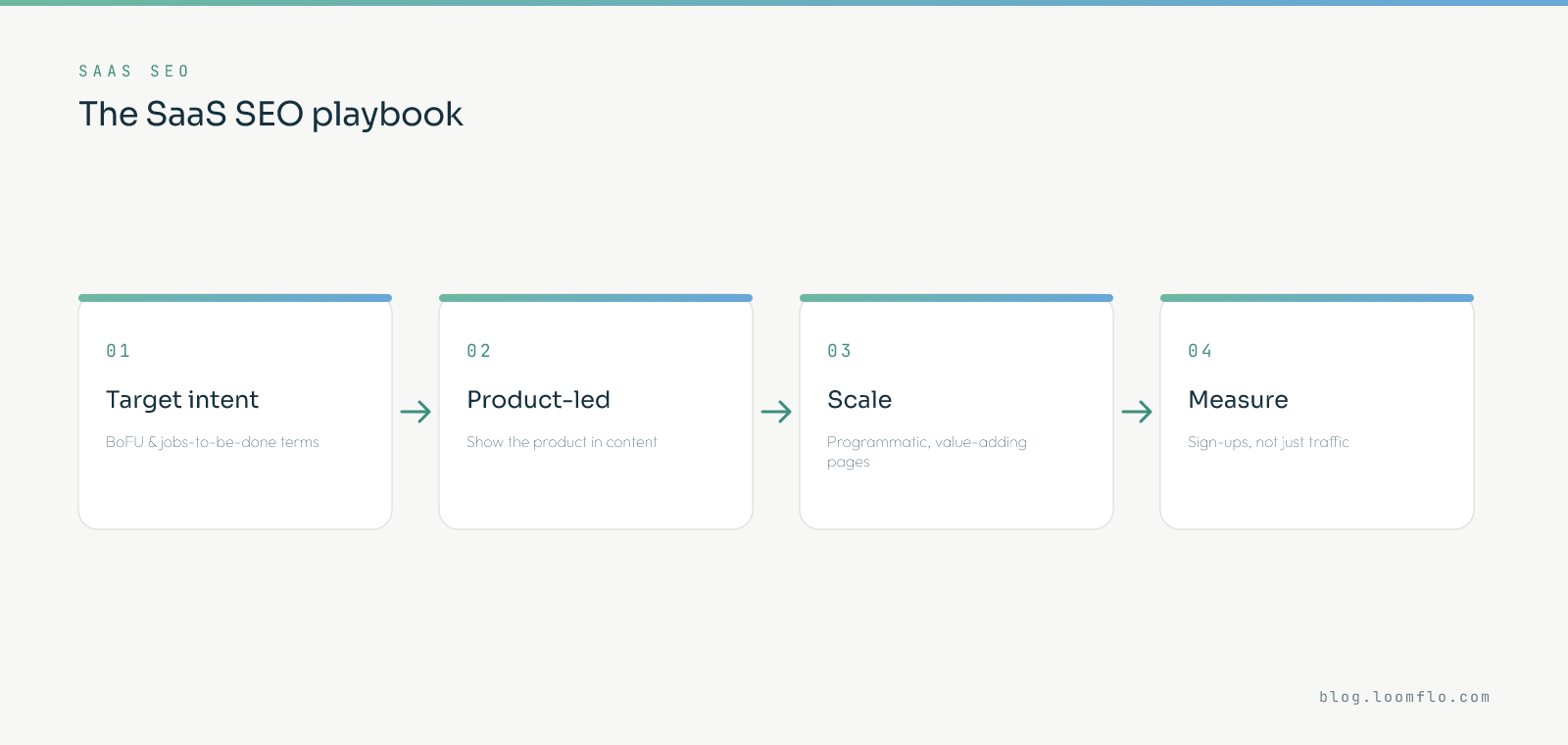
1. Target bottom-of-funnel keywords
Prioritise high-intent terms “best X software,” “alternative to Y,” use-case and integration searches because those searchers are closest to signing up. Volume matters less than intent.
2. Build product-led content
Write content where your product is a natural part of the answer, not a bolt-on. This is how Ahrefs grew its blog over 1,000% and credits content for thousands of paying customers.
3. Scale with programmatic SEO
Use templates and data to build value-adding pages at scale integrations, comparisons, templates. Zapier’s programmatic integration pages drive about 16% of its organic traffic, and Canva’s template pages pull tens of millions of visits.
4. Organise into topic clusters
Group content into pillars and clusters to build topical authority across a category. It’s the structure that lets you rank for a whole space, not just single keywords.
The reality: most pages get nothing
It only works when it’s strategic, because publishing alone is a losing game. The base rate is harsh.
Ahrefs found 96.55% of all pages get zero organic traffic. Churning out content without targeting real demand just adds to that silent majority.
The lesson is to chase intent, not volume. Every page should target a search a real buyer makes on the way to a purchase.
How to do SaaS SEO well
The teams that win at SaaS SEO share a handful of habits. They’re about strategy, not just output.
1. Rank keywords by sign-up potential
Score keywords by how likely a searcher is to convert, not just by traffic. A 200-visit page that converts beats a 20,000-visit page that doesn’t.
2. Make the product the hero
Show your product solving the problem in the content itself. Product-led SEO is what turns readers into trials and trials into customers.
3. Add genuine value at scale
When you go programmatic, ensure every page answers a real query as Zapier and Canva did. Thin, templated pages get penalised and bloat your index.
4. Invest in evergreen, refreshable content
Build content designed to compound, and update it as it ages. A small share of compounding pages will drive the majority of your long-term traffic.
5. Measure pipeline, not vanity metrics
Track sign-ups, trial-to-paid and CAC from organic not just rankings and sessions. Organic leads close far higher, so tie SEO to revenue to prove its worth.
How long does it take?
Honestly, months and that’s the point, not a flaw. SaaS SEO compounds, which is why it beats paid over time but rarely spikes early.
Bottom-of-funnel pages can convert within weeks of ranking, while topical authority builds over quarters. The durable advantage comes from a consistent program, not a one-time push.
That patience is also the moat. Most competitors quit during the slow phase, which is exactly why the ones who persist pull away.
Where it fits in growth
SaaS SEO is the compounding base layer of acquisition the channel that lowers CAC as it grows. It works best run as a system, not a one-off content push.
That system thinking is the difference between scaling and stalling. For how to run the content loop without manual busywork, see our guide on automating SEO, and on winning both Google and AI answers, AEO vs SEO.
Done right, SaaS SEO turns search demand into a predictable, ever-cheaper source of sign-ups.
The content types that drive SaaS sign-ups
Not all SaaS content converts equally. A few types do the heavy lifting for sign-ups.
- Comparison & alternative pages: “Best X” and “alternative to Y” capture buyers in active evaluation.
- Use-case pages: Showing how your product solves a specific job for a specific role.
- Integration pages: Programmatic pages for every tool you connect with, capturing long-tail intent.
- Product-led tutorials: How-to content where your product is the natural way to get it done.
- Free tools & templates: Useful utilities that rank, earn links and funnel users to sign-up.
Each targets a searcher who’s close to a decision. That’s why they convert far better than generic top-of-funnel posts.
Don’t neglect technical SEO
Great content can’t rank if search engines struggle with your site. Technical SEO is the floor SaaS SEO stands on.
Make sure key pages are crawlable and indexable, since a stray block can hide whole sections of your product. Speed and mobile experience matter too, because page experience is a ranking factor.
And fix the silent issues broken links, duplicate pages, thin programmatic pages. They bleed authority and drag down the content that should rank.
SaaS SEO vs paid acquisition
Most SaaS companies don’t have to choose they layer both. But the roles are different, and getting the balance right matters.
Paid delivers instant, controllable traffic, which is ideal for launches and short-term pushes. The catch is that it stops the moment you stop paying, and costs keep rising.
SaaS SEO is the compounding base that lowers blended CAC over time. The smart play is paid for speed on top of an organic engine that keeps producing sign-ups for free.
Frequently asked questions
What is SaaS SEO?
It’s using organic search to drive sign-ups and revenue for a software company, through keyword strategy, product-led content and often programmatic pages. It’s measured by pipeline, not just traffic.
Does SaaS SEO actually drive sign-ups?
Yes, organic converts B2B visitors at 2.6% versus 1.5% for paid search, and companies like Ahrefs credit content with thousands of paying customers. The key is targeting high-intent, bottom-of-funnel searches.
Is SEO better than paid ads for SaaS?
Over time, usually it converts better, costs less per acquisition, and compounds instead of stopping when you stop paying. Many SaaS companies use both, with SEO as the durable base.
How long does it take to work?
Months, because it compounds. Bottom-of-funnel pages can convert within weeks, but topical authority and the biggest gains build over quarters.
What keywords should a SaaS target?
High-intent, bottom-of-funnel terms “best [category] software,” “alternative to [competitor],” integrations and use cases. Those searchers are closest to signing up.
What is product-led SEO?
Content where your product is a natural part of the answer, not an afterthought. It’s how SaaS companies turn organic readers into trials and paying customers.
Does programmatic SEO work for SaaS?
Yes, when each page adds real value Zapier and Canva drive huge organic traffic this way. The risk is thin, templated pages, so quality and genuine search demand are essential.
How do I measure success?
Track sign-ups, trial-to-paid conversion and customer acquisition cost from organic, not just rankings. Organic leads close at far higher rates, so tie it to revenue.
Is it worth it for early-stage startups?
Yes, if you start with bottom-of-funnel, high-intent content. It builds a compounding, low-CAC channel though it takes months, so pair it with faster channels early.
What’s the biggest mistake?
Chasing high-volume top-of-funnel keywords that don’t convert, while ignoring intent. With 96.55% of pages getting zero traffic, targeting real buyer demand is everything.
Does my SaaS need a blog for SEO?
A blog helps, but product, comparison, use-case and integration pages often convert better. The best SaaS SEO mixes product-led pages with genuinely useful content.
How is SaaS SEO different from regular SEO?
SaaS SEO is judged on sign-ups and pipeline, not traffic, and leans heavily on product-led and programmatic pages. The focus is converting search demand into users, not just ranking.
What’s a good conversion rate?
Organic B2B traffic converts around 2.6% on average, but bottom-of-funnel pages can do much better. Trends and pipeline matter more than any single benchmark.
Can content alone grow a SaaS?
It can be a primary channel Ahrefs reached $100M+ ARR largely on content and word of mouth. But it works best as product-led content tied to real search demand.
Does SaaS SEO help with AI search too?
Yes, the same authoritative, well-structured content that ranks on Google also gets cited by AI engines. Optimising for both is increasingly one job, not two.
How many keywords should a SaaS target?
Quality of intent beats quantity a focused set of bottom-of-funnel and use-case terms outperforms chasing hundreds of high-volume keywords. Start with searches closest to a sign-up.
How much does it cost?
It’s mostly an investment of time and content rather than ad spend, which is why it lowers CAC over time. The cost is front-loaded; the returns compound.
Should I do SEO in-house or outsource it?
Either works the key is consistent, intent-driven content and someone who understands your product. Many software teams start in-house on bottom-of-funnel pages, then scale with help.
Make organic your cheapest channel
Loomflo’s HEO system runs research, product-led content, linking and refreshing as one loop so your organic sign-ups compound while your CAC falls. First articles live in 30 days, or you don’t pay.