
Content repurposing turns one asset into many formats instead of creating everything from scratch. It’s efficient and effective the average blog post takes about 3.5 hours to write (Orbit Media), while updating an old post can lift its organic traffic by 106% (HubSpot). Create once, distribute everywhere.
Creating content from scratch is slow and expensive, and most of what teams produce is never fully used. That’s a lot of effort for a single post that goes live once and fades.
Content repurposing solves both problems at once. This guide explains the model, gives you 14 concrete ideas, and shows how AI makes it scale.
What is content repurposing?
Content repurposing is the practice of taking one existing piece of content and adapting it into multiple new formats, channels or angles instead of creating each one from scratch. Think “create once, distribute everywhere.”
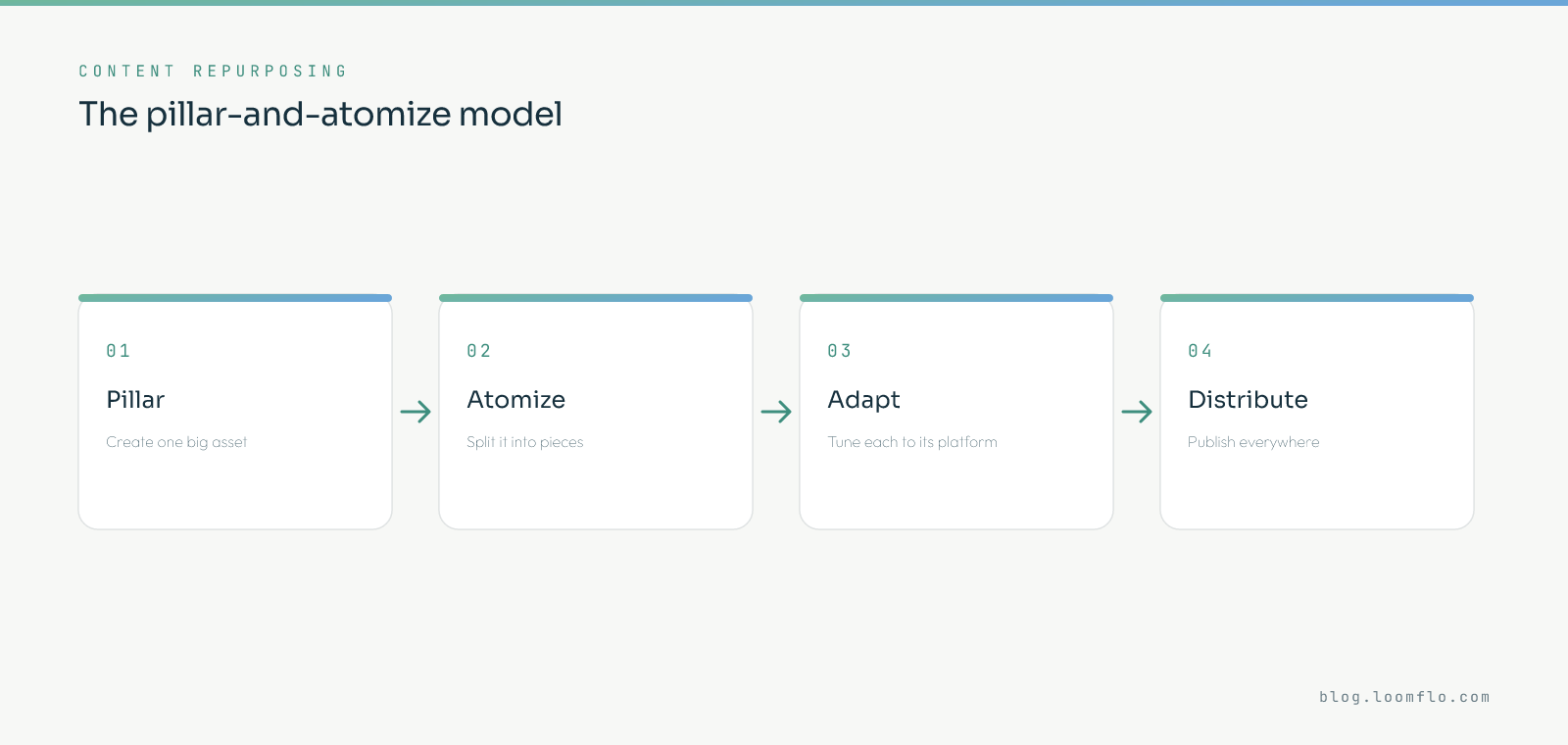
The core model is pillar-and-atomize. You build one substantial asset, then break it into many smaller pieces tuned to different platforms.
It’s not copy-pasting the same thing everywhere. It’s reshaping one core idea to fit how each audience actually consumes content.
Why content repurposing matters
The business case is simple: creation is costly, and most content is underused. Repurposing fixes the ratio.
Orbit Media found the average blog post now takes about 3 hours 25 minutes to write. Meanwhile, the classic SiriusDecisions estimate that 60–70% of B2B content goes unused still captures the waste problem.
Repurposing also meets a real shift in behavior. HubSpot found 35% of marketers now repurpose content across channels, driven by fragmenting discovery audiences are everywhere, so your content has to be too.
The benefits of repurposing
Repurposing pays off in four ways at once. Together they make your content work far harder.
- Reach: Different formats meet audiences on the platforms they actually use.
- SEO: Refreshing and re-optimizing old content lifts rankings and traffic.
- Consistency: Repurposing fuels a steady posting cadence without constant net-new creation.
- Efficiency: You extract far more value from work you’ve already done.
None of these require inventing new ideas. They just distribute the ones you already proved.
What content to repurpose
Don’t repurpose everything start with what already works. Your best performers earned their reach for a reason.
Look at your top posts by traffic, engagement or conversions, and your evergreen pillars that stay relevant. Time-sensitive or low-quality content isn’t worth the effort.
14 ways to repurpose content
Here’s the practical part concrete ways to turn one asset into many. Mix and match to fit your channels.
- Blog post → X/Twitter thread breaking the key points into a numbered sequence.
- Blog post → LinkedIn carousel with one insight per slide.
- Blog post → short-form video script for Reels, Shorts and TikTok.
- Blog post → email newsletter summary, or a serialized mini-course.
- Blog post → infographic turning a process or dataset into a visual.
- Webinar → recap post plus highlight clips and pull-quote graphics.
- Podcast → blog article with audiograms and quote cards.
- Long video → 5–10 short clips cut for social.
- Research report → stat cards and a slide deck.
- Several posts → a downloadable ebook or gated lead magnet.
- Customer questions → an FAQ page or Q&A series.
- Old post → updated and republished for a traffic refresh.
- Case study → a LinkedIn story, a one-page PDF and a testimonial clip.
- Expert answer → a how-to post or short explainer video.
Refresh your old content
One of the highest-ROI forms of repurposing is updating content you already published. It’s often faster than writing anything new.
HubSpot found that updating and re-optimizing old posts lifted their monthly organic views by an average of 106% and more than doubled leads. Orbit Media similarly found bloggers who update old posts are about twice as likely to report strong results.
So before writing a new post, look at what’s slipping. A refresh can outperform a from-scratch article.
Why repurposing into video matters
If you repurpose into one new format, make it short-form video. That’s where attention and ROI concentrate.

HubSpot found short-form video is the #1 ROI-driving format, named by 49% of marketers, and Wyzowl found 73% of consumers prefer short-form video to learn about a product. Turning a blog post or webinar into clips meets that demand directly.
Common repurposing mistakes
Repurposing goes wrong in a few predictable ways. Each is easy to avoid.
- Lazy copy-paste: Dropping identical text everywhere ignores each platform’s native format.
- No distribution plan: Creating atoms without scheduling them wastes the effort.
- Repurposing weak content: Amplifying a post that didn’t work just spreads the miss.
- Ignoring platform norms: What works on LinkedIn flops on TikTok, and vice versa.
Avoid these and repurposing multiplies your reach. Ignore them and it just makes noise.
How AI makes repurposing scale
Repurposing is where AI delivers its clearest, least-hyped ROI. The source thinking already exists, so AI reshapes rather than invents which keeps accuracy risk low.
AI transcribes a webinar or podcast into text in minutes, the raw material for posts, quotes and captions. Clipping tools auto-detect highlights and cut short-form video, and from one approved post AI can draft the thread, carousel and email variants.
It can even produce faceless video from a script using AI avatars, and schedule the atoms across channels automatically. Adoption is already mainstream 32% of marketers use AI to repurpose content (CMI).
The honest caveat: AI does the heavy lifting on drafts, but a human edits for accuracy and brand before anything ships. The value is the infrastructure plus judgment, not push-a-button-and-walk-away.
Where content repurposing fits
Content repurposing is the multiplier on everything you create. It turns each pillar asset into a steady stream of distribution instead of a single publish.
It works hand in hand with the rest of your content engine. See how it connects to B2B content marketing and how AI content creation feeds the pillar assets you atomize.
Start with your best content, atomize it across platforms, and let AI scale the work that’s how one idea becomes a month of distribution.
Frequently asked questions
What is content repurposing?
It’s taking one existing piece of content and adapting it into multiple new formats, channels or angles. The idea is to create once and distribute everywhere.
Why should you repurpose content?
Because creating from scratch is slow and most content goes underused, while repurposing extends reach, SEO and consistency for far less effort. It extracts more value from work you’ve already done.
How do you repurpose a blog post?
Turn it into a Twitter thread, a LinkedIn carousel, a short video, an email, or an infographic. Each format reshapes the same core idea for a different platform.
Is repurposing bad for SEO?
No, duplicate content means the same text at multiple URLs, while repurposing creates new, format-specific assets on different platforms. Updating an existing post actually helps SEO; only use canonical tags if you republish identical text elsewhere.
What content should you repurpose?
Your proven best performers and evergreen pillars, not low-quality or time-sensitive posts. Start where you already have traffic, engagement or conversions.
How often should you repurpose content?
Build it into the workflow for every pillar asset you create, and revisit old posts to refresh on a regular cadence. Repurposing should be a habit, not a one-off.
Turn one idea into a month of content
Loomflo builds AI growth infrastructure transcription, clipping, format generation and automated distribution that turn each pillar asset into dozens of platform-native pieces.