B2B content marketing works across the whole funnel 87% of B2B marketers say it built brand awareness and 74% say it generated leads (CMI). It also generates about 3x the leads of outbound at 62% lower cost but only 29% of teams rate their strategy as highly effective, so execution is everything.
Almost every B2B company does content marketing. Far fewer do it well and the gap between the two is where the results live.
This guide lays out a data-backed B2B content marketing strategy for 2026: what content actually achieves, which formats and channels perform, and how to build a strategy that generates pipeline instead of just filling a blog.
What is B2B content marketing?
B2B content marketing is the practice of creating and distributing valuable content articles, videos, case studies, research and more to attract, educate and convert other businesses into customers. Instead of interrupting buyers with ads, it earns their attention by being useful.
It is near-universal in B2B for a reason. It builds the trust and credibility that long, multi-stakeholder buying decisions require.
What B2B content marketing actually achieves
The value isn’t just awareness, it spans the entire funnel. The Content Marketing Institute’s benchmark data makes that clear.
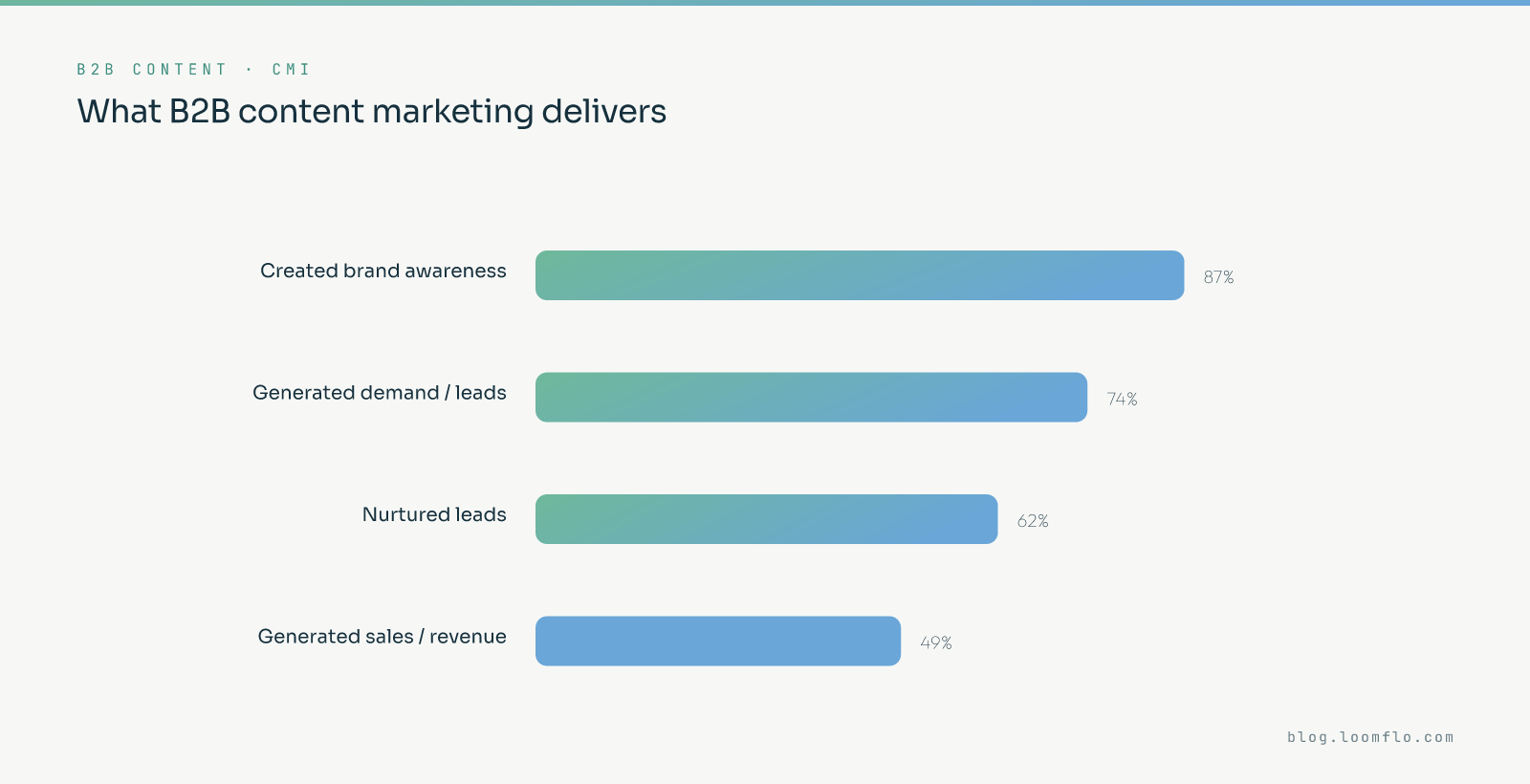
In CMI’s latest benchmark, B2B marketers reported content marketing built brand awareness (87%), generated demand and leads (74%), nurtured audiences (62%) and generated sales or revenue (49%) in the past year.
The efficiency case is just as strong. Demand Metric’s long-cited benchmark found content marketing generates roughly 3x as many leads as outbound while costing 62% less.
That combination full-funnel impact at lower cost is why content remains the backbone of B2B demand generation.
Which content formats perform best
There’s a gap between what teams publish most and what actually works. Closing it is an easy win.
CMI found the most-used formats are short articles (92%) and videos (76%), but the most effective are videos (58%), case studies (53%) and research reports and white papers (45%).
The lesson is to invest beyond high-volume blog posts. Video, customer stories and original research punch above their usage in effectiveness.
Short-form video is rising fastest. HubSpot found it’s the most-used format, and 41% of B2B marketers say it drives the highest ROI of any video.
Which channels perform best
Distribution decides whether content gets seen. Again, usage and effectiveness diverge.
CMI found the most-used channels are organic social (89%) and blogs (84%), but the most effective are in-person events (52%), webinars (51%) and email (42%).
For organic social, one platform dominates B2B. 85% of B2B marketers say LinkedIn delivers the best value, far ahead of YouTube and Instagram.
And owned channels lead on ROI. HubSpot found website, blog and SEO is the single highest-ROI channel marketers report.
Why most strategies underperform
Here’s the uncomfortable truth that creates the opportunity. Most B2B content isn’t working as well as it could.
CMI found only 29% of B2B marketers rate their content strategy as highly effective, while 58% call it merely “moderately effective.”
The reasons are specific and fixable. Among underperformers, 42% blame a lack of clear goals and 39% say content isn’t tied to the buyer’s journey.
The top challenges and the role of AI
Knowing the common obstacles helps you avoid them. The data names them clearly.
CMI found the biggest challenges are lack of resources (54%), measuring results (47%) and aligning content to the buyer’s journey (45%). Measurement is especially hard 56% can’t attribute content ROI.
AI is now part of the answer, with caveats. 81% of B2B content teams use generative AI, but only 4% have high trust in its output and just 19% have integrated it into daily workflows.
How to build a B2B content marketing strategy
A strong strategy isn’t complicated, but it has to be deliberate. These are the moves the data rewards.
1. Document clear, aligned goals
Write down a strategy tied to business goals, since a lack of clear goals is the top reason strategies fail. Top performers cite goal alignment and audience understanding as their biggest success drivers.
2. Map content to the buyer’s journey
Build full-funnel content, not just awareness pieces, because misalignment with the journey sinks 39% of underperforming strategies. Match each asset to a real stage and question.
3. Prioritise high-effectiveness formats
Invest in video, case studies and original research, not just high-volume short posts. They deliver the best usage-to-effectiveness ratio.
4. Lead with credibility and experts
Partner with subject-matter experts and industry voices 55% of B2B marketers now do. Credible, human-led content beats generic brand messaging.
5. Fix measurement and use AI with guardrails
Tie content to business outcomes so you can prove ROI, and adopt AI deliberately with usage guidelines. Use it for efficiency while protecting quality.
Consistency compounds
The final ingredient is consistency, not just quality. Content marketing is a compounding asset that rewards sustained publishing.
HubSpot’s foundational research found companies publishing 16+ posts a month generated about 4.5x more leads than those publishing four or fewer. The directional lesson holds: more consistent, useful content drives more demand.
This is exactly where automation earns its place. For how to sustain that output without manual busywork, see our guide on automating SEO, and on winning both Google and AI answers, AEO vs SEO.
Mapping content to the buyer’s journey
The teams that win build content for every stage, not just the top. B2B buying is long and multi-stakeholder, so each phase needs its own content.
Awareness (top of funnel)
Educational articles, short videos and social posts that introduce the problem you solve. The goal is reach and credibility, not a hard sell.
Consideration (middle of funnel)
Guides, webinars, comparison content and original research that help buyers evaluate options. This is where you build trust and shape the criteria.
Decision (bottom of funnel)
Case studies, customer stories and ROI content that prove you deliver. These are the highest-effectiveness formats for a reason they de-risk the purchase.
Most teams over-invest in awareness and starve the rest. Balancing the funnel is one of the fastest ways to turn content into pipeline.
How to distribute B2B content
Creating content is only half the job distribution decides whether it’s seen. A great asset no one finds generates nothing.
Lead with owned channels. Your blog and SEO are the highest-ROI channel marketers report, and they compound over time.
Then amplify on LinkedIn. It’s the platform B2B marketers rate best by a wide margin, so repurpose every asset into native posts there.
And convert with email. Email is among the most effective B2B channels, so use it to nurture the audience your content attracts.
How to measure B2B content marketing
Measurement is the field’s biggest weakness and your chance to stand out. Most teams can’t tie content to revenue.
The scale of the gap is clear. CMI found 56% of B2B marketers can’t attribute content ROI, and nearly half rank measurement among their top challenges.
Fix it by tracking the funnel, not just traffic. Map content to leads, pipeline and closed revenue, and watch engagement signals like time on page and return visits along the way.
That closed loop is what turns content from a cost centre into a provable growth channel. What you can measure, you can defend and scale.
Where B2B content budgets are going
Budgets reveal where the field is heading, and the direction is clear. Most teams are investing more, not less.
CMI found 46% of B2B marketers expected content budgets to rise, with only 8% expecting a cut. Content is seen as a growth investment, not a cost to trim.
The money is flowing toward specific bets. Top planned investments are video (61%), thought leadership (52%) and AI for content (around 40%).
The pattern fits everything above. Spend is moving toward the formats and tools that combine effectiveness with efficiency.
How B2B content differs from B2C
B2B content isn’t just B2C with a suit on. The audience and the stakes are different.
B2B buying involves multiple stakeholders and long cycles, so content has to build consensus and reduce risk, not trigger an impulse purchase. Logic and proof outweigh emotion.
That’s why formats like case studies, research and thought leadership matter so much they give buying committees the evidence they need. Credibility is the currency.
The upshot is depth over virality. B2B content wins by being genuinely useful to a specific buyer, not by chasing the widest possible reach.
Frequently asked questions
What is B2B content marketing?
It’s creating and distributing valuable content to attract, educate and convert other businesses into customers. Instead of interrupting buyers, it earns attention by being genuinely useful.
Does it actually generate leads?
Yes, 74% of B2B marketers say content generated demand and leads, and it produces roughly 3x the leads of outbound at 62% lower cost. The catch is execution: only 29% rate their strategy as highly effective.
What content works best for B2B?
By effectiveness, video, case studies and original research lead even though short articles are used most. Distributing through LinkedIn, webinars, events and email tends to outperform.
How much should I invest in B2B content?
Most B2B teams are increasing content budgets, skewing toward video, thought leadership and AI. The bigger driver of results, though, is a clear, goal-aligned strategy not just spend.
Should I use AI for B2B content?
Yes, deliberately. 81% of teams already do, but with low trust in raw output so use AI for efficiency with human editing, fact-checking and usage guidelines.
How long does B2B content marketing take to work?
Months, because it compounds rather than spikes. Consistency is the key variable sustained, useful publishing is what builds awareness, trust and pipeline over time.
Is B2B content marketing still effective in 2026?
Yes, 87% of B2B marketers say it built awareness and 74% say it generated leads. The differentiator now is strategy, since only 29% rate their approach as highly effective.
What content type generates the most B2B leads?
By effectiveness, video, case studies and original research lead, even though short articles are used most. Gated research and customer stories are especially strong for capturing leads.
How much content should a B2B company publish?
Consistency matters more than a magic number, though more frequent publishing correlates with more leads. Aim for a steady cadence of useful, on-strategy content over sporadic bursts.
How long until it pays off?
Typically months, because it compounds. Early assets build authority that makes later ones rank and convert better, so returns accelerate over time.
Does it work without a big budget?
Yes, it generates roughly 3x the leads of outbound at 62% lower cost, which makes it ideal for lean teams. A clear strategy matters more than spend.
What’s the biggest B2B content mistake?
Publishing without a documented, goal-aligned strategy. A lack of clear goals is the top reason content strategies underperform.
How does AI fit into B2B content marketing?
81% of B2B teams already use generative AI, mainly for ideation, drafting and optimisation. The key is human editing and clear guidelines, since trust in raw AI output remains low.
Which channels work best for B2B content?
Owned blog and SEO lead on ROI, LinkedIn dominates organic social, and webinars, events and email rate among the most effective. A mix tuned to your audience beats relying on one.
Should I gate my B2B content?
Gate high-value assets like research and templates to capture leads, and keep top-of-funnel content open for reach and SEO. A mix of both usually works best.
Make content your growth engine
Loomflo’s HEO system runs research, creation, distribution and refreshing as one loop so your B2B content compounds into pipeline without the manual work. First articles live in 30 days, or you don’t pay.