AI lead generation uses autonomous agents to handle the top of your sales funnel, finding ideal-fit prospects, qualifying them by intent, and engaging them around the clock.
The stakes are huge: firms that contact a lead within five minutes are 100× more likely to connect than those that wait 30 minutes (MIT/InsideSales), yet the average company takes 42 hours to respond and 23% never respond at all (Harvard Business Review).
Agents close that gap automatically.
Most sales teams lose their best hours to the least valuable work: building lists, researching prospects, sending first-touch emails, and chasing replies. In fact, Salesforce’s State of Sales research found reps spend less than 30% of their time actually selling, the rest goes to admin, data entry, and prospecting research.
It’s necessary work, but it’s repetitive, and it caps how many conversations a team can start. AI lead generation removes that ceiling, not by replacing your closers, but by handing them a calendar that fills itself.
What is AI lead generation?
AI lead generation is the use of autonomous AI agents to find, qualify, and engage potential customers automatically, identifying people who match your ideal customer profile, scoring them by fit and intent, and reaching out with personalised messages until a qualified meeting is booked. It automates the top of the funnel so human reps spend their time on conversations that are ready to convert.
The shift is from manual prospecting (a rep working a list one row at a time) to autonomous prospecting (agents working thousands of prospects in parallel, continuously). And it’s already mainstream: Salesforce reports that 81% of sales teams are experimenting with or have fully implemented AI, and that 54% of sellers have now used AI agents specifically.
The data behind “24/7”: why speed-to-lead decides the deal
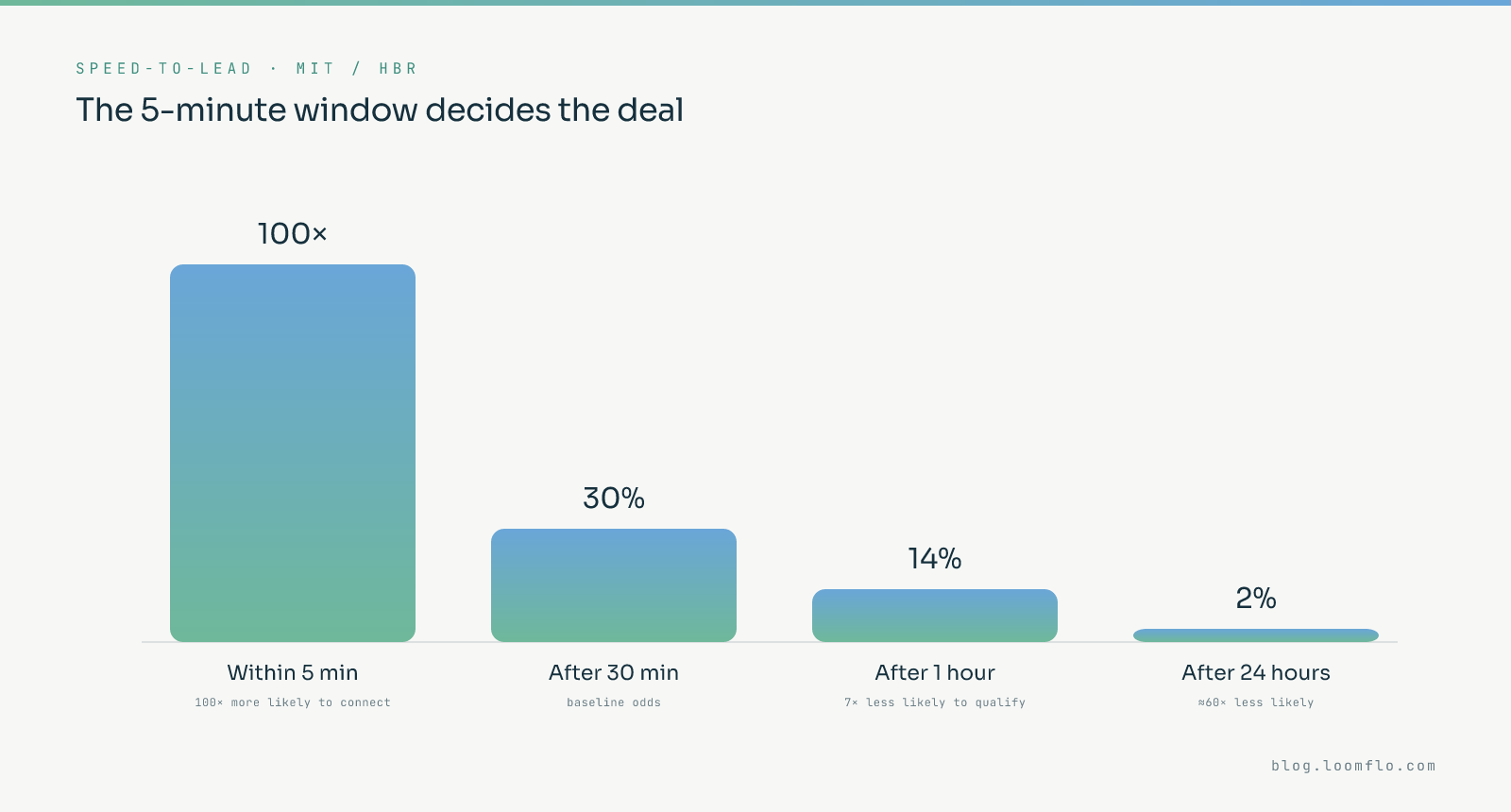
The single most important reason to automate lead engagement is timing. The foundational research here is Dr. James Oldroyd’s lead-response study (MIT / InsideSales.com), which analysed more than 15,000 leads and 100,000 call attempts.
Its findings are stark:
- Contacting a web lead within 5 minutes makes you 100× more likely to connect and 21× more likely to qualify the lead than waiting just 30 minutes.
- The follow-up Harvard Business Review study (“The Short Life of Online Sales Leads”) found firms that responded within an hour were nearly 7× more likely to have a meaningful conversation than those who waited one more hour, and 60× more than those who waited 24 hours.
- Yet in an audit of 2,241 US companies, the average first-response time was 42 hours, only 37% responded within an hour, and 23% never responded at all.
Read that together: the window that decides conversion is measured in minutes, but the average human process responds in days — when it responds at all. No human can watch the inbox every minute of every day.
An autonomous agent can, and does, responding in seconds, 24/7, to 100% of inbound leads. InsideSales research also found that 35–50% of sales go to the vendor that responds first; an agent is structurally first every time.
How autonomous lead-gen agents actually work
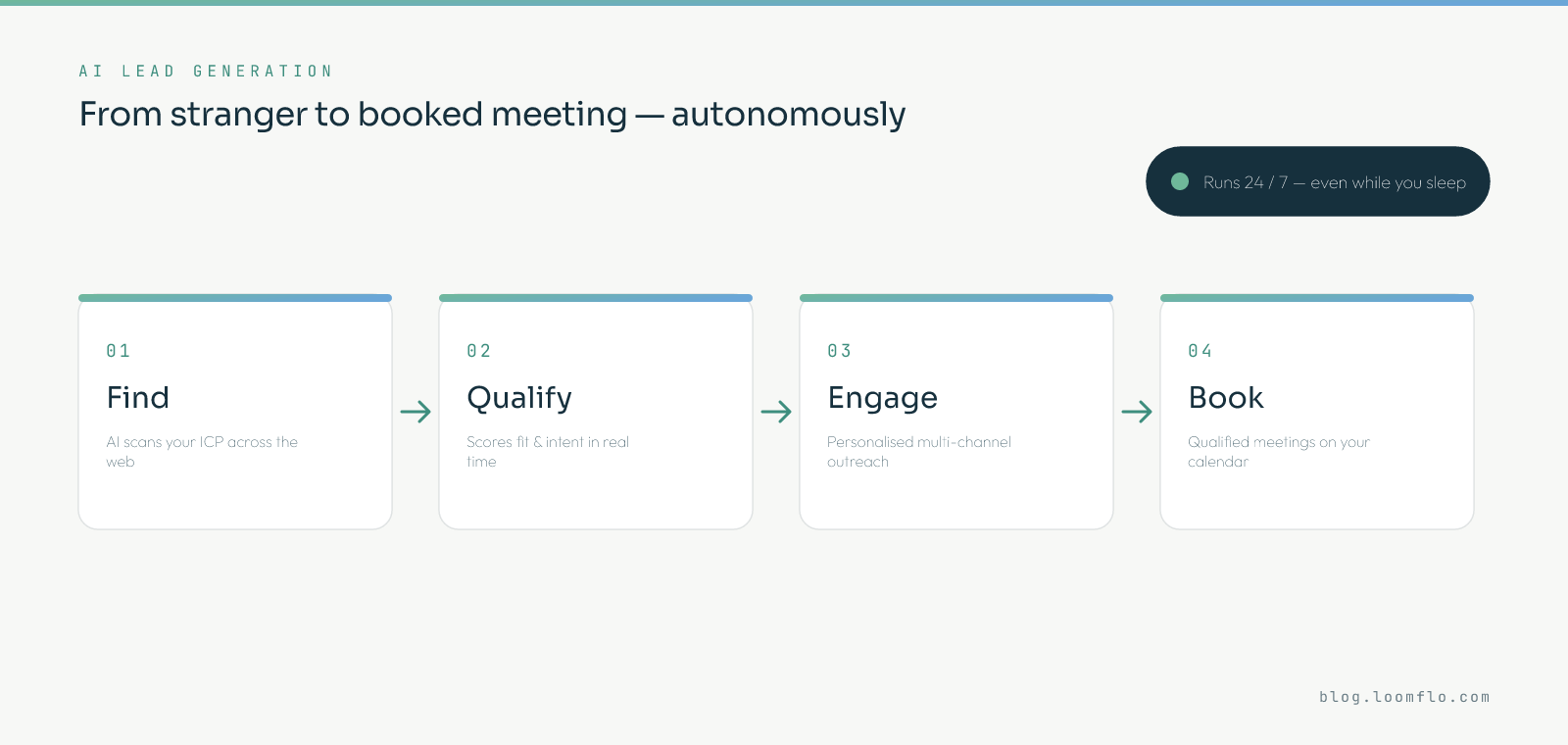
A well-built system runs four stages without stopping:
1. Find
Agents scan the web and data sources for people and companies that match your ideal customer profile, by role, industry, size, technology, and signals of relevance, building a live prospect list instead of a stale static one.
2. Qualify
Each prospect is scored in real time on fit and buying intent, so low-quality leads are filtered out before anyone spends effort on them. Your reps only ever see prospects worth their time.
3. Engage
The system reaches out across channels with messaging personalised to each prospect’s context, then follows up intelligently based on how they respond. This matters more than most teams admit: RAIN Group’s research found it takes an average of 8 touchpoints to land a first meeting, and top performers convert 52 of every 100 contacts versus just 19 for everyone else.
Consistency is the difference, and it’s exactly what humans drop.
4. Book
When a prospect is ready, the agent books a qualified meeting directly onto your team’s calendar. Your closers walk into conversations that are already warm.
The follow-up gap: the most expensive habit in sales
If speed-to-lead is the first leak in the funnel, weak follow-up is the second, and it’s enormous. Industry research widely cited across sales studies finds that roughly 48% of salespeople never make a single follow-up attempt after the first contact, and that only a minority of inbound leads ever get worked at all.
Given that it takes ~8 touches to convert, a process that stops after one is leaving most of its pipeline on the table.
Companies spend real money generating leads, then never follow up on most of them. With an average B2B cost per lead around $84, an unworked lead isn’t neutral, it’s money set on fire.
An AI agent doesn’t get busy, distracted, or discouraged. It executes every touch in a multi-step sequence, on schedule, until the prospect responds or the sequence ends.
The single biggest preventable loss in most pipelines, the follow-up that never happened, simply stops happening.
Why “24/7” is the real advantage
A human SDR works eight hours a day, five days a week, and needs ramp time, management, and rest. An AI agent works every hour of every day, never forgets a follow-up, and scales instantly.
That means prospects get engaged the moment they show intent, including the evenings, weekends, and after-hours windows when your competitors’ inboxes sit unattended and that 5-minute conversion window is quietly expiring.
What AI lead generation is, and isn’t
- It is a system for filling the top of the funnel with qualified, ready-to-talk prospects, consistently and at scale.
- It is not a spam cannon. Volume without qualification burns your domain and your brand; the value is in targeted outreach, not blasting everyone.
- It is a complement to human selling, agents handle discovery and first touch; people handle relationships and closing.
- It is not “set and forget.” It is infrastructure that improves with feedback, like any good system.
The payoff is measurable. Salesforce found that 83% of sales teams using AI grew revenue in the prior year, versus 66% of teams that didn’t.
The gap isn’t magic, it’s the compounding effect of responding faster, following up more, and freeing humans to sell.
The economics: what an ignored lead really costs
It helps to put numbers on the leak. Say you generate 500 inbound leads a month at an average B2B cost per lead of around $84, that’s roughly $42,000 of demand-generation spend.
Now apply the manual-process reality: if 23% never get a response (HBR) and only a fraction of the rest are followed up beyond the first touch, you may be actively working fewer than half of the leads you paid for. The other half isn’t “saved for later”, it’s spend that produced nothing, because the 5-minute conversion window closed and no one reopened it.
An autonomous agent changes that arithmetic in three ways: it responds to 100% of leads in seconds, it runs the full 8-touch sequence every time instead of stopping at touch one, and it does both at 2 a.m. on a Sunday exactly as well as Tuesday at noon. You’re not generating more leads, you’re finally cashing the ones you already bought.
Personalisation at scale: the part humans can’t sustain
The objection to automated outreach is always quality: surely a human writes a better email? Sometimes, for the first ten.
But personalisation is a volume problem, and volume is where humans break down. An AI agent can research each prospect’s role, company, recent activity and likely pain point and tailor the message accordingly, across thousands of prospects, on every follow-up, without copy-pasting a template.
The result is outreach that reads as relevant rather than blasted, which is exactly what protects your reply rates and your sender reputation.
This is the distinction that separates effective AI lead generation from spam: qualification and relevance come before volume, not after. The agent engages people who genuinely fit your profile, with messages tied to their context, at a sensible cadence.
Done that way, automation doesn’t degrade your brand, it makes a consistently good first impression at a scale no team could staff.
What good looks like: the metrics to watch
If you deploy AI lead generation, judge it on the numbers that map to the research above:
- Speed-to-lead — median time from inbound to first contact. The target is seconds, not hours. This is the lever worth the most (100× connect odds).
- Coverage — what percentage of leads received a full sequence, not just one touch. Aim for 100%; the manual baseline is often under 50%.
- Touches per prospect — are you actually hitting the ~8 it takes to convert?
- Qualified meetings booked — the only output that matters, and the one your closers feel directly.
- Reply & positive-sentiment rate — the guardrail that tells you targeting and personalisation are working, not annoying.
Why multi-channel beats email-only outreach
A common mistake is to equate “AI lead generation” with “AI email.” Email is one channel, and a crowded one, reply rates have been sliding for years. The prospects you want are reachable in several places: email, LinkedIn, and sometimes phone or SMS, each at the moment they’re most receptive.
An autonomous system can orchestrate a sequence across those channels, a LinkedIn touch after an unopened email, a follow-up timed to a website visit, without a human tracking the state of every thread.
That orchestration is exactly what makes the ~8 touchpoints achievable. A human running multi-channel cadences manually for hundreds of prospects loses track and drops sequences; an agent simply executes the plan.
The breadth isn’t about being everywhere for its own sake, it’s about meeting each prospect on the channel and at the time that actually earns a reply, consistently, at a scale no manual process can match.
Frequently asked questions
Does AI lead generation replace human sales reps?
No. It replaces the repetitive top-of-funnel work, list building, research, first-touch outreach, follow-ups, so human reps focus on qualified conversations and closing. Since reps currently spend under 30% of their time selling (Salesforce), automating the other 70% is the point.
Is automated outreach considered spam?
Only if it’s untargeted. The difference between spam and effective AI outreach is qualification: good systems engage people who genuinely match your profile, with relevant personalised messages, at sensible volume.
That protects your brand and your deliverability.
How quickly can it start booking meetings?
Once the ideal customer profile and messaging are dialled in, agents can begin finding and engaging prospects immediately, and because they respond within the critical 5-minute window 24/7, they often convert leads a human process would have lost to delay.
How is this different from buying a lead list?
A purchased list is a static, decaying snapshot. AI lead generation builds a live pipeline, continuously finding fresh prospects, qualifying them, and engaging them across the ~8 touches it takes to convert, so quality stays high instead of going stale the day you buy it.
Fill your calendar while you sleep
Loomflo’s AI Lead Generation deploys autonomous agents that find, qualify and engage your ideal customers 24/7, responding in seconds and following up relentlessly so qualified meetings land on your calendar on autopilot. Book a discovery call →
Related reading: AI vs Human SDRs: What Autonomous Outreach Actually Costs.