Win loss analysis is asking buyers why they really chose you or didn’t. It matters because the reason in your CRM is the rep’s theory, not the buyer’s decision and those two are rarely the same. “We lost on price” is the most over-reported reason in B2B.
Every lost deal gets a reason attached to it. Almost none of those reasons come from the person who actually decided.
Win loss analysis closes that gap. This guide covers why the CRM misleads you, how to run the interviews, and what to do with what you learn.
What is win loss analysis?
Win loss analysis is the practice of interviewing buyers after a deal closes won or lost to find out what genuinely drove the decision. It replaces internal assumption with first-hand evidence.
The critical word is buyers. Asking your own reps why they lost produces a survey of your reps’ beliefs, which is useful for coaching and nearly useless for strategy.
Why the reason in your CRM is wrong
Loss reasons are usually entered by the person who just lost, in a hurry, from a dropdown. Three forces bend them.
Price is the safest answer
“They went cheaper” costs the rep nothing to say. It rarely survives contact with the buyer, who more often cites fit, confidence or a missing capability.
The rep only saw part of the room
B2B purchases involve three or more people in about 92% of cases, with larger deals averaging around eleven (Forrester, 6sense). Your champion cannot tell you what the security lead thought.
Nobody codes the wins
Teams dissect losses and wave through wins, so they never learn what they are actually good at — which is the more useful half.
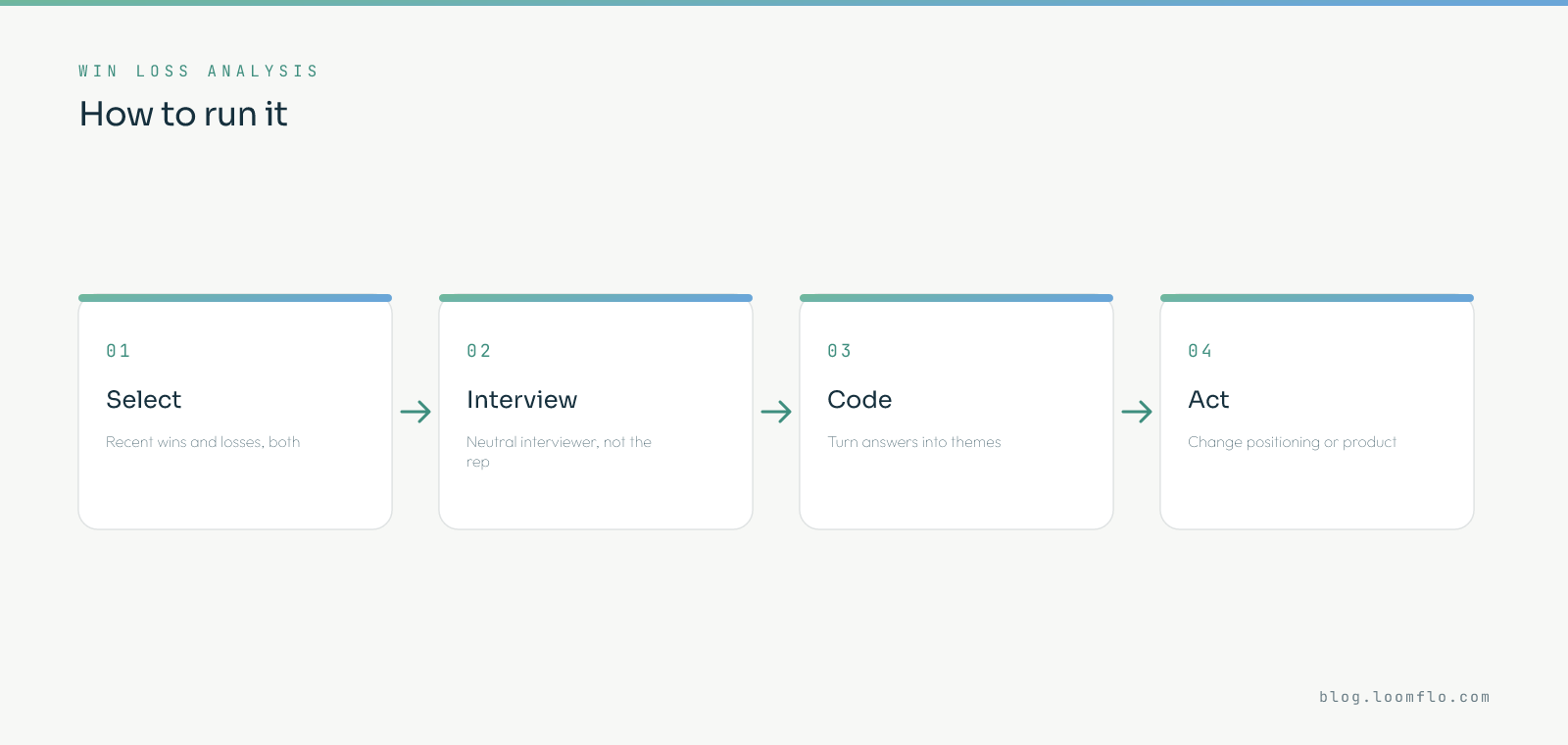
How to run it
This is a research process, not a survey. The rigour is what makes it worth doing.
- Interview both outcomes: Roughly equal wins and losses. Losses tell you what to fix; wins tell you what to double down on.
- Use a neutral interviewer: Buyers soften the truth for the rep who chased them. Someone unconnected to the deal gets a straighter answer.
- Move fast: Within two to four weeks of the decision, while the reasoning is still recallable.
- Ask open questions: “Walk me through how you decided” beats any ranked list of factors you supply.
- Reach past the champion: Where you can, speak to someone else in the buying group. That is where the surprises live.
- Code into themes: Twenty anecdotes are a story; twenty coded interviews are a pattern you can act on.
What to ask
A handful of questions do most of the work.
Start with the trigger: what made you start looking at all? Then the shortlist: how did we end up on it, and who else was on it? Then the decision itself: what finally settled it, and who had the strongest opinion?
Close with the two that sting. What nearly stopped you choosing us asked of winners as well as losers. And what would have changed your mind? That last question is where your roadmap and your positioning both come from.
What the patterns usually reveal
Across a set of interviews, the same handful of findings show up again and again.
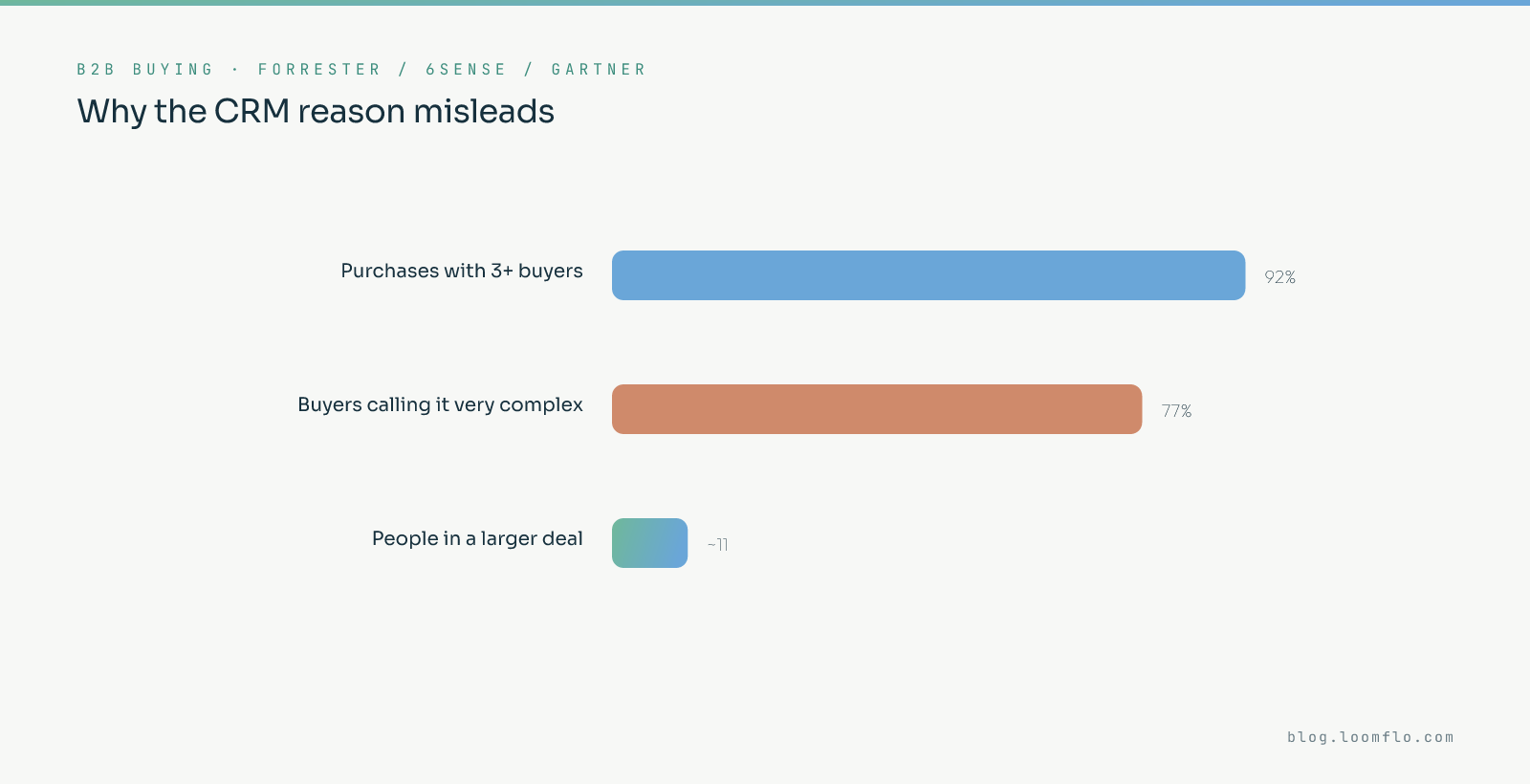
Reported price objections usually turn out to be value-communication problems the buyer did not doubt the number, they doubted the return. Deals are lost in the middle far more often than at the close, and losing to “no decision” is common in a market where 77% of buyers describe their purchase as very complex (Gartner).
The wins are just as informative. Teams routinely discover they are being chosen for a reason that appears nowhere on their homepage.
Common mistakes
Win loss programmes fail in a few reliable ways.
- Letting the rep interview their own deal: Guarantees a polite, useless answer.
- Only studying losses: You learn what to stop and never what to repeat.
- Waiting for volume: Ten well-run interviews beat a hundred CRM dropdowns.
- Filing the report: If nothing changes in positioning, pricing or product, the exercise was theatre.
- Running it once: Markets move. A one-off snapshot ages fast.
How AI helps
The bottleneck in win loss analysis has always been effort someone has to schedule, interview, transcribe and code. That is exactly the work automation absorbs.
Call recordings and transcripts can be analysed at scale to surface the language buyers actually use, including objections that never made it into a CRM field. Themes that a human would need forty interviews to notice show up across every conversation you have already had.
Sentiment and stall-point detection across the deal cycle also show where confidence dropped, not just that it did. The honest caveat: transcripts only capture the meetings you were in. The most valuable finding what the buying group said when you were not on the call still requires an actual interview with an actual human.
Where it fits
Win loss analysis is the feedback loop for everything upstream of it. Without it, positioning and targeting are educated guesses that never get corrected.
It sharpens the inputs directly it tells you whether your ideal customer profile matches who actually buys, and where in the sales funnel stages deals really die. For high-value accounts it pairs naturally with account-based marketing, where losing one deal is expensive enough to justify understanding it properly.
Interview both outcomes, stay neutral, code the themes, and change something. That last step is the whole point.
Frequently asked questions
What is win loss analysis?
It is interviewing buyers after a deal closes won or lost to learn what genuinely drove their decision, replacing internal assumptions with first-hand evidence from the people who chose.
Why not just use CRM loss reasons?
Because they are the rep’s theory, entered quickly from a dropdown by the person who just lost. Price is the safest thing to record and the most over-reported reason in B2B.
How many interviews do I need?
Themes usually emerge somewhere between ten and twenty well-run interviews. Depth matters far more than volume ten real conversations beat a hundred dropdown entries.
Should I interview wins too?
Yes, roughly half. Losses show you what to fix; wins show you what to repeat. Teams that skip wins often never learn why they are actually chosen.
Who should do the interviews?
Someone with no stake in the deal an internal researcher or an external party. Buyers soften their answers for the rep who pursued them.
How soon after the decision?
Within two to four weeks. Later than that and buyers reconstruct a tidy story rather than recalling what actually happened.
Find out why you really lost
Loomflo builds AI growth infrastructure conversation analysis and stall detection that surface the objections your CRM never recorded.