The sales funnel stages map how a stranger becomes a customer awareness, consideration, decision, and retention. Most deals leak between the middle stages, where the average marketing-qualified lead converts to a sales-qualified one only about 13% of the time (Implisit / First Page Sage).
Every customer travels the same path from not knowing you exist to signing a contract. When that path is invisible, you can’t see where deals fall out.
The sales funnel stages make it visible. This guide walks each stage, shows where deals leak, and explains how to plug the gaps.
What are the sales funnel stages?
The sales funnel stages are the steps a prospect moves through on the way to buying typically awareness, consideration, decision, and then retention. Each stage maps to a different buyer mindset.
The funnel is wide at the top and narrow at the bottom, because not everyone who becomes aware will buy. The job at each stage is to move the right people down and let the wrong ones fall away.
The four core stages
B2B funnels range from three to seven stages, but they collapse into four essential ones. Each has a distinct goal.
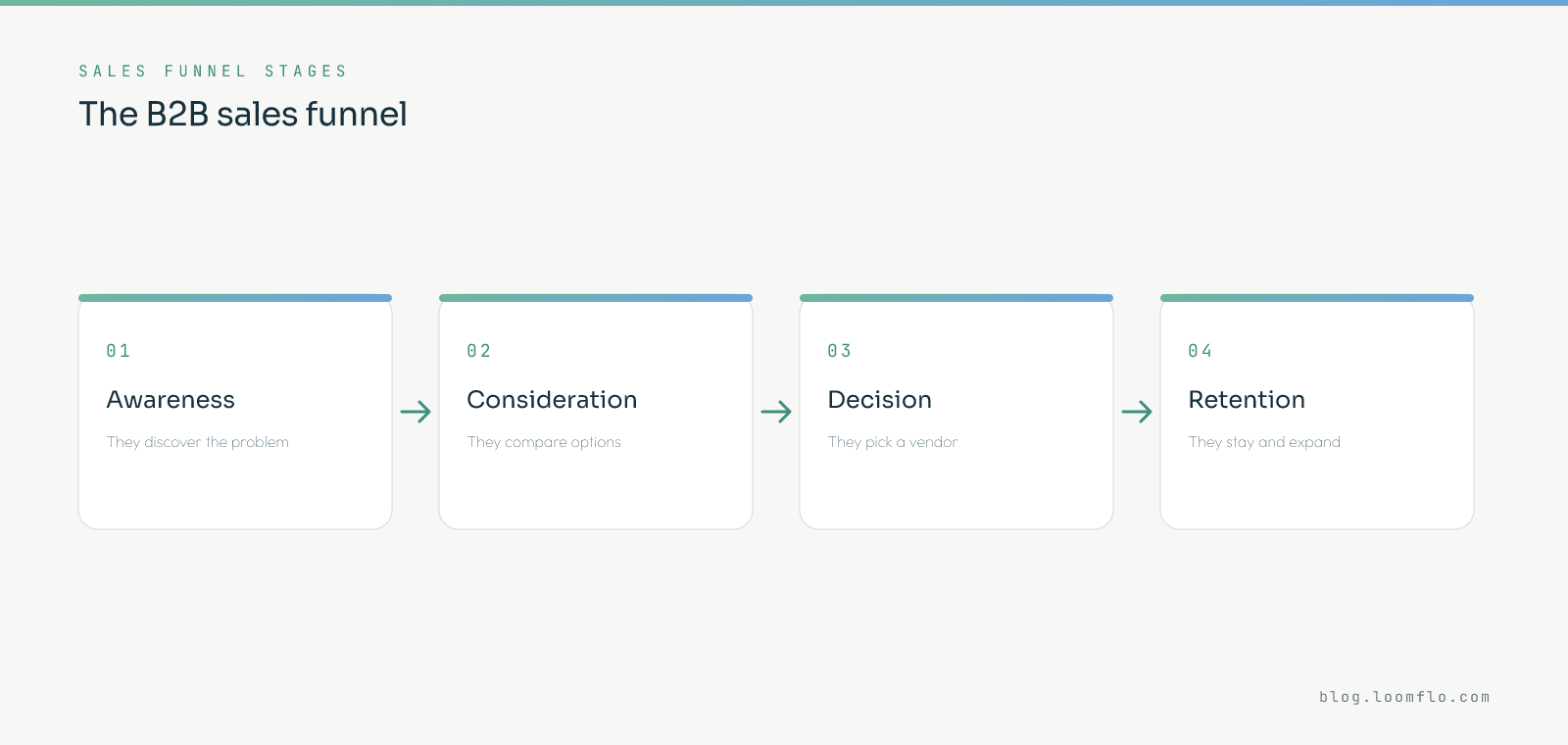
1. Awareness
The buyer realizes they have a problem and starts looking for answers. Your job is to be found and to be genuinely useful, not to pitch.
2. Consideration
They’re actively comparing options and building a shortlist. This is where content, proof and positioning decide whether you make the list.
3. Decision
They evaluate finalists and pick a vendor. Demos, case studies, pricing clarity and fast follow-up win or lose it here.
4. Retention
The sale isn’t the end it’s where expansion and referrals begin. Keeping and growing the customer is what makes the funnel pay off.
Where deals leak
Every stage loses some prospects, but the losses aren’t evenly spread. Knowing the benchmarks tells you where to focus.
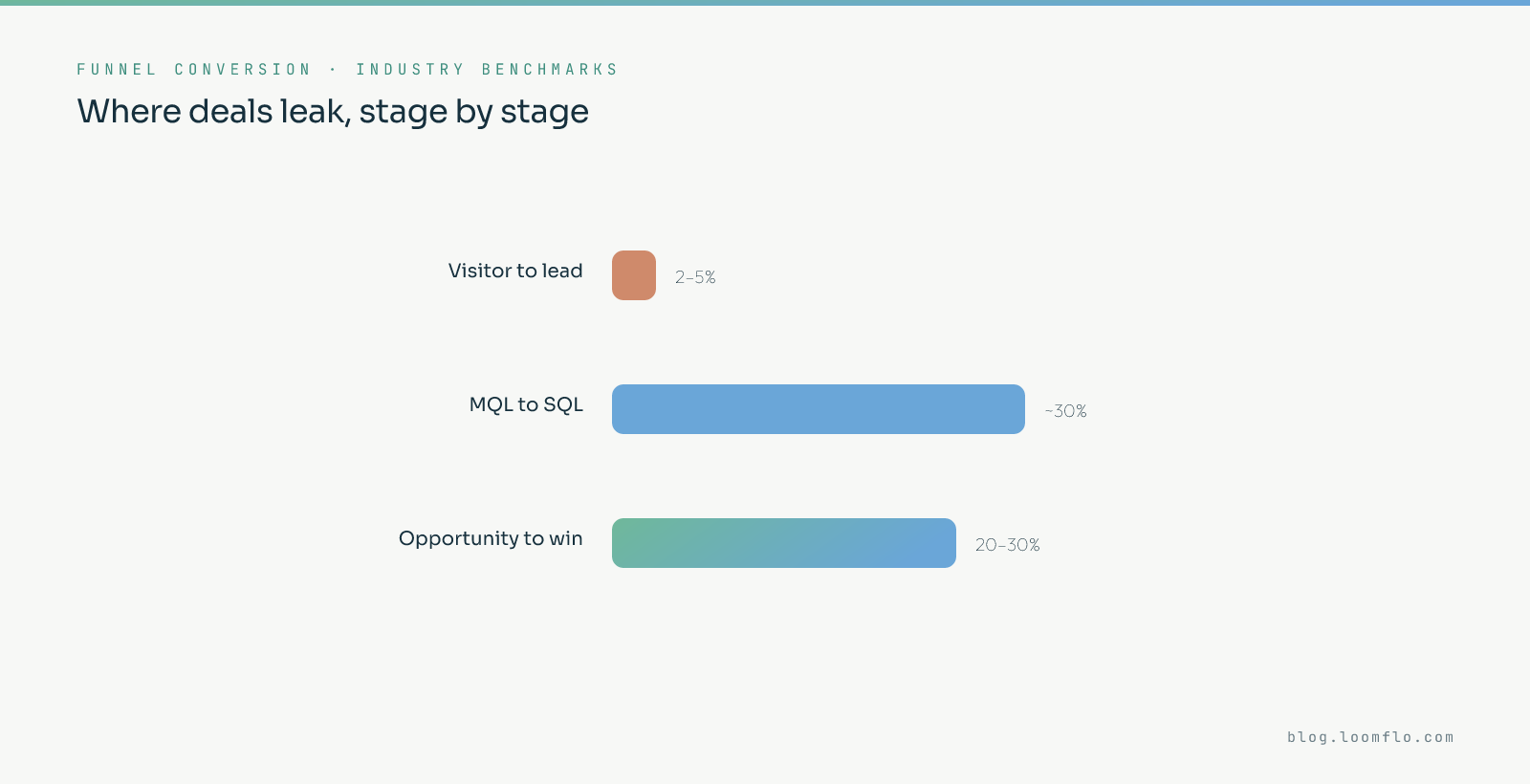
Visitor-to-lead conversion usually runs 2–5%, MQL-to-SQL around 30%, and opportunity-to-win between 20–30%. The consideration-to-evaluation handoff is the biggest bottleneck, thanks to complex, multi-person decisions.
The MQL-to-SQL gap is the one to watch. It averages about 13% across industries (Implisit), but teams that qualify with real behavioral signals push it far higher.
Why the B2B funnel is different
B2B funnels don’t behave like B2C ones, and treating them the same causes problems. The differences are structural.
B2B cycles are longer, involve buying committees rather than individuals, and rest on relationships and proof. That means lower top-of-funnel conversion but higher close rates at the bottom, once trust is established.
It also means the middle stages take real work. A single champion rarely closes a deal alone you have to enable a whole group.
How to move prospects down the funnel
Progression isn’t automatic; each stage needs a deliberate push. A few moves matter most.
- Match content to the stage: Educate at awareness, compare at consideration, prove at decision.
- Qualify with behavior, not just forms: Real intent signals separate ready buyers from browsers.
- Respond fast: Speed to lead turns more of the same traffic into conversations.
- Nurture the not-yet-ready: Most prospects aren’t ready today, so stay useful until they are.
Common funnel mistakes
A few patterns quietly break funnels. Each is fixable.
- Measuring volume, not conversion: More leads mean nothing if they don’t move between stages.
- Ignoring the middle: Teams obsess over the top and bottom and neglect where deals actually leak.
- Passing leads too early: Sending unready leads to sales burns time and trust.
- Stopping at the sale: Forgetting retention throws away expansion and referrals.
How AI improves the funnel
AI helps most at the leaky middle, where human bandwidth runs out. It makes progression faster and smarter.
Predictive scoring identifies which leads are genuinely ready to advance, lifting that weak MQL-to-SQL handoff. Faster, automated lead response converts more of the traffic you already paid for.
Behavior-triggered nurturing keeps the not-yet-ready moving until they’re sales-ready, and attribution shows which stages and channels actually drive revenue. The honest caveat: AI accelerates a well-designed funnel it can’t fix a broken offer or a bad-fit audience.
Where the funnel fits
The sales funnel stages are the map your whole go-to-market runs on. Seeing each stage is what lets you find and fix the leaks.
It connects the systems that fill and move it. See how demand generation feeds the top and how conversion rate optimization widens the narrow points.
Map the stages, measure the leaks, and fix the middle that’s how a funnel turns strangers into customers predictably.
Frequently asked questions
What are the sales funnel stages?
The core stages are awareness, consideration, decision and retention the path a prospect takes from discovering a problem to buying and staying. Each maps to a different buyer mindset.
How many stages are in a sales funnel?
Most B2B funnels use three to seven stages, but they collapse into four essentials: awareness, consideration, decision and retention. More granular funnels just split these further.
What’s a good funnel conversion rate?
Benchmarks vary by stage visitor-to-lead runs 2–5%, MQL-to-SQL around 30%, and opportunity-to-win 20–30%. “Good” depends on your industry and channel mix.
Where do most deals leak?
Usually in the middle the consideration and evaluation stages, and especially the MQL-to-SQL handoff, which averages about 13%. That’s where complex, multi-person decisions stall.
What’s the difference between a sales funnel and a marketing funnel?
They describe the same journey from different angles marketing owns the top (awareness and interest), sales owns the bottom (decision and close). In practice they’re one funnel handed off in the middle.
How do you improve funnel conversion?
Match content to each stage, qualify with behavioral signals, respond to leads fast, and nurture the not-yet-ready. Fixing the leaky middle usually pays off most.
Find the leaks in your funnel
Loomflo builds AI growth infrastructure scoring, instant lead response and nurturing that move more prospects through every stage of the funnel.