Generative engine optimization is the practice of getting your content cited inside AI answers from ChatGPT, Perplexity, Gemini and Google’s AI Mode. It is a distinct discipline from SEO, and the research shows the right tactics can lift your visibility in those answers by up to 40%.
Search is splitting into two games. One is the old game of ranking in a list of links, and the other is the new game of being the source an AI quotes when it answers a question directly.
Generative engine optimization is how you win that second game. This is the 2026 playbook, what it is, why it matters now, and the specific tactics that get you cited.
What is generative engine optimization?
Generative engine optimization (GEO) is the practice of structuring and promoting your content so that generative AI engines cite it when they synthesise an answer. The goal is not a ranked link, it is being named and quoted inside the AI’s response.
It is a measurable discipline, not a buzzword. The foundational research, “GEO: Generative Engine Optimization” from a Princeton, Georgia Tech and Allen Institute for AI team (KDD 2024), built a 10,000-query benchmark and showed GEO methods can boost a source’s visibility in AI answers by up to 40%.
GEO vs SEO vs AEO: what’s the difference?
The three overlap but optimise for different moments. It helps to be precise about each.
- SEO wins a ranked position in the blue links, and the prize is a click.
- AEO (answer engine optimization) wins the direct answer, a featured snippet or a voice result.
- GEO wins a citation inside a generative AI answer, where the engine writes a new response and names its sources.
The line that makes GEO its own discipline is the zero-click answer. When an AI writes the answer, ranking alone no longer guarantees you are seen.
Why GEO matters now
The audience has already moved, fast. ChatGPT reached 800 million weekly active users by late 2025, and Pew Research found 34% of US adults have used it, roughly double the 2023 share.
Dedicated answer engines are scaling too. Perplexity handled 780 million queries in a single month, and Google’s own AI Overviews passed 2 billion monthly users.
Even Google expects the shift. Gartner predicted in 2024 that traditional search volume would fall 25% by 2026 as queries move to AI assistants.
And the clicks are leaking. Pew found that when an AI summary appears, users click a traditional result just 8% of the time, versus 15% without one.
The tactics that actually increase citations
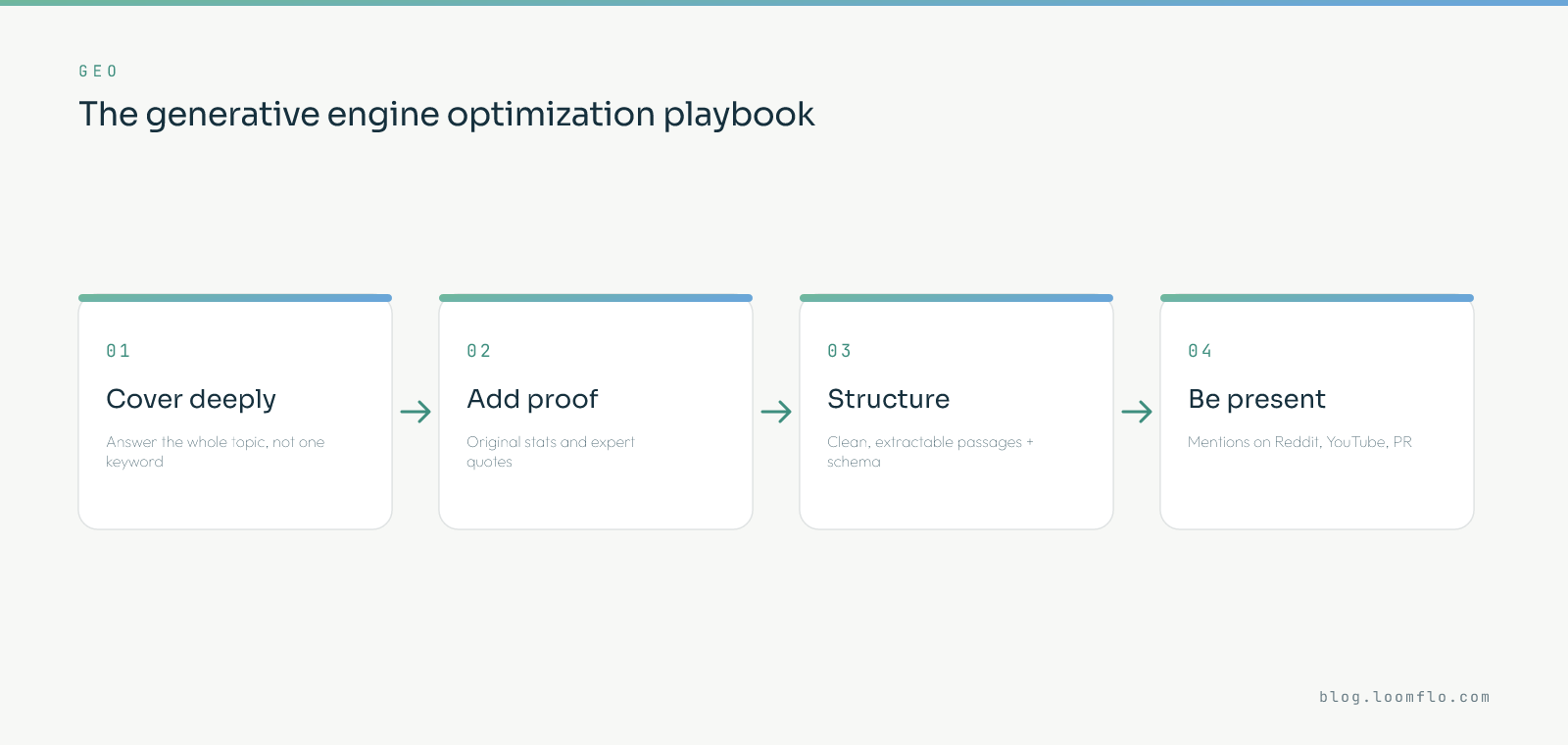
The GEO research did not just prove the discipline works, it measured which tactics work best. The winners were about credibility, not keywords.
1. Add original statistics and data
Concrete numbers are among the highest-uplift modifications in the GEO study. Engines preferentially quote passages backed by specific, citable data.
2. Add expert quotations
Named, credible quotations were another top performer in the research. They signal authority that a model is comfortable repeating.
3. Cite your own sources
Linking out to authoritative sources raised citation odds in the study. It reads as trustworthiness to the engine, which is why this article does it on purpose.
4. Don’t stuff keywords
The same research found keyword stuffing performed worse than the baseline. Padding word count without structure had close to zero effect.
5. Be present where engines pull from
Generative engines lean heavily on community and video sources. Semrush found Reddit among the most-cited domains in AI answers, with YouTube and Quora also ranking highly, so digital PR and community presence now feed your AI visibility.
6. Structure for extraction
Clear question-style headings, short passages and clean formatting make your content easy to lift. BrightEdge found pages with structured data and FAQ blocks saw a 44% increase in AI citations, though some studies dispute the schema link, treat it as a helpful, not guaranteed, signal.
Is AI referral traffic even worth it?
Yes, disproportionately. AI may send fewer clicks, but the people who do click arrive with intent already formed.
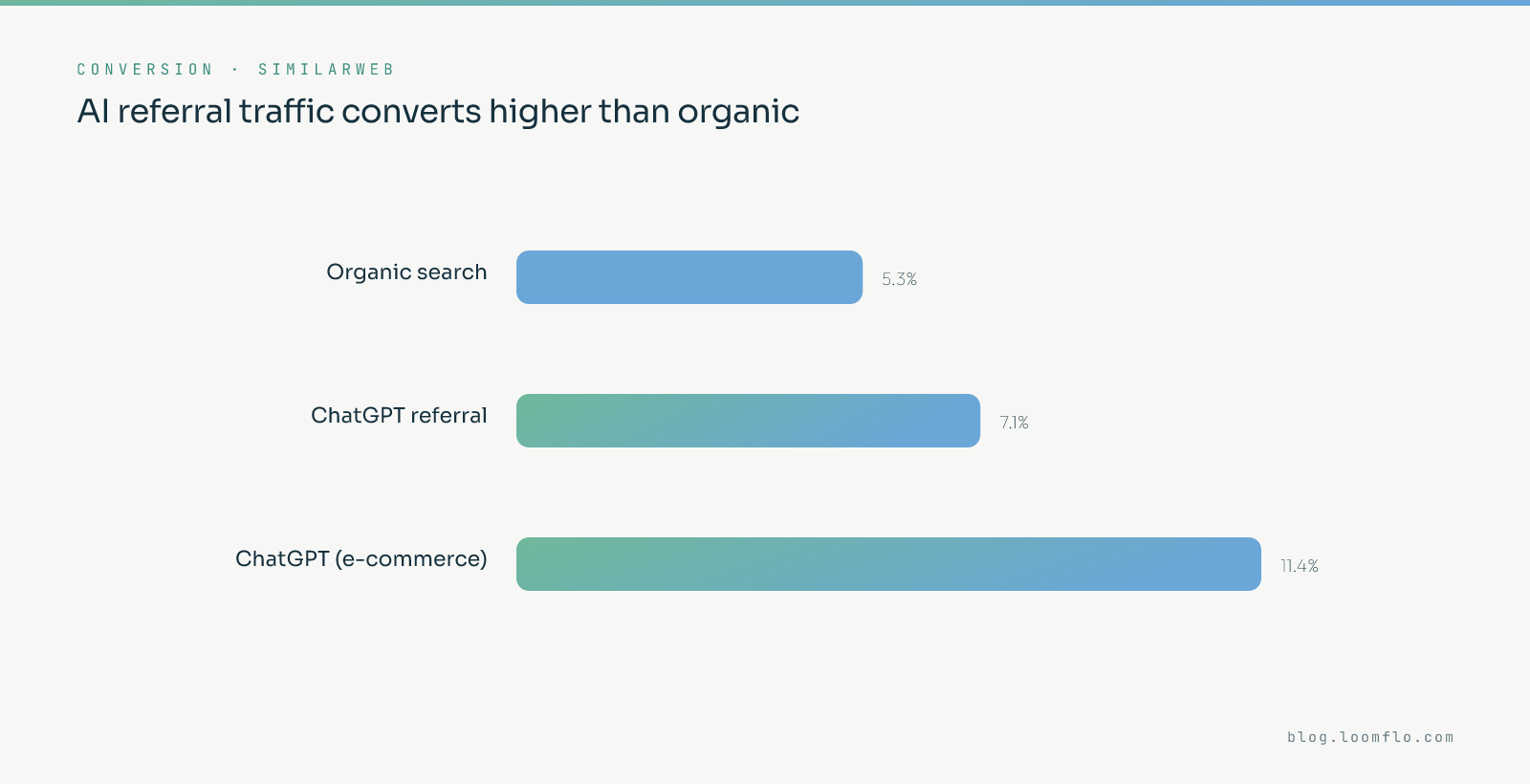
The numbers back it up. Similarweb reported AI platforms drove over 1.13 billion referral visits in June 2025, up 357% year over year, with ChatGPT referrals converting at 7.1% and 11.4% for e-commerce, versus 5.3% for organic.
Other studies push the gap further. Ahrefs and Semrush found AI search visitors convert anywhere from 4.4x to 23x higher than organic traffic, because the answer that cited you already did the qualifying.
How GEO fits with your wider strategy
GEO is not a replacement for SEO, it is a layer on top of it. The same authority and clarity that earn rankings also earn citations.
That is why we run them as one system rather than separate projects. For the classic-versus-AI comparison, see our guide on AEO vs SEO, and for Google’s own AI answers, our guide on Google AI Overviews.
The category is growing into a real industry. The GEO services market was valued at around $886 million in 2024 and is projected to reach $7.3 billion by 2031, per Valuates Reports.
How generative engines choose what to cite
Understanding the selection logic makes generative engine optimization concrete. Engines do not pull sources at random, they favour content that is authoritative, clear and easy to trust.
Authority leads. Engines lean on sources that are widely referenced and carry brand recognition, which is why a strong reputation across the web feeds your citations.
Clarity comes next. A model quotes the passage that answers the question most cleanly, so the source that states the answer plainly usually wins.
Freshness matters too. Engines favour current, maintained content, so updated pages stay eligible to be cited while stale ones drop out.
And consistency helps. When your facts line up across your own site and the wider web, a model is more comfortable repeating them.
How to measure your GEO performance
You cannot optimise what you cannot see, so set up measurement first. GEO needs its own metrics, separate from rankings.
Track citations directly. Ask the major engines your target questions and record whether, and how, your brand appears in the answers.
Watch AI referral traffic. Analytics now surface visits from ChatGPT, Perplexity and other engines, and that traffic is worth monitoring given how well it converts.
Monitor brand mentions. Because mentions drive citations, growth in how often you are talked about is a leading indicator of GEO success.
Use dedicated tools. A wave of AI-visibility trackers now report which prompts cite you, turning a fuzzy goal into a measurable one.
Common GEO mistakes to avoid
Most GEO failures come from treating it like old-school SEO. The tactics that once gamed rankings actively backfire with generative engines.
- Keyword stuffing. The research found it performs worse than baseline, engines reward clarity, not repetition.
- Padding word count. Adding words without structure had near-zero effect, so length for its own sake is wasted.
- Vague, unsourced claims. Without data or quotes to anchor them, your passages are the first a model discards.
- Ignoring off-site presence. If you are never mentioned where engines pull from, on-page work alone rarely earns citations.
- Letting content go stale. Outdated pages quietly fall out of the answers they once appeared in.
Does GEO work the same on every engine?
The fundamentals are shared, but the weighting differs by engine. ChatGPT, Perplexity, Gemini and Google’s AI Mode each blend their own training, live web data and ranking signals differently.
Perplexity leans heavily on live citations, so fresh, linkable sources do well there. Google’s AI answers lean on what already ranks, so classic SEO carries more weight.
The practical takeaway is reassuring. Build genuinely authoritative, well-structured, well-promoted content and you cover all of them at once.
Where to start with generative engine optimization
You do not need to boil the ocean to begin. Pick your highest-intent topics, the questions a buyer asks right before choosing a solution, and make those pages the best, most quotable answers on the web.
Then layer in proof and promotion. Add original data and expert quotes to those pages, and earn mentions on the communities and channels your engines cite.
From there it compounds. Each authoritative, well-promoted page raises your odds across every engine at once, which is why GEO rewards consistency over clever one-off tricks.
GEO is ultimately a trust play
Strip away the tactics and generative engine optimization comes down to one thing: becoming a source AI trusts. Every winning move — original data, expert quotes, citations, off-site mentions, is really a trust signal.
That reframes the work. You are not gaming an algorithm; you are building the kind of authority a careful researcher would rely on.
It also explains why shortcuts fail. Keyword stuffing and thin pages are exactly what an engine learns to distrust, which is why the research found they backfire.
The upside is durability. Trust built this way does not evaporate with the next algorithm change, because it rests on genuine authority rather than a loophole.
And it compounds across surfaces. The same trust that earns a ChatGPT citation also helps you rank on Google and appear in an AI Overview, one investment, many returns.
For businesses, the strategic implication is clear. The brands that invest early in being genuinely citable will own a share of AI answers that latecomers find very hard to claw back.
Frequently asked questions
What is generative engine optimization?
It is the practice of optimising content to be cited inside AI-generated answers from engines like ChatGPT, Perplexity and Gemini. Research shows the right tactics can raise that visibility by up to 40%.
How is GEO different from SEO?
SEO wins a ranked link and a click, while GEO wins a citation inside an AI-written answer. They share foundations like authority and clarity, but GEO matters specifically because AI answers often resolve a query with no click at all.
What are the best GEO tactics?
Add original statistics and expert quotes, cite credible sources, structure content for easy extraction, and build mentions on the platforms engines pull from such as Reddit and YouTube. Avoid keyword stuffing, which the research shows actively hurts.
Does GEO replace SEO?
No. It builds on the same authority and content quality, so the strongest approach runs SEO and GEO together as one system rather than choosing between them.
Is GEO the same as AEO?
They overlap but are not identical. AEO targets direct answers like featured snippets, while GEO targets citations inside generative AI responses, and both build on the same authority and clarity.
How long does GEO take to work?
Like SEO, it compounds rather than spikes. Structural and authority improvements can surface in AI answers within weeks, but durable visibility comes from a consistent program run over months.
Can small businesses compete at GEO?
Yes, especially on focused topics. Genuinely authoritative, well-structured pages on specific questions can earn citations even where larger brands have shallow coverage.
What content types get cited most by AI?
Clear, well-structured pages with original data, statistics and direct answers tend to get cited most. Listicles, how-tos and definition-led explainers map neatly to how engines assemble responses.
Can I optimise existing pages for GEO, or do I need new ones?
You can often start with what you have. Adding statistics, quotes, clearer structure and citations to strong existing pages is one of the fastest ways to earn AI citations.
Does GEO require technical skills?
Not primarily, the highest-impact GEO work is editorial, not technical. Adding data, quotes and clear structure matters more than code, though schema markup can be a helpful bonus.
Get cited by AI, with one system
Loomflo’s HEO system researches, writes and structures content engineered to rank on Google and get cited across AI engines. Your first articles go live in 30 days, or you don’t pay.