Google AI Overviews now appear on roughly one in six searches and answer the question before the user clicks anything. To show up in Google AI Overviews you mostly have to do one thing well: rank in the top 10 organically, then make your page the cleanest, most authoritative source to quote.
Something fundamental changed at the top of Google’s results page. Before the ten blue links, many searches now open with an AI-written answer, and a shrinking share of users scroll past it.
This is the new front door to Google, and most businesses have no strategy for it. This guide explains what Google AI Overviews are, how common they have become, how Google picks the sources it cites, and exactly how to increase your odds of being one of them.
What are Google AI Overviews?
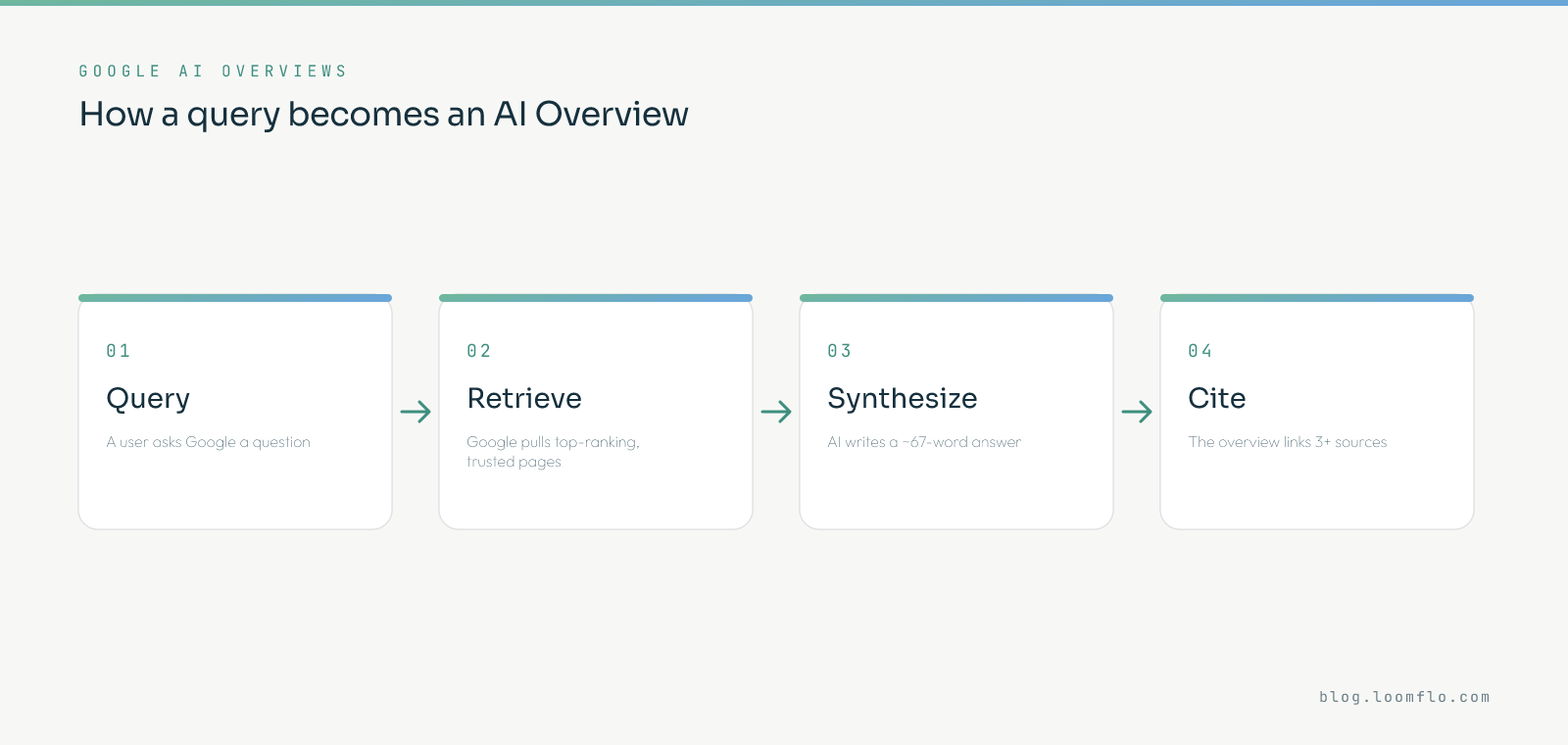
Google AI Overviews are AI-generated answer boxes that appear at the top of Google’s search results, summarising an answer in a few sentences and citing a handful of source pages. They were rolled out from Google’s Search Generative Experience and are now a standard feature of everyday search.
The answer is short by design. Pew Research found the median AI Overview is just 67 words long, and that 88% of them cite three or more sources.
That combination is the whole opportunity. A few sentences, a few cited links, and your job is to be one of those links.
How common are Google AI Overviews now?
Very, and they grew fast. Semrush’s study of 10 million keywords tracked AI Overviews surging from 6.5% of searches in January 2025 to a peak of 24.6% in July, before settling around 15.7% by November 2025.
Independent behavioural data agrees on the scale. Pew Research found that about 18% of all Google searches produced an AI summary, and that 58% of users encountered at least one in a single month.
The reach is enormous. On its Q2 2025 earnings call, Alphabet said AI Overviews had passed 2 billion monthly users, up from 1.5 billion just two months earlier.
So this is not a fringe feature to monitor. It is a primary surface that a large share of your buyers now see first.
Which searches trigger an AI Overview?
For a long time, AI Overviews were mostly an informational-search feature. In January 2025, Semrush found 91.3% of AIO-triggering keywords were informational.
That is changing quickly. By October 2025, informational queries had fallen to 57.1%, while commercial (18.6%), transactional (13.9%) and navigational (10.3%) intents climbed sharply.
The format matters too. Ahrefs found AI Overviews trigger most often for “why” questions (59.8%), question-based queries (57.9%) and longer 7-plus-word searches.
The practical read: AI Overviews are spreading from “how does X work” into commercial, buying-intent queries. The money searches are now in play.
The click question, and an honest caveat
Here is the uncomfortable part. Pew found that when an AI summary appeared, users clicked a traditional result in only 8% of searches, versus 15% without one, and clicked a link inside the summary just 1% of the time.
They also found people ended their session entirely on 26% of visits with an AI summary, versus 16% without. A separate field study reported by Search Engine Journal estimated AI Overviews cut organic click-through rates by around 38%.
In fairness, Google has publicly disputed the Pew study and says overall clicks remain stable. Either way, the direction is clear enough to act on: being the cited source is now as important as being the ranked one.
How Google picks sources for AI Overviews
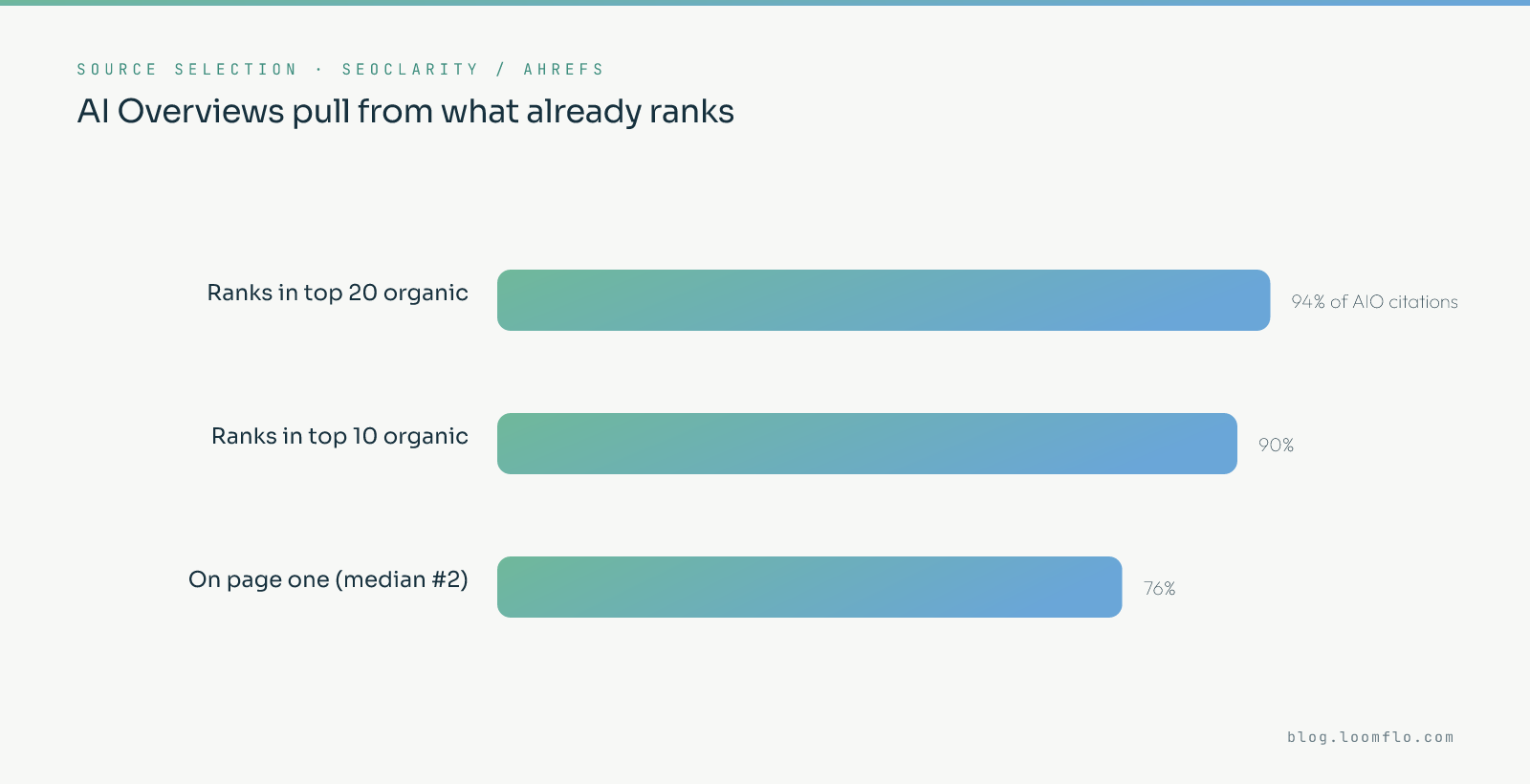
This is the most useful thing to understand, because it makes the strategy concrete. Google does not invent its AI Overview sources from nowhere, it overwhelmingly pulls from pages that already rank.
seoClarity analysed 362,000 keywords and 5.1 million citations. It found 90% of AI Overviews overlapped with the top 10 organic results, and 94% with the top 20.
BrightEdge tracked the same trend over time. Across a 16-month study, the overlap between AI Overview citations and top-10 organic results grew from 32% to 54%, the connection is strengthening, not weakening.
Authority concentrates the field further. Ahrefs found the top 50 domains account for 28.9% of all AI Overview citations, so a small set of trusted sites win a large share.
How to show up in Google AI Overviews
The data points to a clear playbook. Win the fundamentals, then make your page easy to quote.
1. Rank in the top 10 first
This is the single biggest lever. Ahrefs found 76% of AI Overview citations come from page-one results, with the median cited URL sitting at position 2.
In other words, classic SEO is the foundation of AI Overview visibility. If you are not on page one, you are almost never in the answer.
2. Cover the whole topic, not one keyword
Google “fans out” a query into related sub-questions and pulls sources that answer several of them. Ahrefs found pages ranking across many related queries are 161% more likely to be cited, and that ranking for nine related queries lifted citation rates to 57%, versus 9% for zero.
So build comprehensive topic clusters, not thin single-keyword pages. Depth of coverage is what earns the citation.
3. Lead with a direct, liftable answer
Since the overview is about 67 words, give Google a clean passage it can lift. Answer the core question in the first two sentences of each section, then elaborate.
4. Build brand mentions, not just backlinks
Ahrefs’ study of 75,000 brands found branded web mentions were the strongest correlate of AI Overview visibility, nearly three times stronger than backlinks. Getting talked about across the web now directly feeds your AI visibility.
5. Don’t pad word count
More words do not help. Ahrefs found word count has near-zero correlation with citations, with value plateauing around 540 words, precision beats padding.
6. Target question and “why” formats
Because question-based and “why” queries trigger overviews most, structure content around the real questions people ask. Clear question-style headings with direct answers map exactly to how Google assembles an overview.
Where AI Overviews fit in a wider strategy
Google AI Overviews are one surface in a bigger shift toward answer-based search. The same content habits that win them, clear structure, direct answers, strong authority, also help you get cited by ChatGPT, Gemini and Perplexity.
That is why we treat them as one system rather than separate projects. For the full picture of optimising for both classic and AI search, see our guide on AEO vs SEO, and on automating the content engine behind it in Can You Automate SEO?
How many sources does a Google AI Overview cite?
Usually a handful, and it scales with the length of the answer. Most overviews cite somewhere between six and fourteen sources, according to SellersCommerce’s analysis.
Shorter answers cite fewer. An overview under 600 characters cites roughly five sources, while a long one over 6,600 characters can cite around 28.
That is encouraging, not discouraging. Even a competitive query usually has room for several cited sources, so you are competing for a slot, not a single winner-takes-all position.
How to track your Google AI Overviews visibility
You cannot improve what you cannot see, so set up tracking before you optimise. Start with Google Search Console, where AI Overview impressions are now folded into your search performance data.
Watch the gap between impressions and clicks. A pattern of rising impressions with flat clicks is the signature of being shown inside overviews without earning the visit.
Then layer in dedicated tools. Rank trackers from Semrush, Ahrefs and seoClarity now flag which of your keywords show an AI Overview and whether your domain is cited in it.
Finally, track branded search and mentions over time. Because brand authority drives citations, growth there is a leading indicator of growth in your AI Overview visibility.
Common mistakes that keep you out of AI Overviews
Most misses come from a handful of avoidable errors. The biggest is chasing AI Overviews while neglecting the organic rankings that feed them.
- Thin, single-keyword pages. Overviews favour content that answers many related questions, so shallow pages rarely get cited.
- Burying the answer. If a model has to dig for your point, it quotes a cleaner source instead.
- Padding for word count. Length has almost no correlation with citations, so filler only dilutes your answer.
- Weak brand signals. With branded mentions the top correlate of visibility, sites nobody talks about struggle to appear.
- Ignoring “why” and question queries. These trigger overviews most, yet many sites never structure content around them.
Fix those and you are most of the way there. The businesses that win AI Overviews are the ones treating them as an extension of good SEO, not a separate trick.
Will optimising for AI Overviews help with ChatGPT and Perplexity?
Largely, yes, the habits overlap. Clear structure, direct answers, comprehensive topic coverage and strong brand authority help you get cited across every answer engine, not just Google’s.
The weighting differs slightly per engine. Ahrefs found authority and high-quality mentions correlate even more strongly with AI Overview visibility than with ChatGPT or Perplexity, but the foundations are the same everywhere.
That is the real efficiency. One well-built, authoritative page can rank on Google, appear in an AI Overview, and get quoted by ChatGPT, three wins from one piece of work.
Frequently asked questions
What are Google AI Overviews?
They are AI-generated answer boxes at the top of Google results that summarise an answer in roughly 67 words and cite three or more source pages. They reach over 2 billion users a month and appear on around one in six searches.
How do I get my content into a Google AI Overview?
Rank in the top 10 organically, cover the full topic across related questions, lead with direct answers, and build brand authority. Roughly 90% of AI Overview citations come from pages already ranking in the top 10, so strong SEO is the foundation.
Do AI Overviews hurt my traffic?
They can reduce clicks, Pew found click rates roughly halve when an AI summary appears, though Google disputes the size of the effect. The response is to be the cited source, since a citation builds visibility and trust even before a click.
Which keywords trigger AI Overviews?
Informational and question-based queries trigger them most, especially “why” questions and longer searches. But commercial and transactional queries are catching up fast, so buying-intent terms increasingly show them too.
Are AI Overviews the same as featured snippets?
No, though they look similar. A featured snippet pulls a single passage from one ranking page, while an AI Overview synthesises a new answer from several sources and cites three or more of them.
How fast do AI Overviews change?
Constantly, and unpredictably. Coverage swung from 6.5% to 24.6% and back to 15.7% of searches across 2025 alone, so visibility needs ongoing monitoring rather than a one-time fix.
Is it worth optimising for Google AI Overviews?
Yes, because they sit above the organic results and shape the first impression of your brand. Even when they reduce clicks, being the cited source builds visibility and trust that compounds across every search.
Do small businesses stand a chance against big brands?
Yes, on focused topics. While the top 50 domains take a large share of citations overall, comprehensive, genuinely helpful pages on specific questions can still earn a slot, especially where big brands have thin coverage.
Win Google and the AI answer box, with one system
Loomflo’s HEO system researches, writes, links and refreshes content engineered to rank on Google and get cited in AI Overviews. Your first articles go live in 30 days, or you don’t pay.